Mechanical Engineering Basics: Thermodynamics, Strength of Materials, Fluids, Engines and Machines
2. Strength of materials: stress, strain and beams
Stress is force per unit area, σ = P ÷ A; strain is the change in length divided by the original length, ε = ΔL ÷ L (a pure number). Hooke's law: within the elastic limit stress is proportional to strain, and the constant is Young's modulus E = σ ÷ ε. A 50 kN pull on a bar of 500 mm² gives a stress of 50,000 ÷ 500 = 100 MPa; if a 1 m length stretches 0.5 mm, strain = 5 × 10⁻⁴ and E = 100 ÷ 0.0005 = 200 GPa, the usual value for steel. Other moduli: the shear modulus G (shear stress ÷ shear strain) and the bulk modulus K (pressure ÷ volumetric strain). Poisson's ratio is the lateral strain ÷ axial strain, between 0 and 0.5 (about 0.3 for steel). On a stress-strain curve the stages are the proportional limit, elastic limit, yield point, ultimate strength and fracture; a ductile material (mild steel) stretches a great deal before breaking, a brittle one (cast iron, glass) breaks with little strain. The factor of safety is ultimate (or yield) stress ÷ working stress.
A beam carries loads across supports, and its bending moment is greatest where the shear force passes through zero. For a simply supported beam of span L: a central point load W gives reactions of W ÷ 2 each and a maximum moment WL ÷ 4 at the centre, so 10 kN on a 4 m span gives 10 kN m; a uniformly distributed load w per metre gives a maximum moment wL² ÷ 8, so 5 kN/m on a 4 m span also gives 10 kN m. A cantilever (fixed at one end) with an end load W has its maximum moment WL at the fixed end. Torsion twists shafts, and the power transmitted by a shaft is P = 2πNT ÷ 60 watts with N in rpm and torque T in N m: 1,500 rpm and 20 N m give 3,142 W.
Stress is force per unit area, σ = P ÷ A; strain is the change in length divided by the original length, ε = ΔL ÷ L (a pure number). Hooke's law: within the elastic limit stress is…
3. Fluid mechanics, pumps and hydraulics
Density ρ is mass per unit volume (water 1,000 kg/m³), pressure is force per area, and in a static fluid it is p = ρ g h. Pascal's law: pressure applied to a confined fluid is transmitted equally in all directions, the basis of the hydraulic press and brakes: with pistons of 10 cm² and 200 cm², a 100 N force on the small one gives 100 × 200 ÷ 10 = 2,000 N on the large one. Archimedes' principle: the buoyant force on a body equals the weight of the fluid it displaces; it floats if its average density is less than the fluid's. The equation of continuity for steady flow of an incompressible fluid is A₁V₁ = A₂V₂, the discharge Q = A V: 20 cm² at 2 m/s gives 4 L/s, and where the pipe narrows to 10 cm² the speed doubles to 4 m/s. Bernoulli's equation states that along a streamline pressure head + velocity head + elevation head is constant, p ÷ ρg + V² ÷ 2g + z = constant; where velocity rises, pressure falls.
| Device | Note |
|---|---|
| Centrifugal pump | An impeller throws water outward; needs priming; common for large flows at moderate head |
| Reciprocating pump | A piston draws and delivers fluid in strokes; positive displacement; for high head at small flow |
| Pelton, Francis, Kaplan turbines | Hydraulic turbines: Pelton for very high head (impulse), Francis for medium head, Kaplan for low head and large flow |
| Venturimeter, orifice, pitot tube | Flow and velocity measurement using the Bernoulli pressure drop |
Density ρ is mass per unit volume (water 1,000 kg/m³), pressure is force per area, and in a static fluid it is p = ρ g h. Pascal's law: pressure applied to a confined fluid is transmitted…
4. Internal-combustion engines, machine elements and manufacturing
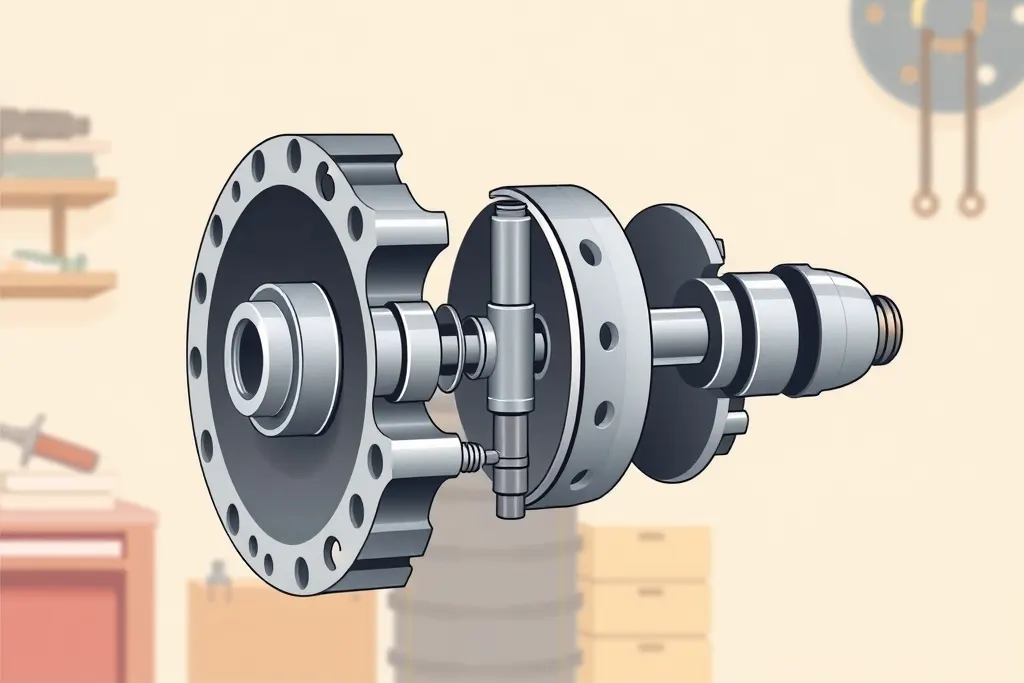
A four-stroke engine completes its cycle in two crankshaft revolutions through suction, compression, power and exhaust strokes; a two-stroke engine does it in one revolution, with a power stroke every revolution, giving more power for a given size but poorer efficiency and more pollution. In the petrol (spark-ignition) engine a carburettor or injector supplies an air-fuel mixture ignited by a spark plug at a compression ratio of about 6 to 10; in the diesel (compression-ignition) engine air alone is compressed (ratio about 15 to 22) until fuel injected into it ignites by heat. Fuel quality is rated by octane number for petrol (resistance to knock) and cetane number for diesel (readiness to ignite). Engine systems are the cooling, lubrication, fuel and ignition systems; the brake power is measured at the shaft, and mechanical efficiency is brake power ÷ indicated power. The Indian Railways' main line locomotive is the diesel-electric or electric locomotive, in which the prime mover or overhead supply drives traction motors.
| Item | Note |
|---|---|
| Gears | Speed ratio = driver teeth ÷ driven teeth inverted: a 20-tooth gear at 600 rpm driving a 60-tooth gear gives 600 × 20 ÷ 60 = 200 rpm; spur, helical, bevel, worm gears |
| Belts, chains, clutches, brakes, bearings | Belts and chains transmit power between shafts; a clutch connects and disconnects them; a brake absorbs energy; bearings carry shafts with low friction (ball and roller are rolling bearings) |
| Casting, forging, rolling, welding | Casting pours molten metal into a mould; forging shapes hot metal by hammering; rolling squeezes it between rolls; welding joins metals by fusion (arc, gas) or pressure |
| Machining | Lathe (turning, facing, threading), drilling, milling, shaper, grinder; cutting speed in m/min = π D N ÷ 1000 with D in mm |
| Materials | Steel is iron with up to about 2% carbon (mild steel low, tool steel high); cast iron has more than 2%; heat treatment (annealing softens, hardening and tempering raise strength and toughness) |
A four-stroke engine completes its cycle in two crankshaft revolutions through suction, compression, power and exhaust strokes; a two-stroke engine does it in one revolution, with a power…
Worked Drills: Efficiency, COP, Modulus, Beam Moments and Drives
Mechanical numericals reuse a short list: thermal efficiency = work ÷ heat supplied; Carnot COP of a refrigerator = T_L ÷ (T_H − T_L) with absolute temperatures; E = stress ÷ strain; maximum bending moment of a simply supported beam is WL/4 for a central point load and wL²/8 for a uniformly distributed load; and for a belt or gear drive, speeds go inversely as diameters (or tooth numbers).
| Question | Working | Answer |
|---|---|---|
| Heat in 500 kJ, rejected 300 kJ | (500 − 300)/500 | 40% |
| Refrigerator between 250 K and 300 K | 250/(300 − 250) | COP = 5 |
| Stress 100 N/mm², strain 0.0005 | 100/0.0005 | 200 GPa |
| UDL 5 kN/m on 6 m span | wL²/8 = 5 × 36/8 | 22.5 kN·m |
| 300 mm pulley at 200 rpm drives 100 mm pulley | 200 × 300/100 | 600 rpm |
Mechanical numericals reuse a short list: thermal efficiency = work ÷ heat supplied; Carnot COP of a refrigerator = T_L ÷ (T_H − T_L) with absolute temperatures; E = stress ÷ strain…
Key takeaways
- First law Q = ΔU + W; second law gives direction (Kelvin-Planck, Clausius); Q = mcΔT; Boyle p₁V₁ = p₂V₂ at constant temperature; temperatures in thermodynamics are absolute (K = °C + 273).
- Carnot η = 1 − T₂ ÷ T₁ is the ceiling; Otto η = 1 − 1 ÷ r^(γ − 1); diesel heat addition is at constant pressure, petrol at constant volume.
- Stress = P ÷ A, strain = ΔL ÷ L, Young's modulus E = stress ÷ strain (about 200 GPa for steel); factor of safety = ultimate stress ÷ working stress.
- Simply supported beam: central load gives WL ÷ 4, uniform load gives wL² ÷ 8; shaft power P = 2πNT ÷ 60.
- Pascal transmits pressure equally (hydraulic press); continuity A₁V₁ = A₂V₂; Bernoulli: faster flow, lower pressure; Pelton high head, Francis medium, Kaplan low head.
- Four-stroke cycle is suction, compression, power, exhaust over two revolutions; petrol is spark-ignited (octane rating), diesel compression-ignited (cetane rating).
Practice questions (25)
Attempt each one before opening the answer. Every explanation names the tempting wrong option as well as the right one, because that is where marks are lost.
The efficiency of a Carnot engine working between 600 K and 300 K is:
Show answer
Answer: A — 50%
η = 1 − T₂ ÷ T₁ = 1 − 300 ÷ 600 = 0.5 = 50%. The efficiency of a real engine between the same temperatures is lower.Stress is defined as:
Show answer
Answer: D — Force ÷ area
Stress is the internal force per unit area, σ = P ÷ A. The change in length divided by the original is strain, and mass per volume is density.A four-stroke engine completes its cycle in how many revolutions of the crankshaft?
Show answer
Answer: B — Two
The four strokes (suction, compression, power, exhaust) take two revolutions, so there is one power stroke every two revolutions. A two-stroke engine completes its cycle in one revolution.
Show the other 22 questions
A force of 100 N acts on a piston of area 10 cm² in a hydraulic press whose large piston has area 200 cm². The force on the large piston is:
Show answer
Answer: D — 2,000 N
By Pascal's law the pressure is equal, so F₂ = F₁ × A₂ ÷ A₁ = 100 × 200 ÷ 10 = 2,000 N. The press multiplies force but gives up distance in the same ratio.A steel bar of area 500 mm² carries a pull of 50 kN. The stress in it is:
Show answer
Answer: A — 100 MPa
σ = 50,000 N ÷ 500 mm² = 100 N/mm² = 100 MPa. Forgetting that 50 kN is 50,000 N gives the wrong 0.1.Water flows at 2 m/s in a pipe of cross-section 20 cm². Where the pipe narrows to 10 cm², the speed becomes:
Show answer
Answer: C — 4 m/s
Continuity requires A₁V₁ = A₂V₂, so V₂ = 20 × 2 ÷ 10 = 4 m/s. Speed rises as area falls, and Bernoulli's equation then says the pressure falls.A simply supported beam of span 4 m carries a central point load of 10 kN. The maximum bending moment is:
Show answer
Answer: B — 10 kN m
M = WL ÷ 4 = 10 × 4 ÷ 4 = 10 kN m, at the centre. The 40 kN m product WL is the cantilever value for an end load, and 20 kN m would be WL ÷ 2.A 20-tooth driver gear turning at 600 rpm meshes with a 60-tooth driven gear. The driven gear's speed is:
Show answer
Answer: A — 200 rpm
Speeds are inversely proportional to the number of teeth: N₂ = 600 × 20 ÷ 60 = 200 rpm. The larger gear turns slower, so 1,800 rpm inverts the ratio.A heat engine receives 500 kJ of heat from a source and rejects 300 kJ to the sink. Its thermal efficiency is:
Show answer
Answer: A — 40%
Work = 500 − 300 = 200 kJ and efficiency = 200/500 = 40%. The value 60% is the fraction of heat rejected.A Carnot refrigerator works between a cold space at 250 K and surroundings at 300 K. Its coefficient of performance is:
Show answer
Answer: A — 5
COP = T_L/(T_H − T_L) = 250/(300 − 250) = 5. The value 6 is the COP of a heat pump (T_H/(T_H − T_L)).A steel bar of cross-section 500 mm² carries a pull of 50 kN and shows a strain of 0.0005. Its Young's modulus is:
Show answer
Answer: A — 200 GPa
Stress = 50,000 N / 500 mm² = 100 N/mm², and E = 100/0.0005 = 2,00,000 N/mm² = 200 GPa, the usual value for steel. Forgetting the factor 1,000 between N/mm² and GPa gives other figures.A simply supported beam of span 6 m carries a uniformly distributed load of 5 kN per metre over the whole span. The maximum bending moment is:
Show answer
Answer: A — 22.5 kN·m
M = wL²/8 = 5 × 36/8 = 22.5 kN·m at mid-span. Using WL/4 with W = 30 kN gives 45 kN·m, which is the central point load formula, and 30 is the total load.Consider the following statements about flow in a circular pipe:
1. Flow with a Reynolds number below about 2,000 is laminar.
2. Flow with a Reynolds number above about 4,000 is turbulent.
Which of the statements is/are correct?Show answer
Answer: A — Both 1 and 2
The usual limits for pipe flow are laminar below about 2,000 and turbulent above about 4,000, with a transition region between them. Both statements are correct.The gauge pressure at a depth of 10 m in water (density 1,000 kg/m³, g = 10 m/s²) is:
Show answer
Answer: A — 100 kPa
P = ρgh = 1,000 × 10 × 10 = 1,00,000 Pa = 100 kPa. This is gauge pressure; absolute pressure adds the atmospheric pressure of about 101 kPa.A driver pulley of 300 mm diameter running at 200 rpm drives a driven pulley of 100 mm diameter by a belt without slip. The speed of the driven pulley is:
Show answer
Answer: A — 600 rpm
Without slip the belt speed is the same on both pulleys, so N₂ = N₁ × D₁/D₂ = 200 × 300/100 = 600 rpm; the smaller pulley spins faster. The value 67 rpm inverts the diameters.The Poisson's ratio of steel is approximately:
Show answer
Answer: B — 0.3
Poisson's ratio is lateral strain ÷ longitudinal strain, about 0.25–0.33 for steel. Values like 3.0 are impossible for ordinary solids.A steel bar of length 2 m and area 200 mm² carries an axial pull of 20 kN. With E = 200 GPa, the elongation is:
Show answer
Answer: A — 1 mm
δ = PL ÷ AE = (20,000 × 2,000) ÷ (200 × 2,00,000) = 4 × 10⁷ ÷ 4 × 10⁷ = 1 mm. Check: stress 100 MPa, strain 0.0005, 0.0005 × 2,000 = 1 mm. Not converting metres to mm gives a tempting factor-of-1,000 error.The heat needed to raise the temperature of 5 kg of water by 40 °C, taking the specific heat as 4.2 kJ/kg K, is:
Show answer
Answer: C — 840 kJ
Q = m c ΔT = 5 × 4.2 × 40 = 840 kJ. Check: 5 × 40 = 200 and 200 × 4.2 = 840. Leaving out the mass gives the tempting 168.The difference in the way fuel is ignited in a diesel engine compared with a petrol engine is that in a diesel engine the fuel is ignited:
Show answer
Answer: B — By the heat of compressed air, without a spark plug
A diesel engine compresses air to a high temperature and injects fuel, which self-ignites. A spark plug belongs to the petrol (Otto) engine, the tempting wrong option.A venturimeter fitted in a pipeline is used to measure:
Show answer
Answer: D — The discharge (rate of flow) through the pipe
A venturimeter uses the pressure drop at a throat, from Bernoulli's equation, to find the flow rate. Viscosity is measured by a viscometer, the tempting confusion.An engine running at 1,500 rpm delivers a torque of 40 N·m. Its power output is about:
Show answer
Answer: D — 6.28 kW
P = 2πNT ÷ 60 = 2π × 1,500 × 40 ÷ 60 = 6,283 W = 6.28 kW. Using N × T directly gives 60,000 W, the tempting unit slip.An engine has an indicated power of 25 kW and a brake power of 20 kW. Its mechanical efficiency is:
Show answer
Answer: A — 80%
Mechanical efficiency = brake power ÷ indicated power = 20 ÷ 25 = 80%. Inverting gives 125%, impossible for an efficiency, which is the tempting slip.A cantilever of length 1.5 m carries a point load of 20 kN at its free end. The maximum bending moment, at the fixed end, is:
Show answer
Answer: C — 30 kN·m
For a cantilever with an end load, M = W × L = 20 × 1.5 = 30 kN·m. The WL ÷ 4 formula (7.5) belongs to a simply supported beam with a central load, the tempting mix-up.Assertion (A): For the same weight and material, a hollow circular shaft transmits more torque than a solid one.
Reason (R): The material near the axis of a shaft carries very little shear stress.
Which one of the following is correct?Show answer
Answer: A — Both A and R are true, and R is the correct explanation of A
Shear stress grows with radius, so metal near the axis is wasted and moving it outward raises the polar moment of inertia, so R explains A. A hollow shaft is not stronger because it is lighter, the tempting error.Consider the following statements about the second law of thermodynamics:
1. No heat engine operating in a cycle can convert all the heat it receives into work.
2. Heat flows by itself from a colder body to a hotter body.
Which of the statements given above is/are correct?Show answer
Answer: A — 1 only
Statement 1 is the Kelvin-Planck form. Statement 2 contradicts the Clausius form: heat does not flow from cold to hot without work, which is the tempting error.