Agriculture III: Agrometeorology, Monsoon and Seed Science
2. Climate Classification, Monsoon and Climate Change
Climates are classified by Köppen (temperature, rainfall and the vegetation they support) and by Thornthwaite (a moisture index from rainfall and potential evapotranspiration). For planning, India is divided into 15 agro-climatic regions and, under the National Agricultural Research Project, 127 agro-climatic zones, each with its own suitable crops and varieties.
The south-west monsoon reaches Kerala about 1 June, covers the country by mid-July, and brings about three-fourths of the annual rainfall between June and September, which sets the kharif crops. The north-east (retreating) monsoon of October to December rains on Tamil Nadu and the east coast; western disturbances bring winter rain to north India, helping rabi wheat. El Niño years, with warm Pacific waters, usually weaken the monsoon; La Niña years usually strengthen it. A dry spell in a break monsoon at flowering can cost a rain-fed crop dearly.
Climate change matters to crops in several ways: rising temperature shortens the grain-filling period of wheat (terminal heat stress), erratic rain brings droughts and floods, rising carbon dioxide helps C3 crops such as wheat and rice more than C4 crops such as maize, sea-level rise salinises coastal fields, and agriculture itself emits methane (paddy fields and ruminants) and nitrous oxide (fertilisers). Adaptation includes stress-tolerant varieties, changed sowing dates, crop insurance (PMFBY, 2016) and the National Innovations in Climate Resilient Agriculture project.
Climates are classified by Köppen (temperature, rainfall and the vegetation they support) and by Thornthwaite (a moisture index from rainfall and potential evapotranspiration). For…
3. Seed Structure, Pollination, Dormancy and Classes of Seed
A dicot seed such as the bean has a seed coat (testa and tegmen), a hilum (scar) and micropyle, and an embryo with two cotyledons that store food, a radicle, plumule and the parts between them (hypocotyl, epicotyl). Many dicots (bean, pea, gram) are non-endospermic; castor is endospermic. A monocot grain such as maize or wheat is a caryopsis whose seed coat is fused with the fruit wall; it has one cotyledon, the scutellum, a large starchy endosperm with an outer aleurone layer, and the embryo protected by a coleoptile (over the plumule) and coleorhiza (over the radicle).
| Feature | Dicot (bean, gram, mustard) | Monocot (maize, wheat, rice) |
|---|---|---|
| Cotyledons | Two | One (scutellum) |
| Food store | Mostly in cotyledons | Mainly in endosperm |
| Sheath over shoot and root | Absent | Coleoptile and coleorhiza |
| Germination | Epigeal in bean (cotyledons rise above ground); hypogeal in pea and gram | Hypogeal in maize and wheat |
Pollination is the transfer of pollen to the stigma: self-pollination (wheat, rice, gram, groundnut) or cross-pollination by wind (maize, bajra) or insects (mustard, sunflower). In double fertilisation, one male gamete fuses with the egg to form the diploid zygote and the other with the two polar nuclei to form the triploid (3n) endosperm. Dormancy is a rest period of a viable seed, caused by a hard seed coat, an immature embryo or chemical inhibitors such as abscisic acid; it is broken by scarification, stratification (chilling moist seed), soaking in water, gibberellic acid or potassium nitrate.
The classes of seed follow the multiplication chain nucleus seed, breeder seed, foundation seed, certified seed. Breeder seed comes from the plant breeder (golden-yellow tag), foundation seed from breeder seed (white tag) and certified seed, the one sold to farmers, from foundation seed (blue tag). Under the Seeds Act, 1966 seed must meet standards of genetic purity, physical purity, germination and moisture, and truthfully labelled seed (green tag) is self-certified by the producer. Seed rate (kg/ha) = population per m² × test weight in g × 100 ÷ (germination % × purity %), so lower germination or purity raises the quantity to be sown.
A dicot seed such as the bean has a seed coat (testa and tegmen), a hilum (scar) and micropyle, and an embryo with two cotyledons that store food, a radicle, plumule and the parts between…
4. Worked Calculations: Pure Live Seed and Growing Degree Days
A seed lot is judged by its purity and germination. The pure live seed percentage is purity times germination divided by 100. A lot that is 98 per cent pure with 85 per cent germination has 98 × 85 / 100 = 83.3 per cent pure live seed. If a crop needs 40 kg of seed per hectare at 100 per cent, then with this lot the seed rate must be raised to 40 / 0.833 ≈ 48 kg to give the same number of live seeds. The classes of seed in the certified chain are breeder seed, foundation seed and certified seed, and the colour of the tag distinguishes them: golden yellow for breeder, white for foundation and blue for certified.
Crop development is also tracked through heat. Growing degree days for one day are the mean of the maximum and minimum temperatures minus the base temperature below which the crop does not grow. With a maximum of 32 °C, a minimum of 18 °C and a base of 10 °C, a day gives (32 + 18)/2 − 10 = 15 degree days, and 100 such days add up to 1,500. A crop reaches maturity after a fairly constant total of degree days, so a cool season delays harvest and a warm one hastens it.
A seed lot is judged by its purity and germination. The pure live seed percentage is purity times germination divided by 100. A lot that is 98 per cent pure with 85 per cent germination has…
Key takeaways
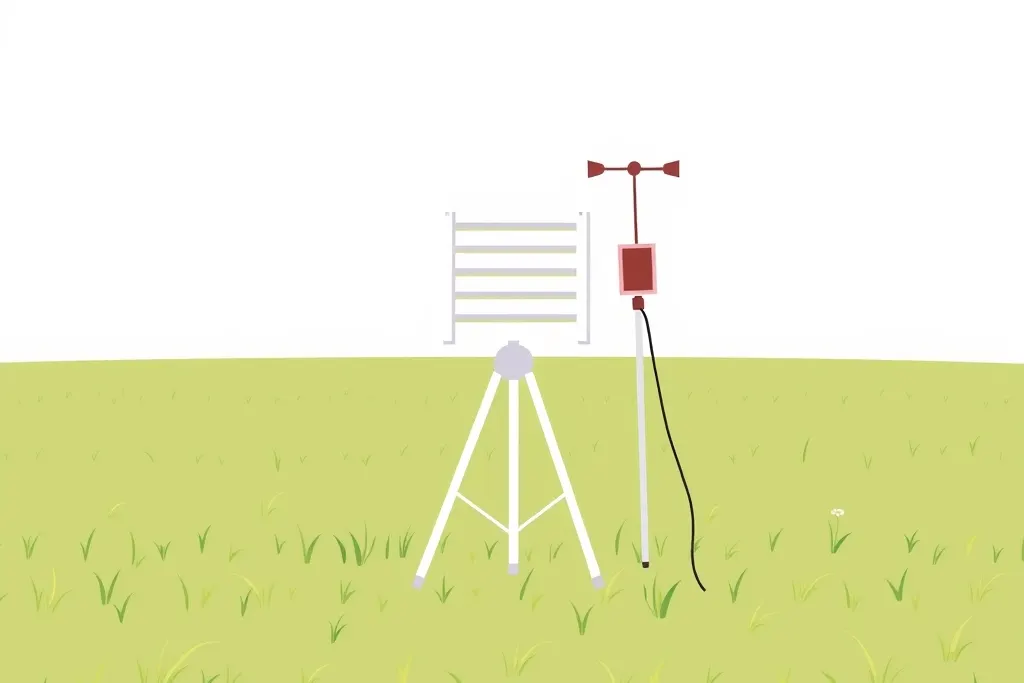
- The elements of weather are rainfall, temperature, humidity, wind and sunshine, measured with the rain gauge, thermometer in a Stevenson screen, hygrometer, anemometer and sunshine recorder.
- Weather is short-term and climate the 30-year average; the south-west monsoon, June to September, gives about three-fourths of India's rain and sets the kharif crops.
- Climate change shortens wheat grain-filling, makes rain erratic and salinises coasts; agriculture emits methane and nitrous oxide; adaptation uses tolerant varieties, shifted sowing and insurance.
- A dicot seed has two cotyledons; a monocot grain has one (scutellum), endosperm with an aleurone layer, coleoptile and coleorhiza.
- Double fertilisation gives a 2n zygote and 3n endosperm; dormancy is broken by scarification, stratification, soaking, GA or KNO3; seed classes run nucleus, breeder, foundation, certified.
Practice questions (24)
Attempt each one before opening the answer. Every explanation names the tempting wrong option as well as the right one, because that is where marks are lost.
Rainfall is measured with a
Show answer
Answer: B — rain gauge, in millimetres
The rain gauge collects the water and the depth is read in mm. The anemometer measures wind speed, the hygrometer humidity and the barometer pressure.The thermometers of a weather station are kept in a Stevenson screen so that they
Show answer
Answer: A — read the air temperature in the shade with good ventilation
Direct sun would heat the bulb and give a false air temperature, so the louvred screen shades the instruments while letting air through.The south-west monsoon normally reaches Kerala about
Show answer
Answer: D — 1 June
The onset over Kerala about 1 June starts the kharif season; the monsoon withdraws from north-west India in September. The north-east monsoon is the October to December rain of the south-east coast.
Show the other 21 questions
Which pair of climate classifications is correctly named?
Show answer
Answer: C — Köppen and Thornthwaite
Köppen used temperature, rainfall and vegetation, and Thornthwaite a moisture index. Richter and Mercalli scales measure earthquakes, Beaufort wind force.Rising air temperature affects wheat mainly by
Show answer
Answer: B — shortening the grain-filling period and lowering yield
Terminal heat stress, as in March 2022 in north-west India, hastens maturity and shrivels grain. It does not remove the crop's water need, which actually rises.In a dicot seed such as bean, the part that grows into the root is the
Show answer
Answer: A — radicle
The plumule becomes the shoot, the testa is the outer coat and the micropyle the tiny pore through which water enters.The single cotyledon of a monocot grain such as maize is called the
Show answer
Answer: D — scutellum
The scutellum absorbs food from the endosperm for the embryo. The coleoptile is the sheath over the shoot and the aleurone the outer protein-rich layer of the endosperm.In double fertilisation the triploid endosperm results from the fusion of one male gamete with
Show answer
Answer: C — the two polar nuclei
The other male gamete fuses with the egg to give the diploid zygote. With three sets of chromosomes the endosperm is 3n.The correct order of seed classes in the multiplication chain is
Show answer
Answer: B — nucleus, breeder, foundation, certified
Each class is multiplied from the one before, and the final certified seed (blue tag) is what farmers buy. Breeder seed has a golden-yellow tag and foundation seed a white tag.A seed lot has 90 per cent germination and 98 per cent purity. Compared with a lot of 100 per cent on both, the quantity to sow for the same plant population is
Show answer
Answer: A — about 13 per cent larger
Seed rate varies inversely with germination × purity: 100 × 100 ÷ (90 × 98) = 1.134, so about 13 per cent more is needed. Lower quality means more seed, not less.Wind speed is measured with an:
Show answer
Answer: B — Anemometer
An anemometer with rotating cups gives wind speed. Barometer is the tempting wrong option, which measures atmospheric pressure.Atmospheric humidity is measured with a:
Show answer
Answer: C — Hygrometer or psychrometer
Hygrometers and psychrometers (wet and dry bulb) give humidity. Anemometer is the tempting wrong option, which gives wind speed.The tag of foundation seed is of which colour?
Show answer
Answer: D — White
Foundation seed carries a white tag. Blue is the tempting wrong option, which is the tag of certified seed.The tetrazolium test is used to determine seed:
Show answer
Answer: A — Viability
Living tissue turns red with tetrazolium, indicating viability quickly. Moisture content is the tempting wrong option, which is measured by oven drying.A Class A open pan is used in agrometeorology to measure:
Show answer
Answer: B — Evaporation
The pan records water lost by evaporation. Rainfall is the tempting wrong option, since the pan is open to rain, but it is read for evaporation.An El Niño year is generally associated, over India, with:
Show answer
Answer: C — A weak or deficient monsoon
Warm Pacific waters weaken the monsoon circulation in many El Niño years. A strong monsoon is the tempting wrong option, which is the usual La Niña outcome.The tag of certified seed is:
Show answer
Answer: D — Blue
Certified seed carries a blue tag. White is the tempting wrong option, which is foundation seed; breeder seed has a golden yellow tag.About the seed multiplication chain, consider:
(1) Nucleus seed is produced under the breeder's control and is genetically purest.
(2) Foundation seed is the progeny of breeder seed.
(3) Certified seed is produced directly from nucleus seed.Show answer
Answer: A — 1 and 2 only
Statements 1 and 2 are true; certified seed comes from foundation seed, so 3 is wrong. Option 4 is the tempting wrong option.Assertion (A): Seeds are stored at low moisture content. Reason (R): Low moisture lowers respiration and the growth of storage fungi.
Show answer
Answer: A — Both A and R are true, and R is the correct explanation of A
Both are true and R explains A: dry seed stays viable longer because metabolism and moulds are suppressed. Option 2 is the tempting wrong option, though R gives the cause.Match the instrument with the element it measures.
A. Anemometer – 1. Wind speed;
B. Barometer – 2. Air pressure;
C. Hygrometer – 3. Humidity;
D. Sunshine recorder – 4. Duration of bright sunshine.Show answer
Answer: B — A-1, B-2, C-3, D-4
The second option is correct for all four. Option 1 is the tempting wrong option, which swaps wind speed and pressure.A seed lot of 1,000 kg at 18% moisture is dried to 12% moisture (wet basis). Its final weight is about:
Show answer
Answer: C — 931.8 kg
Dry matter = 1,000 × 82% = 820 kg; final weight = 820 ÷ 0.88 = 931.8 kg. 940 kg is the tempting wrong option, which removes the 6% difference directly from 1,000 kg.A 2-hectare field receives 40 mm of rain. The volume of water received is (1 mm over 1 ha = 10 m³):
Show answer
Answer: D — 800 m³
Volume = 40 × 10 × 2 = 800 m³. 400 m³ is the tempting wrong option, which forgets to multiply by the 2 hectares.Reference evapotranspiration is 5 mm/day and the crop coefficient (Kc) is 0.8. The crop water need over 10 days is:
Show answer
Answer: A — 40 mm
ETc = Kc × ET₀ = 0.8 × 5 = 4 mm/day; over 10 days 40 mm. 50 mm is the tempting wrong option, which ignores the crop coefficient.On a day the maximum temperature is 34 °C and the minimum 16 °C. With a base temperature of 10 °C, the growing degree days for the day are:
Show answer
Answer: B — 15
GDD = (34 + 16)/2 − 10 = 25 − 10 = 15. 25 is the tempting wrong option, which is the mean temperature and forgets to subtract the base.