Agriculture IV: Cell, Genetics, Plant Breeding and Biotechnology
2. Mendel's Laws and Quantitative Inheritance
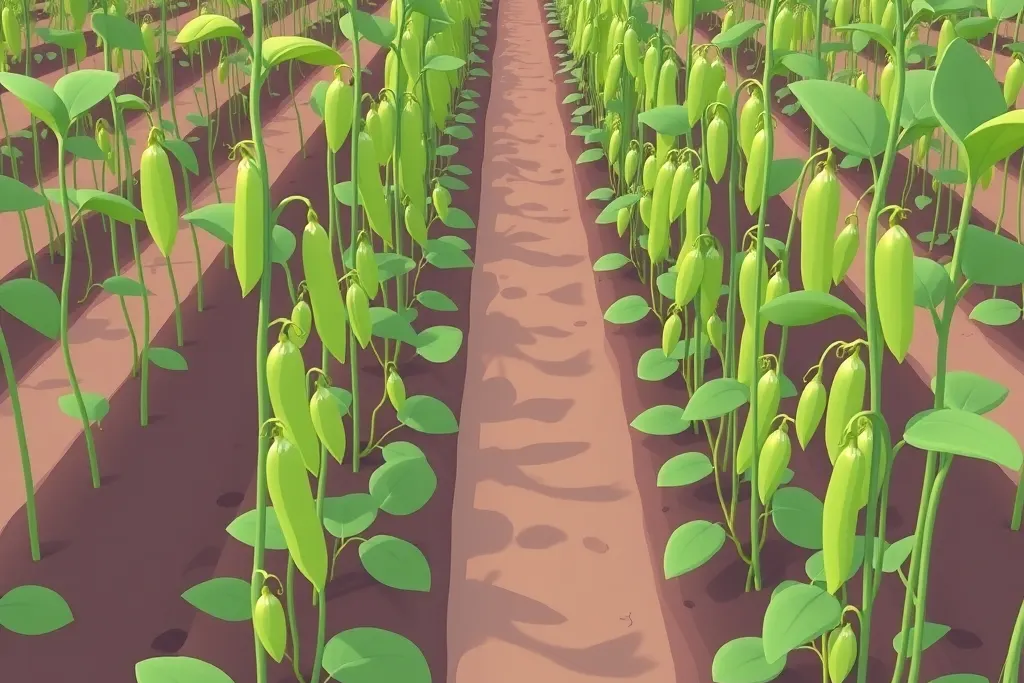
Mendel (1866) crossed garden pea plants. His laws are: dominance (in a hybrid, one factor masks the other), segregation (the two alleles separate in gamete formation, giving a 3:1 phenotypic ratio and 1:2:1 genotypic ratio in F2) and independent assortment (genes of different traits assort independently, giving 9:3:3:1 in a dihybrid F2). He succeeded because he chose a self-pollinated plant with clear contrasting traits and short life cycle, studied one or two traits at a time, counted large numbers and kept careful records; the seven traits he chose were on different chromosomes (or far apart), so there was no linkage to confuse his ratios.
| Feature | Monogenic (qualitative) | Polygenic (quantitative) |
|---|---|---|
| Genes involved | One or two with large effect | Many with small additive effects |
| Variation | Discontinuous: distinct classes such as tall and dwarf | Continuous: a bell-shaped range |
| Environment | Little effect | Large effect |
| Examples | Tall or dwarf pea, seed shape, rust resistance by a single gene | Yield, plant height, grain weight, ear length |
Mendel (1866) crossed garden pea plants. His laws are: dominance (in a hybrid, one factor masks the other), segregation (the two alleles separate in gamete formation, giving a 3:1…
3. Plant Breeding Methods and Biotechnology
Plant breeding is the improvement of crops by changing their heredity. Its objectives include higher yield, resistance to disease and pests, tolerance of drought, salinity and heat, better quality and shorter duration. Its steps are collection of variability, selection, hybridisation, evaluation and release. For self-pollinated crops (wheat, rice, gram) the methods are introduction, pure-line selection, the pedigree and bulk methods, and backcross for adding one gene. For cross-pollinated crops (maize, bajra) they are mass selection, recurrent selection and hybrids exploiting heterosis (hybrid vigour) with inbred lines; seed is bought every season because hybrid vigour is lost in the next generation.
Mutation breeding uses X-rays, gamma rays or chemicals such as EMS to create new variation (the Sharbati Sonora wheat of India is a gamma-ray mutant). Polyploidy, doubling or multiplying the chromosome sets with colchicine, gave triticale (a wheat-rye hybrid) and seedless watermelon (triploid). Tissue and cell culture grows whole plants from a cell or piece of tissue in sterile nutrient medium (totipotency), used for micropropagation of banana and sugarcane, virus-free plants by meristem culture and protoplast fusion.
Plant biotechnology applies tools of genetics to crops. Genetic engineering moves a gene across species, as in Bt cotton, which carries a gene from Bacillus thuringiensis for a toxin against bollworms (approved in India in 2002); marker-assisted selection uses DNA markers to select plants quickly; transgenic crops can carry genes for herbicide tolerance, delayed ripening or vitamin A (golden rice). Concerns include gene flow, effects on non-target insects, seed monopoly and food safety, so GM crops need regulatory approval.
Plant breeding is the improvement of crops by changing their heredity. Its objectives include higher yield, resistance to disease and pests, tolerance of drought, salinity and heat, better…
4. Worked Problems: Ratios, Heritability and Response to Selection
Mendel's ratios turn into counts with simple multiplication. A monohybrid cross Tt × Tt gives genotypes TT, Tt and tt in the ratio 1 : 2 : 1 and phenotypes tall to dwarf in the ratio 3 : 1, so of 1,200 progeny about 1,200 × ¼ = 300 are dwarf. A dihybrid cross between two double heterozygotes gives the phenotypic ratio 9 : 3 : 3 : 1, so of 1,600 plants the expected numbers are 900, 300, 300 and 100. A test cross, with the recessive parent, reveals an unknown genotype: a tall plant that gives all tall offspring is TT, while one that gives tall and dwarf in equal numbers is Tt.
For quantitative traits such as yield, breeders use heritability in the broad sense, h² = genetic variance divided by total phenotypic variance, which shows how much of the variation seen is passed on. The expected response to selection is R = h² × S, where S is the selection differential, the difference between the mean of the selected parents and the population mean. With h² = 0.4 and S = 10 units, the gain per generation is R = 0.4 × 10 = 4 units. A trait with low heritability responds slowly to selection, which is why breeders use hybrid breeding, mutation and biotechnology to create new variation for traits such as yield.
Mendel's ratios turn into counts with simple multiplication. A monohybrid cross Tt × Tt gives genotypes TT, Tt and tt in the ratio 1 : 2 : 1 and phenotypes tall to dwarf in the ratio 3 : 1…
From Selection to Transgenic Crops
Plant breeding methods can be placed on a ladder of increasing control. Introduction brings in a variety from elsewhere, selection picks the best plants from a mixed population, and hybridisation crosses two parents to combine their good traits, sometimes giving heterosis, or hybrid vigour, in the first generation, which is why hybrid seed is bought fresh each season. Mutation breeding creates new variation with radiation or chemicals, and polyploidy doubles chromosome sets to produce larger, sometimes seedless, forms. Biotechnology goes further. Tissue culture grows whole plants from a few cells because plant cells are totipotent, and genetic engineering transfers a gene across species, as in Bt cotton, which carries a gene from the soil bacterium Bacillus thuringiensis that makes a protein toxic to the bollworm.
Plant breeding methods can be placed on a ladder of increasing control. Introduction brings in a variety from elsewhere, selection picks the best plants from a mixed population, and…
Key takeaways
- Mitosis keeps the chromosome number and makes identical cells; meiosis halves it, makes four haploid gametes and recombines genes by crossing over.
- DNA is a double helix with A-T and G-C pairing; RNA is single-stranded with uracil; flow is DNA to RNA to protein.
- Mendel's laws are dominance, segregation (3:1) and independent assortment (9:3:3:1); his success owed to pea, few traits, large counts and no linkage.
- Monogenic traits show discontinuous classes; polygenic (quantitative) traits such as yield and height vary continuously and are strongly influenced by environment.
- Breeding steps are variability, selection, hybridisation, evaluation, release; methods include pure-line selection, hybrids with heterosis, mutation, polyploidy and tissue culture; Bt cotton is a transgenic crop.
Practice questions (24)
Attempt each one before opening the answer. Every explanation names the tempting wrong option as well as the right one, because that is where marks are lost.
Meiosis differs from mitosis in that meiosis
Show answer
Answer: B — produces four haploid cells and involves crossing over
Meiosis reduces the chromosome number by half and recombines genes, giving gametes with new combinations; mitosis gives identical diploid cells for growth.Which base is found in RNA but not in DNA?
Show answer
Answer: A — uracil
RNA has uracil in place of thymine, and ribose in place of deoxyribose. Adenine and cytosine occur in both nucleic acids.In a monohybrid cross of tall (TT) and dwarf (tt) pea plants, the F2 generation shows a phenotypic ratio of
Show answer
Answer: D — 3 tall : 1 dwarf
F1 is all tall (Tt) by dominance and selfing gives TT, Tt, Tt, tt, a 3:1 phenotypic ratio and a 1:2:1 genotypic ratio.
Show the other 21 questions
One reason for Mendel's success was that
Show answer
Answer: C — the traits he studied showed no linkage and he counted large numbers
He worked on one or two traits at a time in a self-pollinating plant. DNA was identified decades after his work.Grain yield and plant height are best described as
Show answer
Answer: B — polygenic traits showing continuous variation
Many genes with small effects plus environment give a bell-shaped range, which is why selection for yield needs careful trials over places and years.Heterosis (hybrid vigour) is exploited commercially mainly in
Show answer
Answer: A — cross-pollinated crops such as maize and bajra
Farmers must buy fresh hybrid seed each season because vigour declines when hybrids are selfed or randomly mated.Triticale, a man-made cereal, is a hybrid of
Show answer
Answer: D — wheat and rye, with chromosomes doubled
The wheat-rye hybrid is sterile until its chromosome number is doubled with colchicine, an example of polyploidy breeding.Micropropagation of banana is based on the idea of totipotency, which means that
Show answer
Answer: C — a single plant cell can grow into a complete plant
In sterile nutrient medium with the right hormones a piece of tissue regenerates into a whole plant, giving thousands of uniform, disease-free plants.Bt cotton is resistant to bollworms because it carries a gene from
Show answer
Answer: B — the bacterium Bacillus thuringiensis
The gene codes for a crystal protein toxic to certain insects but safe to humans. Bt cotton was approved for commercial cultivation in India in 2002.Two plants heterozygous for two independent genes are crossed, and 1,600 offspring are raised. How many are expected to show both recessive traits?
Show answer
Answer: A — 100
In the 9 : 3 : 3 : 1 ratio the double recessive class is 1 part in 16, so 1,600 / 16 = 100. The figures 900 and 300 are the double dominant and the single-recessive classes.A test cross is a cross of the F1 (or any dominant-phenotype individual) with:
Show answer
Answer: C — A homozygous recessive parent
Crossing with the recessive parent exposes the unknown genotype. Homozygous dominant is the tempting wrong option, which would show only dominant offspring and reveal nothing.In a DNA molecule, adenine pairs with:
Show answer
Answer: D — Thymine
A pairs with T through two hydrogen bonds. Uracil is the tempting wrong option, which pairs with adenine only in RNA.Golden rice is genetically engineered to contain:
Show answer
Answer: A — Beta-carotene (provitamin A)
It makes beta-carotene in the grain to fight vitamin A deficiency. Insecticidal protein is the tempting wrong option, which is the trait of Bt crops.In incomplete dominance (e.g. snapdragon), the phenotypic ratio in the F2 generation is:
Show answer
Answer: B — 1 : 2 : 1
The heterozygote shows an intermediate phenotype, so the phenotypic ratio matches the genotypic 1 : 2 : 1. 3 : 1 is the tempting wrong option, which is the ratio under complete dominance.The start codon AUG codes for the amino acid:
Show answer
Answer: C — Methionine
AUG initiates translation and codes for methionine. Tryptophan is the tempting wrong option, which is coded by UGG and is also unique to one codon.DNA replication is called semi-conservative because each daughter DNA has:
Show answer
Answer: D — One old and one new strand
Each new molecule keeps one parental strand, as shown by Meselson and Stahl. Two new strands is the tempting wrong option, which describes the rejected dispersive-or-conservative alternatives.About the genetic code, consider:
(1) Each codon is a triplet of nucleotides.
(2) UAA, UAG and UGA are stop codons.
(3) AUG is a stop codon.Show answer
Answer: A — 1 and 2 only
Statements 1 and 2 are correct; AUG is the start codon, so 3 is wrong. Option 4 is the tempting wrong option.Assertion (A): A test cross reveals the genotype of an individual showing the dominant phenotype. Reason (R): The offspring of a cross with a homozygous recessive show the types of gametes made by the unknown parent.
Show answer
Answer: A — Both A and R are true, and R is the correct explanation of A
Both are true and R explains A: the recessive parent contributes only recessive gametes, so the offspring ratio mirrors the unknown parent's gametes. Option 2 is the tempting wrong option, though R is the logic.Match the technique with an example.
A. Tissue culture – 1. Micropropagation of banana;
B. Biofortification – 2. High-protein wheat Atlas 66;
C. Mutation breeding – 3. Sharbati Sonora wheat;
D. Genetic engineering – 4. Bt cotton.Show answer
Answer: B — A-1, B-2, C-3, D-4
The second option is correct for all four. Option 4 is the tempting wrong option, which swaps biofortification and mutation breeding as both involve improved wheat.Two plants heterozygous for two independent genes (AaBb × AaBb) produce 1,600 offspring. The number expected to show one dominant and one recessive trait (A_bb or aaB_) is:
Show answer
Answer: C — 600
Each such class is 3/16, so together 6/16 × 1,600 = 600. 300 is the tempting wrong option, which counts only one of the two classes.A DNA molecule has 36% guanine plus cytosine. The percentage of adenine in it is:
Show answer
Answer: D — 32%
G = C = 18%, so A + T = 64% and A = T = 32% by Chargaff's rules. 64% is the tempting wrong option, which is A + T together, not adenine alone.The coding region of an mRNA has 300 nucleotides including one stop codon. The number of amino acids in the polypeptide is:
Show answer
Answer: A — 99
300 ÷ 3 = 100 codons; the stop codon codes for no amino acid, leaving 99. 100 is the tempting wrong option, which counts the stop codon.One double-stranded DNA molecule is amplified by PCR for 5 cycles. The number of DNA copies at the end is:
Show answer
Answer: B — 32
Each cycle doubles the number, so 2⁵ = 32. 10 is the tempting wrong option, from adding 2 per cycle instead of doubling.A population has a mean yield of 40 q/ha. Parents selected for breeding average 50 q/ha and the narrow-sense heritability is 0.4. The expected mean of the next generation is:
Show answer
Answer: C — 44 q/ha
Response = h² × selection differential = 0.4 × 10 = 4, so the mean becomes 44. 50 is the tempting wrong option, which assumes the offspring fully equal the selected parents.