Agriculture II: Fertilisers, Irrigation, Pest Management and Livestock
2. Methods of Irrigation
| Method | How water is applied | Suits | Water economy |
|---|---|---|---|
| Flood (basin) | Whole field is flooded | Rice, level fields | Lowest; large losses |
| Furrow | Water runs in channels between crop rows | Row crops: maize, sugarcane, cotton | Moderate |
| Sprinkler | Pressurised water sprayed like rain | Uneven land, sandy soil, pulses, vegetables | Good |
| Drip (trickle) | Drops delivered at each plant’s root through emitters | Orchards, vegetables, water-scarce areas | Highest; saves a large share of water |
Irrigation scheduling follows the crop’s critical stages, when a water shortage most reduces yield: the crown-root initiation stage of wheat (about 21 days after sowing) and the flowering and grain-filling stages of most crops. Over-irrigation with poor drainage leads to waterlogging and salinity, a problem of canal-irrigated tracts, so drainage matters as much as supply.
Irrigation scheduling follows the crop’s critical stages, when a water shortage most reduces yield: the crown-root initiation stage of wheat (about 21 days after sowing) and the flowering…
3. Integrated Pest Management and Horticulture
Integrated pest management (IPM) keeps pests below the economic threshold, the level at which the loss from the pest equals the cost of control, by using a combination of methods and chemicals only as the last resort. The cultural methods are crop rotation, clean seed, timely sowing and field sanitation; the mechanical ones are hand-picking, traps and bird perches; the biological ones use natural enemies such as Trichogramma wasps against borers, ladybird beetles against aphids and the bacterium Bacillus thuringiensis (Bt); the host-plant resistance method uses resistant varieties, as Bt cotton, approved for commercial growing in India in 2002; and chemical pesticides come last, used with care because they kill natural enemies and leave residues.
Horticulture is the growing of fruits, vegetables, flowers and spices, which earn more per hectare than grain and employ more labour. It uses propagation by cuttings, layering, budding and grafting to copy a good plant exactly, since a seed of a fruit tree does not breed true. After harvest, losses are cut by grading, proper packing, cold storage and quick transport, and a cold chain keeps perishable produce fresh.
- CulturalRotation, clean seed, timely sowing
- MechanicalHand-picking, traps, bird perches
- BiologicalTrichogramma, ladybird beetles, Bt
- Host-plant resistanceResistant varieties, as Bt cotton
- Chemical, last of allKill natural enemies, leave residues
Integrated pest management (IPM) keeps pests below the economic threshold, the level at which the loss from the pest equals the cost of control, by using a combination of methods and…
4. Animal Husbandry, Dairying and Fisheries
| Group | Examples |
|---|---|
| Indigenous milch cattle | Gir, Sahiwal, Red Sindhi |
| Exotic milch cattle | Jersey, Holstein-Friesian |
| Buffalo | Murrah, Mehsana, Surti |
| Sheep and goat | Merino (wool); Jamunapari, Beetal (goat) |
| Poultry | Layers (White Leghorn), broilers |
Animal husbandry covers feeding, breeding, housing and health care. Good milk output needs a balanced ration of green fodder, dry fodder and a concentrate, clean water, and protection against disease by vaccination (foot-and-mouth disease and haemorrhagic septicaemia are the commonest vaccinated diseases). Cross-breeding an indigenous cow (hardy, disease-resistant) with an exotic one (a high yielder) gives hardy animals that give much more milk. Fisheries are marine and inland, and composite fish culture stocks a pond with species that feed at different levels, such as catla (surface), rohu (middle) and mrigal (bottom), so that the pond’s food is used fully. Apiculture (bee-keeping) gives honey and wax and helps pollination.
Animal husbandry covers feeding, breeding, housing and health care. Good milk output needs a balanced ration of green fodder, dry fodder and a concentrate, clean water, and protection…
5. Worked Calculations: Grades, Irrigation Volumes and Pumping Time
A fertiliser grade such as 10:26:26 means 10 per cent N, 26 per cent P₂O₅ and 26 per cent K₂O by weight. A 50 kg bag of a 15:15:15 complex therefore holds 50 × 0.15 = 7.5 kg each of N, P₂O₅ and K₂O. If a bag of urea costs ₹270 for 45 kg, the cost per kg of nitrogen is 270 / (45 × 0.46) = 270 / 20.7 ≈ ₹13, and comparing the cost per kilogram of nutrient, not per bag, is the right way to choose between fertilisers. For irrigation, the volume is area times depth: 2 ha at 5 cm needs 10 ha-cm, which is 1,000 m³ or 10 lakh litres. A pump delivering 10 litres a second needs 1,000,000 / 10 = 100,000 seconds, about 27.8 hours, to deliver that volume, which fixes how long the pump must run.
| Item | Working | Result |
|---|---|---|
| N in 50 kg of 15:15:15 | 50 × 0.15 | 7.5 kg |
| Cost per kg N, urea ₹270/45 kg | 270 / 20.7 | ₹13 |
| Water for 2 ha at 5 cm | 10 ha-cm | 1,000 m³ |
| Pumping time at 10 L/s | 10⁶ / 10 s | 27.8 h |
A fertiliser grade such as 10:26:26 means 10 per cent N, 26 per cent P₂O₅ and 26 per cent K₂O by weight. A 50 kg bag of a 15:15:15 complex therefore holds 50 × 0.15 = 7.5 kg each of N, P₂O₅…
Water-Saving Irrigation and Integrated Pest Management
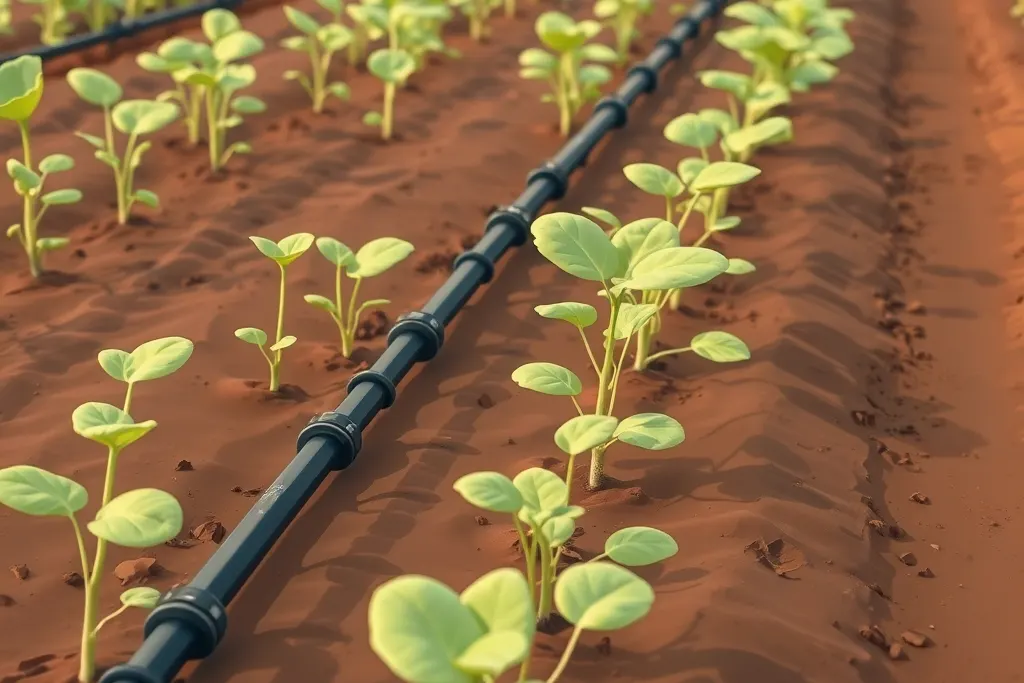
Drip irrigation delivers water drop by drop to the root zone through pipes and emitters, and sprinklers spray it like rain, so both lose far less water to evaporation and run-off than flooding a field. Drip suits orchards, vegetables and widely spaced crops, and sprinklers suit cereals and uneven land. Integrated pest management combines methods rather than relying on one. Cultural practices such as crop rotation and clean seed, biological control through natural enemies of the pest, and mechanical methods such as traps come first, and chemical pesticides are used last and only when the pest crosses the economic threshold, the level at which the loss from the pest exceeds the cost of control.
Drip irrigation delivers water drop by drop to the root zone through pipes and emitters, and sprinklers spray it like rain, so both lose far less water to evaporation and run-off than…
Key takeaways
- Fertiliser grades are N : P₂O₅ : K₂O; urea is 46% N, DAP 18 : 46 : 0, SSP 16% P₂O₅, MOP 60% K₂O; divide the dose by the fraction.
- Manures add humus and biofertilisers (Rhizobium, Azotobacter, BGA, Azolla, mycorrhiza) are living cultures; integrated nutrient management combines both kinds.
- Drip irrigation is the most water-efficient and flood irrigation the least; crown-root initiation is the critical stage in wheat.
- IPM holds pests below the economic threshold using cultural, mechanical, biological and resistant-variety methods first and chemicals last.
- Gir, Sahiwal and Murrah are Indian milch breeds; Jersey and Holstein-Friesian are exotic; composite fish culture uses catla, rohu and mrigal at three levels.
Practice questions (24)
Attempt each one before opening the answer. Every explanation names the tempting wrong option as well as the right one, because that is where marks are lost.
The nitrogen content of urea is:
Show answer
Answer: A — 46%
Urea carries 46% N, the highest of the common solid fertilisers. DAP is 18% N, MOP 60% K₂O and SSP 16% P₂O₅.The quantity of urea needed to apply 100 kg of nitrogen is nearly:
Show answer
Answer: A — 217 kg
100/0.46 = 217 kg. Multiplying by 0.46 gives 46 kg, the nitrogen in 100 kg of urea, the reverse of the need.DAP of grade 18 : 46 : 0 supplies how much nitrogen when 130 kg is applied?
Show answer
Answer: A — 23.4 kg
130 × 0.18 = 23.4 kg N, while the same 130 kg gives 130 × 0.46 = 60 kg P₂O₅. The nitrogen in DAP is counted against the urea dose.
Show the other 21 questions
Which biofertiliser is used for leguminous crops?
Show answer
Answer: A — Rhizobium
Rhizobium forms nodules on legume roots and fixes nitrogen. Azolla and blue-green algae are used for paddy and mycorrhiza for phosphorus uptake.The irrigation method that saves the largest share of water, delivering it at the root of each plant, is:
Show answer
Answer: A — Drip irrigation
Drip irrigation delivers drops at the root with very little loss to evaporation or runoff. Flood irrigation loses the most.In integrated pest management, the economic threshold is the pest level at which:
Show answer
Answer: A — The loss from the pest equals the cost of control
Control begins when damage would cost more than the control. Treating at the first sight of any pest wastes money and harms natural enemies.Trichogramma, used against stem borers, is an example of:
Show answer
Answer: A — Biological control
Trichogramma is a parasitic wasp that lays its eggs in the eggs of the pest, a natural enemy used as a control agent.In composite fish culture, the surface-feeding fish is:
Show answer
Answer: A — Catla
Catla feeds at the surface, rohu in the middle and mrigal at the bottom, so the three together use the whole pond. Common carp is a bottom feeder.A 50 kg bag of a 15:15:15 fertiliser is applied. If urea (46% N) were used instead to supply the same amount of nitrogen, how many kilograms of urea would be needed, to the nearest kilogram?
Show answer
Answer: A — 16 kg
The bag holds 50 × 0.15 = 7.5 kg of N. Urea at 46 per cent needs 7.5 / 0.46 ≈ 16.3 kg, so about 16 kg. The figure 7.5 kg is the nitrogen, not the urea, and multiplying 7.5 by 0.46 would wrongly shrink it.Murrah is a well-known breed of:
Show answer
Answer: C — Buffalo
Murrah is the leading high-milk-yield buffalo breed of Haryana. Cow is the tempting wrong option, whose famous milch breeds are Gir and Sahiwal.Muriate of Potash (MOP) is a fertiliser mainly supplying:
Show answer
Answer: D — Potassium
MOP contains about 60% K₂O. Nitrogen is the tempting wrong option, which is the nutrient of urea.White Leghorn is a breed of:
Show answer
Answer: A — Poultry (egg layer)
White Leghorn is the most widely used egg-laying fowl. Sheep is the tempting wrong option, where Merino is the famous wool breed.In composite fish culture, Mrigal is a:
Show answer
Answer: B — Bottom feeder
Mrigal feeds at the bottom of the pond. Surface feeder is the tempting wrong option, which is Catla; Rohu is the column feeder.Azolla, a floating water fern, is used as a biofertiliser mainly in:
Show answer
Answer: C — Rice fields
Azolla hosts nitrogen-fixing Anabaena and thrives in flooded paddy. Wheat fields is the tempting wrong option, which are not flooded and so unsuited to it.Mastitis in dairy cattle is the inflammation of the:
Show answer
Answer: D — Udder
Mastitis affects the mammary gland and cuts milk yield. Hoof is the tempting wrong option, since hoof problems are linked with foot-and-mouth disease, not mastitis.The average gestation period of a cow is about:
Show answer
Answer: A — 280 days
A cow carries a calf for about nine months, around 280 days. 150 days is the tempting wrong option, which is the figure for goats and sheep.Bt cotton protects the crop mainly against:
Show answer
Answer: B — Bollworms
Bt cotton makes a Cry protein toxic to bollworm caterpillars. Weeds is the tempting wrong option, since herbicide-tolerant crops are a different trait.About biofertilisers, consider:
(1) Rhizobium fixes nitrogen in the root nodules of legumes.
(2) Azotobacter is a free-living nitrogen fixer.
(3) Mycorrhiza fixes atmospheric nitrogen in rice.Show answer
Answer: C — 1 and 2 only
Statements 1 and 2 are true; mycorrhiza mainly improves phosphorus uptake and does not fix nitrogen, so 3 is false. Option 4 is the tempting wrong option.Match the breed with the animal.
A. Gir – 1. Cattle (milch);
B. Jamunapari – 2. Goat;
C. Merino – 3. Sheep (wool);
D. White Leghorn – 4. Poultry.Show answer
Answer: D — A-1, B-2, C-3, D-4
The fourth option is correct for all four. Option 1 is the tempting wrong option, which swaps Gir and Jamunapari, both being Indian breeds.A crop needs 60 kg K₂O per hectare, supplied by MOP containing 60% K₂O. For 3 hectares the MOP required is:
Show answer
Answer: A — 300 kg
Per hectare MOP = 60 ÷ 0.6 = 100 kg; for 3 ha, 300 kg. 100 kg is the tempting wrong option, which forgets to multiply by the area.Broiler chicks consume 4.2 kg of feed to gain 2.0 kg of body weight. The feed conversion ratio is:
Show answer
Answer: B — 2.1
FCR = feed consumed ÷ weight gained = 4.2 ÷ 2.0 = 2.1. 0.48 is the tempting wrong option, from inverting the ratio, which gives the feed efficiency instead.A layer farm averages 480 live hens and collects 360 eggs in a day. The hen-day egg production is:
Show answer
Answer: C — 75%
Hen-day production = 360 ÷ 480 × 100 = 75%. 133% is the tempting wrong option, from dividing hens by eggs.In pest management, the Economic Threshold Level (ETL) compared with the Economic Injury Level (EIL) is:
Show answer
Answer: D — Lower, so that control starts before the EIL is reached
Control is triggered at the ETL, set below the EIL, to stop the pest reaching damaging levels. Higher than the EIL is the tempting wrong option, which would act too late.A 0.05% active-ingredient spray is to be prepared in 20 litres of water using a pesticide containing 50% active ingredient. The commercial product required is:
Show answer
Answer: A — 20 mL
Active ingredient = 0.05% of 20,000 mL = 10 mL; product = 10 ÷ 0.5 = 20 mL. 10 mL is the tempting wrong option, which is the active ingredient alone.