Science Content, Classes VI–VIII, Part III: Plants, Animals, Cells and Ecology
2. Reproduction in Plants and Animals
Asexual reproduction needs one parent and gives offspring identical to it. In plants it is vegetative propagation by cutting (rose, sugarcane), layering (jasmine), budding (yeast) or tubers and bulbs (potato, onion), and by spores in fungi and ferns. Sexual reproduction needs two parents and gametes and produces varied offspring. In a flower the stamen (anther and filament) is male and the pistil (stigma, style, ovary) is female. Pollination is the transfer of pollen to the stigma, by wind, water, insects or birds; fertilisation is the fusing of the male and female gametes; the ovule becomes the seed and the ovary the fruit. Seeds spread by wind (maple, dandelion), water (coconut), animals (burr) and explosion (castor).
Animals reproduce sexually (fertilisation is internal in mammals, birds and reptiles and external in frogs and fish) and a few asexually (hydra by budding, amoeba by binary fission). Animals that lay eggs are oviparous and those that give birth to young are viviparous. The frog goes through metamorphosis: egg, tadpole, froglet and adult, and a butterfly through egg, larva, pupa and adult.
- One parent
- Offspring identical to the parent
- Cutting, layering, budding, spores
- Two parents and gametes
- Varied offspring
- Pollination, then fertilisation
Asexual reproduction needs one parent and gives offspring identical to it. In plants it is vegetative propagation by cutting (rose, sugarcane), layering (jasmine), budding (yeast) or tubers…
3. The Cell and Microorganisms
| Part | Plant cell | Animal cell |
|---|---|---|
| Cell wall | Present, of cellulose | Absent |
| Cell membrane | Present | Present |
| Nucleus | Present, pushed to the side | Present, central |
| Vacuole | One large central vacuole | Small or none |
| Chloroplasts | Present | Absent |
The cell is the basic unit of life, and an organism may be unicellular (amoeba, bacteria) or multicellular. Microorganisms (bacteria, viruses, fungi, algae and protozoa) are seen only under the microscope. Many are useful: Lactobacillus turns milk into curd, yeast makes bread rise and ferments sugar to alcohol, and antibiotics such as penicillin (discovered by Alexander Fleming in 1928, from a mould) kill bacteria but not viruses. Some cause disease: malaria (spread by the female Anopheles mosquito), dengue (Aedes), cholera and typhoid (contaminated water), tuberculosis (air) and polio, measles and COVID (viruses). Vaccination trains the body’s defence in advance.
The cell is the basic unit of life, and an organism may be unicellular (amoeba, bacteria) or multicellular. Microorganisms (bacteria, viruses, fungi, algae and protozoa) are seen only under…
4. Ecosystem, Conservation and Pollution
An ecosystem is the living things of an area and their non-living surroundings. A food chain begins with a producer (a green plant) and passes through consumers (herbivores, then carnivores) to decomposers (bacteria, fungi), as in grass → grasshopper → frog → snake → eagle, and many chains join into a food web. Deforestation removes the habitats, soil cover and rain-making of forests, and conservation protects them through sanctuaries, national parks and biosphere reserves, replanting (afforestation) and sustainable use. Pollution is harmful change in air (vehicle smoke, industry), water (sewage, chemicals) and soil (plastic, pesticides), and global warming is the heating of the Earth by greenhouse gases such as carbon dioxide and methane. Children’s practical response is the three Rs: reduce, reuse, recycle.
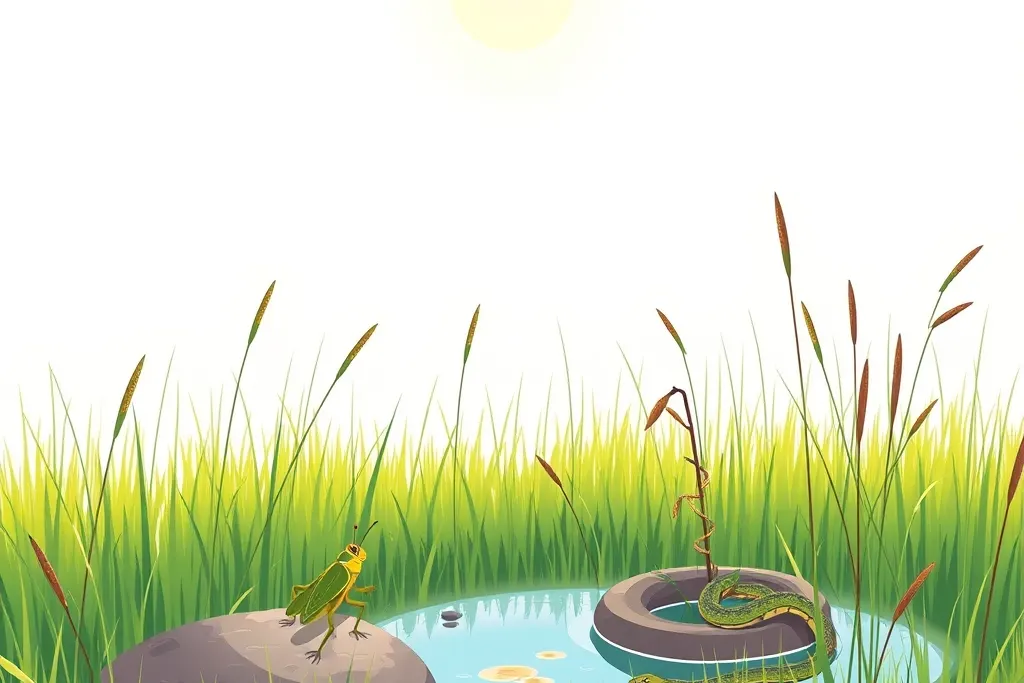
- GrassProducer
- Grasshopper
- Frog
- Snake
- Eagle
An ecosystem is the living things of an area and their non-living surroundings. A food chain begins with a producer (a green plant) and passes through consumers (herbivores, then…
5. Energy Flow and the Ten Per Cent Rule
In a food chain only about ten per cent of the energy at one trophic level passes to the next; the rest is used in life processes or lost as heat. If green plants (producers) fix 10,000 J of energy, the herbivores that eat them receive about 1,000 J, the carnivores that eat the herbivores about 100 J, and the top carnivores about 10 J. This is why food chains are short, usually four or five links, and why there are far fewer lions than deer. It also explains why a vegetarian diet uses the sun's energy more directly than a meat diet.
| Level | Example | Energy available |
|---|---|---|
| Producer | Grass | 10,000 J |
| Primary consumer | Deer | 1,000 J |
| Secondary consumer | Snake | 100 J |
| Tertiary consumer | Eagle | 10 J |
In a food chain only about ten per cent of the energy at one trophic level passes to the next; the rest is used in life processes or lost as heat. If green plants (producers) fix 10,000 J…
How to Answer a Life-Science Teaching Question
Life-science teaching questions combine a fact with a method. A good answer first states the correct idea, such as that photosynthesis needs chlorophyll, light, carbon dioxide and water, and then names a classroom activity that lets children see it, such as testing a destarched leaf kept in the dark and one kept in light with iodine solution. For misconceptions, the same pattern holds: the idea that plants take food from the soil is corrected by growing a seedling in water with only minerals, rather than by telling children the right answer. For cells, use onion peel and cheek-cell slides under a microscope, because seeing the cell wall in one and its absence in the other makes the difference memorable. Ecology topics are best taught through a local pond, field or school garden, so that children connect food chains to organisms they have actually seen.
Life-science teaching questions combine a fact with a method. A good answer first states the correct idea, such as that photosynthesis needs chlorophyll, light, carbon dioxide and water…
Plants and Animals Compared
Comparison questions are common. Plants make their own food by photosynthesis, so they are producers, while animals depend on plants or on other animals. Plants are generally fixed in place and grow throughout life, while most animals move and reach a fixed adult size. Both respire all the time, both reproduce, and both are built of cells. Seeds are dispersed by wind, water, animals and explosion of the fruit, and the common feature in each case is that the seed lands away from the parent plant, which reduces competition for light and water. Teachers can sort objects in the school garden into living and non-living, and then into plants and animals, so that children discover these properties themselves.
Comparison questions are common. Plants make their own food by photosynthesis, so they are producers, while animals depend on plants or on other animals. Plants are generally fixed in place…
Key takeaways
- Photosynthesis is 6CO₂ + 6H₂O → C₆H₁₂O₆ + 6O₂ in chlorophyll and sunlight; the iodine test shows starch; parasites, saprotrophs and insectivorous plants are heterotrophic modes.
- Asexual reproduction is by one parent (cutting, budding, spores); sexual reproduction needs gametes; pollination precedes fertilisation, and the ovule becomes the seed and the ovary the fruit.
- Plant cells have a cell wall, a large vacuole and chloroplasts; animal cells have none of these.
- Penicillin (Fleming, 1928) kills bacteria and not viruses; malaria is spread by Anopheles and dengue by Aedes.
- A food chain runs producer, consumers, decomposers; conservation uses sanctuaries and reserves; the three Rs are reduce, reuse and recycle.
Practice questions (24)
Attempt each one before opening the answer. Every explanation names the tempting wrong option as well as the right one, because that is where marks are lost.
The green pigment that traps sunlight for photosynthesis is:
Show answer
Answer: A — Chlorophyll
Chlorophyll, in the chloroplasts, absorbs light energy. Haemoglobin is in blood and melanin gives skin its colour.The substance that turns blue-black when iodine is added to a leaf that has photosynthesised is:
Show answer
Answer: A — Starch
The iodine test detects starch, the stored product of photosynthesis. Proteins and fats give other colours.Cuscuta (amarbel), which takes food from the host plant it grows on, is a:
Show answer
Answer: A — Parasite
A parasite feeds on a living host. A saprotroph feeds on dead matter and an autotroph makes its own food.
Show the other 21 questions
The part of a flower that becomes the fruit after fertilisation is the:
Show answer
Answer: A — Ovary
The ovary becomes the fruit and the ovules inside it become the seeds.A structure found in plant cells but not in animal cells is:
Show answer
Answer: A — Cell wall
The cellulose cell wall, with chloroplasts and a large vacuole, marks plant cells. Nucleus, membrane and cytoplasm are in both.Antibiotics such as penicillin are effective against:
Show answer
Answer: A — Bacteria, not viruses
Antibiotics attack bacterial structures that viruses lack, so they do not cure colds or influenza. Penicillin was found by Fleming in 1928.Malaria is spread by:
Show answer
Answer: A — The female Anopheles mosquito
The female Anopheles carries the Plasmodium parasite. Aedes spreads dengue, and contaminated water spreads cholera and typhoid.Which statement about respiration in plants is correct?
Show answer
Answer: A — Plants respire day and night in all living cells
Respiration goes on constantly in every living cell; by day photosynthesis outpaces it, which hides it. Saying plants respire only at night is the common misconception.The gas released during photosynthesis is:
Show answer
Answer: B — Oxygen
Plants release oxygen and take in carbon dioxide. Carbon dioxide is the tempting answer, which is the raw material, not the product.The control centre of a cell is the:
Show answer
Answer: C — Nucleus
The nucleus holds the genetic material. Cytoplasm is tempting as it fills the cell, but it is the jelly where reactions occur.Fusion of a male and a female gamete is called:
Show answer
Answer: D — Fertilisation
Fertilisation produces the zygote. Pollination is the tempting earlier step, the transfer of pollen.Which of the following is an insectivorous plant?
Show answer
Answer: A — Pitcher plant
The pitcher plant traps insects for nitrogen. Banyan is tempting as an unusual plant, but it makes its own food normally.Which of these is a producer in a pond ecosystem?
Show answer
Answer: B — Algae
Algae photosynthesise. Fish is tempting as a visible pond organism but it is a consumer.Yeast reproduces mainly by:
Show answer
Answer: C — Budding
Yeast forms a bud that detaches. Binary fission is the tempting choice, which is characteristic of bacteria and amoeba.Rhizobium bacteria in the root nodules of pulses help by:
Show answer
Answer: D — Fixing atmospheric nitrogen
They convert nitrogen into usable compounds. Absorbing water is the tempting job of root hairs.Fungi such as mushrooms obtain food by:
Show answer
Answer: A — Absorbing nutrients from dead organic matter
Fungi are saprotrophs. Photosynthesis is the tempting plant-like method, but they lack chlorophyll.In a frog, the tadpole breathes mainly through:
Show answer
Answer: B — Gills
A tadpole is aquatic and uses gills; lungs appear in the adult. Lungs are the tempting adult feature.Which of the following is a greenhouse gas?
Show answer
Answer: C — Carbon dioxide
CO₂ traps heat. Oxygen is tempting as a major air gas, but it does not trap heat significantly.Stomata in leaves are opened and closed by:
Show answer
Answer: D — Guard cells
Pairs of guard cells control the pore. Xylem is tempting because it carries water, but it does not control the pore.If producers in a food chain fix 5000 J of energy, by the ten per cent rule the tertiary consumer receives about:
Show answer
Answer: A — 5 J
Primary gets 500, secondary 50, tertiary 5. The 50 J is the tempting answer, which is the secondary level.Lichens are an association of an alga and a fungus in which both benefit. This relationship is:
Show answer
Answer: B — Symbiosis
Mutual benefit is symbiosis: the alga makes food and the fungus gives shelter. Parasitism is the tempting answer, but there the host is harmed.Which feature suits a wind-pollinated flower?
Show answer
Answer: C — Light, abundant pollen and feathery stigma
Wind carriers need light pollen and a feathery stigma. Bright petals and nectar are the tempting insect-pollination features.Which of the following is an example of ex-situ conservation?
Show answer
Answer: D — Zoo
Zoos conserve outside the natural habitat. A sanctuary is the tempting answer but protects species in their habitat.Which tissue carries water and minerals from the roots to the leaves?
Show answer
Answer: A — Xylem
Xylem conducts water upward. Phloem is the tempting choice since it is the other transport tissue, but it carries prepared food.