Science Content, Classes VI–VIII, Part II: Matter, Motion, Light and Sound
2. Motion, Force and Pressure
Speed is distance divided by time, in m/s or km/h, and 1 m/s = 3.6 km/h: 54 km/h is 15 m/s and 72 km/h is 20 m/s. Average speed is the total distance over the total time: 60 km in 1 hour and 60 km in 3 hours gives 120/4 = 30 km/h, not the mean of 60 and 20. A distance–time graph is a straight line for uniform motion, with a steeper line meaning greater speed and a horizontal line meaning rest. Force is a push or pull that can change speed, direction or shape; friction opposes motion between surfaces and is useful (walking) and wasteful (wear), reduced by lubrication and wheels. Pressure is force divided by area: a 600 N weight on 0.5 m² gives 1,200 Pa but on 0.01 m² gives 60,000 Pa, which is why a sharp knife cuts and a wide tractor tyre does not sink.
Speed is distance divided by time, in m/s or km/h, and 1 m/s = 3.6 km/h: 54 km/h is 15 m/s and 72 km/h is 20 m/s. Average speed is the total distance over the total time: 60 km in 1 hour…
3. Light
Light travels in straight lines, which is why shadows form. The laws of reflection are that the angle of incidence equals the angle of reflection (i = r), and that the incident ray, the reflected ray and the normal lie in one plane. A plane mirror forms an image that is virtual (cannot be caught on a screen), erect, the same size as the object, laterally inverted and as far behind the mirror as the object is in front: an object 2 m from the mirror is 4 m from its own image. White light disperses in a prism into VIBGYOR (violet, indigo, blue, green, yellow, orange, red), with red bent least and violet most, and a rainbow is dispersion by raindrops. Light also refracts, bending when it passes between media such as air and water, which is why a pencil in a glass of water seems bent.
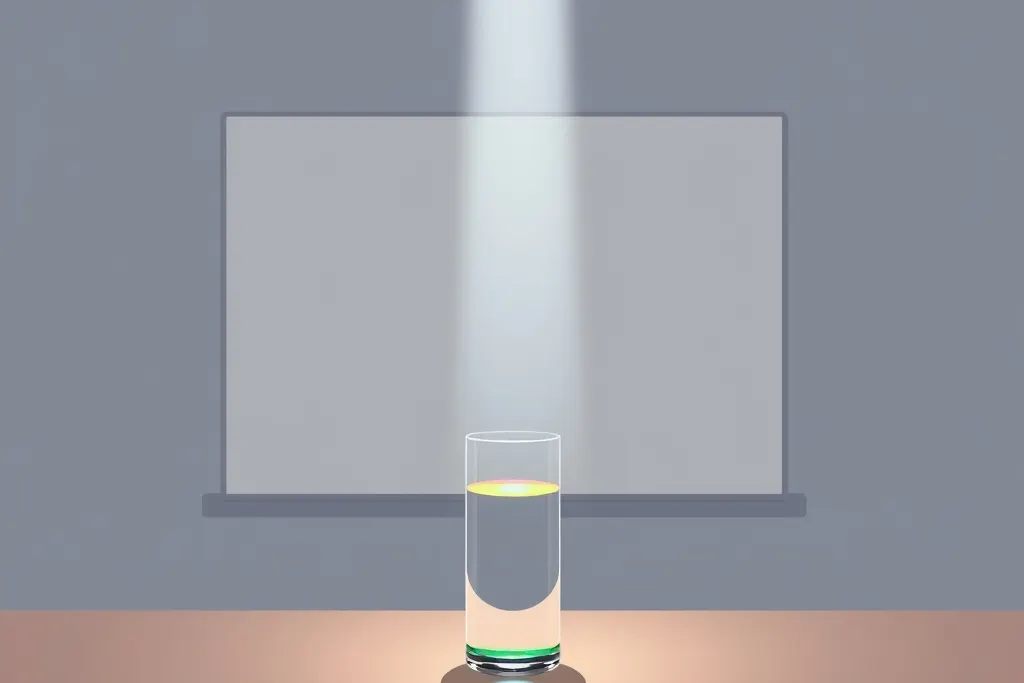
Light travels in straight lines, which is why shadows form. The laws of reflection are that the angle of incidence equals the angle of reflection (i = r), and that the incident ray, the…
4. Sound
Sound is produced by vibration and needs a medium, travelling in solids, liquids and gases but not in a vacuum, and fastest in solids and slowest in gases. In air it travels at about 340 m/s: thunder heard 3 seconds after the lightning means the flash was about 1,020 m away. Frequency is the number of vibrations per second, in hertz (Hz), with period = 1/frequency, so a 50 Hz sound has a period of 0.02 s. Pitch depends on frequency (a high pitch is a high frequency), loudness on amplitude, in decibels. The human ear hears 20 Hz to 20,000 Hz; below is infrasound and above ultrasound, used in medical imaging and by bats. An echo is reflected sound, and because the ear holds a sound for about 0.1 second, a clear echo needs a reflector at least 17 m away (340 × 0.1/2).
Sound is produced by vibration and needs a medium, travelling in solids, liquids and gases but not in a vacuum, and fastest in solids and slowest in gases. In air it travels at about 340…
5. Worked Problems: Density, Speed, Pressure and Echo
Four short calculations cover most numerical questions in this area. Density is mass over volume, so 540 g of metal that occupies 200 cm³ has a density of 2.7 g/cm³. To convert speed from km/h to m/s multiply by 5/18, so 90 km/h is 25 m/s. Pressure is force over area, so a force of 500 N spread over 0.25 m² gives 2,000 Pa, and the same force on a smaller area gives more pressure, which is why a knife is sharpened. For an echo, the sound travels to the obstacle and back, so the distance is half of speed × time: with the speed of sound as 340 m/s, an echo heard after 0.1 s means an obstacle 17 m away, which is the minimum distance for a distinct echo.
| Quantity | Formula | Value |
|---|---|---|
| Density of 540 g in 200 cm³ | mass / volume | 2.7 g/cm³ |
| 90 km/h in m/s | × 5/18 | 25 m/s |
| 500 N on 0.25 m² | force / area | 2,000 Pa |
| Echo after 0.1 s | 340 × 0.1 / 2 | 17 m |
Four short calculations cover most numerical questions in this area. Density is mass over volume, so 540 g of metal that occupies 200 cm³ has a density of 2.7 g/cm³. To convert speed from…
Key takeaways
- Solids have fixed shape and volume, liquids fixed volume only, gases neither; density = mass/volume, and objects of density below 1 g/cm³ float in water.
- Choose the separation method by the property: filtration, evaporation, distillation, chromatography, sublimation, magnetism.
- Acids turn blue litmus red, bases turn red litmus blue; neutralisation gives salt and water; physical change is usually reversible and chemical change is not.
- Speed = distance/time (54 km/h = 15 m/s); average speed is total distance over total time; pressure = force/area.
- Reflection has i = r; a plane mirror image is virtual, erect, same size and laterally inverted; sound needs a medium and a clear echo needs 17 m.
Practice questions (24)
Attempt each one before opening the answer. Every explanation names the tempting wrong option as well as the right one, because that is where marks are lost.
A speed of 54 km/h is equal to:
Show answer
Answer: A — 15 m/s
To convert km/h to m/s multiply by 5/18: 54 × 5/18 = 15 m/s. Dividing by 10 or leaving it unchanged are the common slips.A car travels 60 km in 1 hour and then 60 km in 3 hours. Its average speed is:
Show answer
Answer: A — 30 km/h
Average speed is total distance over total time: 120 km/4 h = 30 km/h. The mean of the two speeds, (60 + 20)/2 = 40, is the usual error.A weight of 600 N rests on an area of 0.01 m². The pressure is:
Show answer
Answer: A — 60,000 Pa
Pressure = force/area = 600/0.01 = 60,000 Pa. The same force on a larger area gives a lower pressure.
Show the other 21 questions
The method that separates sand from water is:
Show answer
Answer: A — Filtration
Sand is an insoluble solid, so filtration holds it back while water passes. Distillation separates liquids.Which of the following is a chemical change?
Show answer
Answer: A — Rusting of iron
Rusting forms a new substance, iron oxide, and cannot be reversed by cooling. The others are physical changes.The image formed by a plane mirror is:
Show answer
Answer: A — Virtual, erect and of the same size
A plane mirror gives a virtual, upright image the same size as the object, laterally inverted, at the same distance behind the mirror.A person stands 2 m in front of a plane mirror. The distance between the person and the image is:
Show answer
Answer: A — 4 m
The image is 2 m behind the mirror, so it is 2 + 2 = 4 m from the person.Thunder is heard 3 seconds after the lightning is seen. Taking the speed of sound as 340 m/s, the lightning was about:
Show answer
Answer: A — 1,020 m
The light arrives almost instantly, so the delay is the sound’s travel time: 340 × 3 = 1,020 m. Dividing by 3 would give 113 m.The SI unit of force is:
Show answer
Answer: A — Newton
Force is measured in newtons. Joule is the tempting unit of work and energy.Sound travels fastest in:
Show answer
Answer: B — Solids
Particles are closest in solids, so sound moves fastest. Vacuum is the tempting fast medium for light, but sound cannot travel there at all.Which of the following is a physical change?
Show answer
Answer: C — Melting of ice
Melting changes state only; no new substance forms. Burning paper is the tempting one because it also looks like a "change of form", but it makes ash and gases.Which mirror is used as a rear-view mirror in vehicles?
Show answer
Answer: D — Convex mirror
A convex mirror gives a wider field of view. Concave is the tempting choice as it magnifies, but it inverts distant images.The separation of iron filings from sand is best done by:
Show answer
Answer: A — Using a magnet
Iron is magnetic and sand is not. Filtration is tempting as a standard separation method, but both solids would stay on the filter.A car covers 150 km in 2.5 hours. Its average speed is:
Show answer
Answer: B — 60 km/h
Speed = 150 ÷ 2.5 = 60 km/h. The 375 is the tempting product of distance and time.A piece of metal has mass 540 g and volume 200 cm³. Its density is:
Show answer
Answer: C — 2.7 g/cm³
Density = 540 ÷ 200 = 2.7 g/cm³. The value 0.37 is the tempting inverted ratio.A force of 500 N acts on an area of 0.5 m². The pressure is:
Show answer
Answer: D — 1000 Pa
Pressure = force ÷ area = 500 ÷ 0.5 = 1000 Pa. The 250 is the tempting error of multiplying by the area.An echo is heard 2 seconds after a shout. If the speed of sound is 340 m/s, the distance to the reflecting wall is:
Show answer
Answer: A — 340 m
The sound travels to the wall and back, so the distance is 340 × 2 ÷ 2 = 340 m. The value 680 m is the tempting error of forgetting the round trip.A pendulum makes 50 oscillations in 10 seconds. Its frequency is:
Show answer
Answer: B — 5 Hz
Frequency = 50 ÷ 10 = 5 Hz; the time period is 0.2 s, which is the tempting wrong answer.The splitting of white light into seven colours by a prism is called:
Show answer
Answer: C — Dispersion
The splitting is dispersion. Scattering is tempting since it is why the sky is blue, but it scatters light in all directions without splitting it into a spectrum.A body starts from rest and reaches 20 m/s in 5 s. Its acceleration is:
Show answer
Answer: D — 4 m/s²
a = (20 − 0) ÷ 5 = 4 m/s². The 100 is the tempting product.A speed of 72 km/h in m/s is:
Show answer
Answer: A — 20 m/s
72 × 1000 ÷ 3600 = 20. The value 259.2 is the tempting error of multiplying by 3.6 instead of dividing.A force of 50 N moves an object 6 m in its own direction. The work done is:
Show answer
Answer: B — 300 J
Work = force × displacement = 300 J. The 8.3 is the tempting error of dividing the force by the distance.A sound of frequency 170 Hz travels at 340 m/s. Its wavelength is:
Show answer
Answer: C — 2 m
λ = v ÷ f = 340 ÷ 170 = 2 m. The 0.5 m is the tempting inverted ratio.Which statement about a plane mirror image is NOT correct?
Show answer
Answer: D — The image is real and can be caught on a screen
The image is virtual and cannot be caught on a screen. The other three statements are correct, so they are tempting only if the NOT is missed.