Indian Defence Technology in Reference: Missiles, Aircraft, Ships and Submarines
Reading Range and Speed: A Short Worked Section
Ballistic missiles are sorted by range: short range below about 1,000 km, medium range from 1,000 to 3,000 km, intermediate range from 3,000 to 5,500 km, and intercontinental above 5,500 km. Speeds are quoted in Mach, the ratio of the missile's speed to the speed of sound, which is about 340 m/s in air at sea level. A missile at Mach 2.8, such as BrahMos, thus moves at about 2.8 × 340 = 952 m/s, which is roughly 3,430 km/h.
Worked example. At that speed a cruise missile covers 290 km, the original BrahMos range, in about 290,000 ÷ 952 ≈ 305 seconds, a little over five minutes. The example matters because the exam likes this kind of estimate: convert to metres per second, divide, and compare with the options. Note that the speed of sound falls with altitude, so the same Mach number means a slower speed in metres per second high up.
| System | Kind | Note |
|---|---|---|
| BrahMos | Supersonic cruise missile | Indo-Russian; named for the Brahmaputra and the Moskva; air, sea, land and submarine versions |
| Astra | Beyond-visual-range air-to-air missile | Indigenous, fired from fighter aircraft |
| Pinaka | Multi-barrel rocket launcher | Artillery rocket system of DRDO |
| Dhanush | Naval ballistic missile, a Prithvi variant | Launched from ships |
| K-15 (Sagarika) and K-4 | Submarine-launched ballistic missiles | Sea leg of the nuclear deterrent |
Ballistic missiles are sorted by range: short range below about 1,000 km, medium range from 1,000 to 3,000 km, intermediate range from 3,000 to 5,500 km, and intercontinental above 5,500…
Aircraft and Helicopters
Hindustan Aeronautics Limited (HAL), Bengaluru, builds most of India's military aircraft. Its HF-24 Marut, designed with the German engineer Kurt Tank, was the first jet fighter designed and built in India and flew in 1961. The Tejas Light Combat Aircraft, designed by the Aeronautical Development Agency and built by HAL, is a single-engine, tailless, compound-delta-wing fighter that first flew in 2001. The Dhruv is an indigenous Advanced Light Helicopter, and the Prachand is a Light Combat Helicopter inducted in 2022.
The air force also flies imported aircraft: the Sukhoi Su-30MKI, a Russian design built under licence by HAL, and the French Rafale bought in the late 2010s. Distinguish a design by India (Marut, Tejas, Dhruv), an import (Rafale), and a licence production (Su-30MKI), which is how questions are built.
Hindustan Aeronautics Limited (HAL), Bengaluru, builds most of India's military aircraft. Its HF-24 Marut, designed with the German engineer Kurt Tank, was the first jet fighter designed…
Ships, Submarines and Land Systems
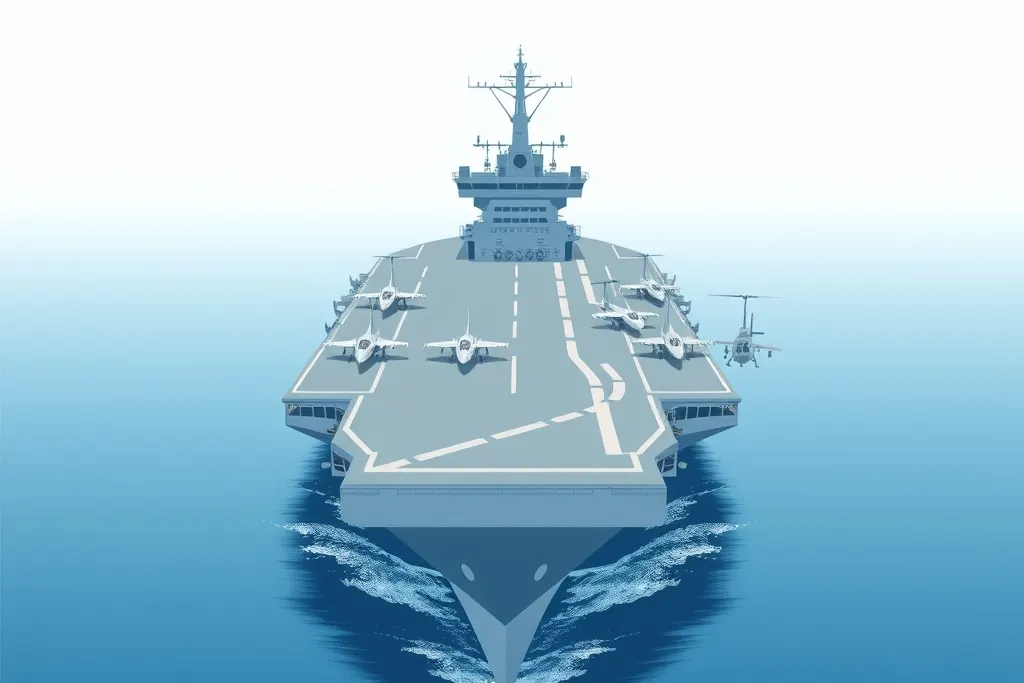
Naval and army platforms
The Nuclear Deterrent in Brief: Tests, Doctrine and the Triad
India's first nuclear test, code-named Smiling Buddha, was carried out at Pokhran in Rajasthan on 18 May 1974, and a series of tests there on 11 and 13 May 1998, known as Operation Shakti, established a weapons capability. India is not a party to the Non-Proliferation Treaty. Its declared doctrine, set out in 2003, rests on credible minimum deterrence and no first use, with a Nuclear Command Authority under the civil leadership deciding any use.
A triad means the ability to deliver weapons from land, air and sea. In India's case the land leg is the Agni and Prithvi missiles, the air leg is fighter aircraft assigned the role, and the sea leg is the ballistic-missile submarine INS Arihant with its K-series missiles. The sea leg matters most for a no-first-use state, because a submarine at sea can survive a first strike and so keeps the promise of a second one credible.
- Land legAgni and Prithvi missiles
- Air legFighter aircraft assigned the role
- Sea legINS Arihant with K-series missiles
India's first nuclear test, code-named Smiling Buddha, was carried out at Pokhran in Rajasthan on 18 May 1974, and a series of tests there on 11 and 13 May 1998, known as Operation Shakti…
Who Builds, Who Commands: the Defence Ecosystem
Three kinds of bodies stand behind the equipment. DRDO designs; public-sector undertakings such as HAL, BEL (electronics) and BDL (missiles) build; and the armed forces use. The old Ordnance Factory Board, which ran the army's factories for more than two centuries, was dissolved in 2021 and its units regrouped into seven defence companies, which is the kind of structural change a question may ask. The aim of the shift was to give production units commercial independence while keeping the armed forces as the main customer.
| Body | Fact |
|---|---|
| Chief of Defence Staff | Post created in December 2019; heads the Department of Military Affairs |
| Andaman and Nicobar Command | The first tri-service command, set up in 2001 |
| Strategic Forces Command | Set up in 2003 to manage the nuclear forces |
| President of India | Supreme Commander of the armed forces under the Constitution |
Three kinds of bodies stand behind the equipment. DRDO designs; public-sector undertakings such as HAL, BEL (electronics) and BDL (missiles) build; and the armed forces use. The old…
How to Read a Defence Question
Defence questions can be sorted by what they ask. If a question asks who designs, the answer is DRDO; who builds, the public-sector units such as HAL, BEL and BDL; who uses, the services. If it asks for the type of a missile, decide whether it is powered throughout, like a cruise missile, or only at the start, like a ballistic one. If it asks for a range class, compare the stated kilometres with the bands in this chapter. If it gives a speed in Mach, remember that Mach 1 is the speed of sound, about 340 m/s at sea level, so Mach 2.8 is about 2.8 times that.
Worked check: at 340 m/s per Mach, a missile flying at Mach 2.8 moves at about 952 m/s, which is about 3,427 km/h. Covering 290 km at that speed takes 290,000 / 952, about 305 seconds. Always convert km to m (or m/s to km/h) before dividing, because mixing the two is the commonest slip in speed questions of this kind.
Defence questions can be sorted by what they ask. If a question asks who designs, the answer is DRDO; who builds, the public-sector units such as HAL, BEL and BDL; who uses, the services.…
Reference Table: Missile Families, Roles and the Speed Arithmetic
Defence questions mostly ask for the role of a named system. Group missiles by the way they are launched and aimed: surface-to-surface, surface-to-air, anti-tank and cruise. The speed arithmetic is short: speed = Mach number × speed of sound, and distance = speed × time.
| System | Role |
|---|---|
| Prithvi | Surface-to-surface, short range |
| Agni series | Surface-to-surface ballistic, intermediate to long range |
| Akash | Surface-to-air |
| Nag | Anti-tank guided missile |
| BrahMos | Supersonic cruise missile, an India–Russia joint venture |
Defence questions mostly ask for the role of a named system. Group missiles by the way they are launched and aimed: surface-to-surface, surface-to-air, anti-tank and cruise. The speed…
Key takeaways
- DRDO was formed in 1958; the IGMDP (1983, led by Dr A. P. J. Abdul Kalam) built Prithvi, Agni, Akash, Trishul and Nag.
- Prithvi and Agni are ballistic; BrahMos is a supersonic cruise missile, Indo-Russian, named for the Brahmaputra and the Moskva.
- Range classes: short below about 1,000 km, medium 1,000 to 3,000, intermediate 3,000 to 5,500, intercontinental above 5,500; Mach is speed over the speed of sound (about 340 m/s).
- HAL designed the HF-24 Marut (first indigenous jet) and builds Tejas, Dhruv and Prachand; the Su-30MKI is licence-built and the Rafale is imported.
- INS Vikrant is the first indigenous carrier (Cochin, 2022); INS Arihant the first indigenous SSBN; Arjun is the DRDO main battle tank.
Practice questions (26)
Attempt each one before opening the answer. Every explanation names the tempting wrong option as well as the right one, because that is where marks are lost.
The Integrated Guided Missile Development Programme was launched in
Show answer
Answer: A — 1983
The IGMDP was approved in 1983 under Dr A. P. J. Abdul Kalam. DRDO itself was formed in 1958, while 1974 and 1998 are the years of the Pokhran tests.Which of the following was NOT one of the five IGMDP missiles?
Show answer
Answer: A — BrahMos
The five were Prithvi, Agni, Akash, Trishul and Nag. BrahMos is an Indo-Russian cruise missile developed separately.Nag is a
Show answer
Answer: A — third-generation anti-tank missile
Nag is a fire-and-forget anti-tank missile. Akash and Trishul are surface-to-air missiles.
Show the other 23 questions
BrahMos is best described as a
Show answer
Answer: A — supersonic cruise missile
BrahMos is a supersonic cruise missile developed jointly with Russia. Agni is the ballistic family and Astra is the air-to-air missile.BrahMos is named after the rivers
Show answer
Answer: A — Brahmaputra and Moskva
The name joins the Brahmaputra of India and the Moskva of Russia. The Volga and the Neva are Russian rivers but do not appear in the name.A missile flying at Mach 2.8 moves at about (take the speed of sound as 340 m/s)
Show answer
Answer: A — 950 m/s
Mach 2.8 means 2.8 times the speed of sound, so 2.8 × 340 = 952 m/s, about 950 m/s. 340 m/s is Mach 1, and 2,800 would be a slip that treats the Mach number as metres.The first jet fighter designed and built in India was
Show answer
Answer: A — HF-24 Marut
The HF-24 Marut first flew in 1961 and was designed with Kurt Tank. The Tejas came four decades later; the Su-30MKI is licence-built and the Rafale is imported.Which of the following is a Light Combat Helicopter inducted in 2022?
Show answer
Answer: A — Prachand
Prachand is the Light Combat Helicopter. Dhruv is the Advanced Light Helicopter, while Tejas and Marut are fixed-wing fighters.INS Vikrant, commissioned in 2022, was built at
Show answer
Answer: A — Cochin Shipyard
Vikrant, the first indigenous aircraft carrier, was built at Cochin Shipyard. Mazagon Dock built the Scorpene-class Kalvari.INS Arihant is India's first indigenous
Show answer
Answer: A — nuclear-powered ballistic-missile submarine
Arihant is an SSBN, a nuclear-powered submarine carrying ballistic missiles. Vikrant is the aircraft carrier and Kalvari a conventional submarine.India's declared nuclear doctrine rests on credible minimum deterrence and
Show answer
Answer: A — no first use
The 2003 doctrine pairs credible minimum deterrence with no first use. First strike is the opposite, and non-alignment is a foreign-policy stance rather than a nuclear doctrine.The first tri-service command of the Indian armed forces, set up in 2001, is the
Show answer
Answer: A — Andaman and Nicobar Command
The Andaman and Nicobar Command was the first integrated tri-service command (2001). The Strategic Forces Command followed in 2003 and manages the nuclear forces.Which of the following is correctly matched?
Show answer
Answer: A — Arjun - main battle tank
Arjun is the DRDO battle tank. Astra is an air-to-air missile, Pinaka a rocket launcher and Dhruv a helicopter.Consider:
(1) Prithvi is a ballistic missile;
(2) BrahMos is a ballistic missile;
(3) the Su-30MKI is built in India under licence.
Which are correct?Show answer
Answer: A — 1 and 3 only
BrahMos is a cruise missile, so statement 2 is false. Prithvi is ballistic and HAL builds the Su-30MKI under licence.Akash is best described as a:
Show answer
Answer: A — Surface-to-air missile
Akash is an Indian medium-range surface-to-air missile developed under the IGMDP. Nag is the anti-tank missile in the same programme.The Agni-V missile belongs to which category?
Show answer
Answer: A — Long-range surface-to-surface ballistic missile
Agni-V is a long-range ballistic missile launched from the surface, with a range above 5,000 km. BrahMos, not Agni, is the supersonic cruise missile.An aircraft flies at Mach 2. Taking the speed of sound as 340 m/s, the time it takes to cover 10.2 km is:
Show answer
Answer: A — 15 s
Speed = 2 × 340 = 680 m/s and time = 10,200 ÷ 680 = 15 s. Using 340 m/s instead of 680 gives the 30 s answer, which forgets to multiply by the Mach number.A missile flies at Mach 3 (speed of sound 340 m/s) for 300 seconds. The distance covered is:
Show answer
Answer: A — 306 km
Speed = 3 × 340 = 1,020 m/s, so distance = 1,020 × 300 = 3,06,000 m = 306 km. The other values are powers of ten away because of unit slips.The Defence Research and Development Organisation (DRDO) was formed in:
Show answer
Answer: A — 1958
DRDO was formed in 1958 by merging the Technical Development Establishments and the Directorate of Technical Development and Production with the Defence Science Organisation. 1983 is the year of the IGMDP and 1998 the Pokhran-II tests.Consider the following statements:
1. The Tejas light combat aircraft is designed in India and built by Hindustan Aeronautics Limited.
2. The Kalvari-class submarines of the Indian Navy are Scorpene-class boats built at Mazagon Dock under a licence arrangement.
Which of the statements is/are correct?Show answer
Answer: A — Both 1 and 2
Tejas was developed by the Aeronautical Development Agency and is produced by HAL. The Kalvari class was built at Mazagon Dock Shipbuilders in Mumbai with technology from the French designer of the Scorpene class. Both statements are correct.The Pinaka is best described as:
Show answer
Answer: C — A multi-barrel rocket launcher system
The Pinaka is a DRDO-developed multiple-launch rocket system. Aircraft and ship names are the tempting wrong categories.INS Vikramaditya, commissioned by the Indian Navy in 2013, is an aircraft carrier acquired from:
Show answer
Answer: C — Russia
INS Vikramaditya is the former Soviet carrier Admiral Gorshkov, refitted in Russia. The indigenous carrier is INS Vikrant (2022), the tempting confusion.An aircraft flies at Mach 2 (speed of sound 340 m/s). The distance it covers in 10 seconds is:
Show answer
Answer: C — 6.8 km
Speed = 2 × 340 = 680 m/s, so the distance is 680 × 10 = 6,800 m = 6.8 km. Using 340 m/s gives the tempting 3.4 km.The Agni-V missile is notable for being:
Show answer
Answer: A — An intercontinental-range ballistic missile of more than 5,000 km range
Agni-V is a long-range surface-to-surface ballistic missile with a range above 5,000 km. BrahMos is the supersonic cruise missile, the tempting confusion.Consider the following statements:
1. DRDO functions under the Ministry of Defence.
2. Hindustan Aeronautics Limited is a defence public-sector company that builds aircraft.
Which of the statements given above is/are correct?Show answer
Answer: A — Both 1 and 2
Both are correct: DRDO is the Defence Ministry's R&D body and HAL builds aircraft such as the Tejas. Placing DRDO under the Space Department is the tempting error.Assertion (A): Nuclear-powered submarines can stay submerged for very long periods.
Reason (R): A nuclear reactor needs no air for combustion.
Which one of the following is correct?Show answer
Answer: A — Both A and R are true, and R is the correct explanation of A
Without the need for air, the submarine does not have to surface to run its engines, so R explains A. Crew supplies still limit the patrol length, the tempting overstatement of unlimited endurance.