Chemistry Fundamentals: Atoms, the Periodic Table, Reactions, Acids and Bases, Metals and Carbon Compounds
The Periodic Table: Why Elements Repeat
Mendeleev (1869) arranged elements by atomic mass and left gaps for undiscovered ones, predicting their properties. The modern periodic law arranges them by atomic number: the properties repeat periodically. The table has 7 periods (horizontal rows) and 18 groups (vertical columns), with about 118 known elements. Elements in a group have the same number of outer electrons and so similar chemistry. Across a period from left to right the atomic size falls and non-metallic character rises, because the nuclear charge increases while the shell count stays the same; down a group the size rises and metallic character rises as more shells are added.
| Group | Name | Members and character |
|---|---|---|
| 1 | Alkali metals | Li, Na, K, Rb, Cs: soft, very reactive, stored under oil; one outer electron |
| 2 | Alkaline earth metals | Be, Mg, Ca, Sr, Ba: harder, less reactive than group 1; two outer electrons |
| 3 to 12 | Transition metals | Fe, Cu, Zn, Ag, Au and the rest: variable valency, coloured compounds, catalysts |
| 17 | Halogens | F, Cl, Br, I: seven outer electrons, reactive non-metals; fluorine the most; bromine is a liquid |
| 18 | Noble gases | He, Ne, Ar, Kr, Xe, Rn: full outer shell, almost inert; helium is used in balloons and neon in signs |
- Liquids at room temperature: only two elements, mercury (a metal) and bromine (a non-metal).
- Lightest and commonest: hydrogen is the lightest element and the most abundant in the universe; oxygen is the most abundant element in the earth's crust by mass, followed by silicon; nitrogen forms about 78% of air.
- Blocks: groups 1 and 2 form the s-block, 13 to 18 the p-block, 3 to 12 the d-block, and the two rows set apart at the foot, lanthanoids and actinoids, the f-block.
Mendeleev (1869) arranged elements by atomic mass and left gaps for undiscovered ones, predicting their properties. The modern periodic law arranges them by atomic number: the properties…
Chemical Bonds and Reactions: Transfer, Sharing and Conservation
Atoms bond to reach a full outer shell. In an ionic bond a metal gives electrons to a non-metal and the oppositely charged ions attract, as in Na⁺Cl⁻. In a covalent bond non-metals share electrons, as in H₂O, CH₄ and CO₂. The two kinds of compound behave differently, and the contrast is a standard question.
| Property | Ionic (e.g. NaCl) | Covalent (e.g. methane, sugar) |
|---|---|---|
| Bonding | Transfer of electrons | Sharing of electrons |
| Melting and boiling points | High | Generally low |
| Conduction | Conduct when molten or dissolved, not as solids | Generally do not conduct |
| Solubility | Usually soluble in water | Usually soluble in organic solvents |
| Type | What happens | Example |
|---|---|---|
| Combination | Two or more substances give one product | CaO + H₂O → Ca(OH)₂ (slaking of lime) |
| Decomposition | One substance splits into simpler ones | CaCO₃ → CaO + CO₂ (heat) |
| Displacement | A more reactive element displaces a less reactive one | Fe + CuSO₄ → FeSO₄ + Cu |
| Double displacement | Two compounds exchange ions, often giving a precipitate | NaCl + AgNO₃ → AgCl↓ + NaNO₃ |
| Redox | Oxidation is loss of electrons (or gain of oxygen), reduction is gain of electrons; they occur together | CuO + H₂ → Cu + H₂O |
Conservation of mass. In any chemical change the total mass of the reactants equals that of the products; 4 g of hydrogen burns with 32 g of oxygen to give 36 g of water, in the balanced equation 2H₂ + O₂ → 2H₂O. A reaction is exothermic if it gives out heat (burning, respiration, neutralisation) and endothermic if it takes it in (photosynthesis, dissolving ammonium chloride). Heating limestone, CaCO₃, gives quicklime CaO and carbon dioxide, so 100 g of limestone gives 56 g of quicklime.
Atoms bond to reach a full outer shell. In an ionic bond a metal gives electrons to a non-metal and the oppositely charged ions attract, as in Na⁺Cl⁻. In a covalent bond non-metals share…
Acids, Bases, Salts and the pH Scale
An acid gives hydrogen ions (H⁺) in water and tastes sour; a base gives hydroxide ions (OH⁻), feels soapy, and a base that dissolves in water is an alkali. Acids turn blue litmus red and bases turn red litmus blue; phenolphthalein is colourless in acid and pink in base, and methyl orange is red in acid and yellow in base. Turmeric turns red with a base, which is why a turmeric stain on cloth turns red when soap is applied. Acid and base react to give a salt and water, the reaction called neutralisation: HCl + NaOH → NaCl + H₂O, and 25 mL of 0.1 M HCl needs 25 mL of 0.1 M NaOH.
The pH scale runs from 0 to 14 and is pH = −log₁₀[H⁺]. Neutral water is 7, acids are below 7 and bases above. Each unit is a factor of ten in hydrogen-ion concentration, so a solution of pH 3 has a hundred times the hydrogen ions of one of pH 5. Rain is naturally slightly acidic, about pH 5.6, because of dissolved carbon dioxide; acid rain has a pH below that, from the oxides of sulphur and nitrogen.
| Substance | Chemical | Note |
|---|---|---|
| Vinegar | Ethanoic (acetic) acid | About 5 to 8% in vinegar |
| Lemon, tamarind | Citric acid; tartaric acid | Sour fruits |
| Gastric juice | Hydrochloric acid | pH about 1.5 to 3.5; antacids (milk of magnesia, Mg(OH)₂) neutralise excess |
| Baking soda | Sodium hydrogencarbonate, NaHCO₃ | Mild base; gives CO₂ on heating, so cakes rise; in antacids and fire extinguishers |
| Washing soda | Sodium carbonate decahydrate, Na₂CO₃·10H₂O | Removes permanent hardness of water; used in glass and soap |
| Bleaching powder | Calcium oxychloride, CaOCl₂ | Disinfects drinking water; bleaches textiles |
| Plaster of Paris | Calcium sulphate hemihydrate, CaSO₄·½H₂O | Sets to gypsum, CaSO₄·2H₂O, on adding water; used for casts and statues |
- pH below 7Acids
- pH 7Neutral water
- pH above 7Bases
An acid gives hydrogen ions (H⁺) in water and tastes sour; a base gives hydroxide ions (OH⁻), feels soapy, and a base that dissolves in water is an alkali. Acids turn blue litmus red and…
Metals, Alloys and Corrosion
Metals are lustrous, malleable, ductile and good conductors of heat and electricity, with high melting points; non-metals are brittle, dull and poor conductors when solid. The exceptions are the usual questions: mercury is a liquid metal, sodium and potassium are soft enough to cut with a knife, graphite, a non-metal, conducts electricity, diamond is the hardest natural substance, and iodine is a lustrous non-metal. Gold and platinum are the least reactive of common metals and so occur free in nature.
| Level | Metals | Consequence |
|---|---|---|
| Very reactive | K, Na, Ca, Mg | Extracted by electrolysis of the molten compound; react with cold water (K, Na, Ca) |
| Moderately reactive | Al, Zn, Fe, Pb | Aluminium is also by electrolysis; zinc, iron and lead are by reduction with carbon; react with steam or acids |
| Hydrogen | (H) | The marker: metals above it displace hydrogen from dilute acids |
| Low reactivity | Cu, Hg, Ag, Au, Pt | Do not displace hydrogen; Hg is obtained from its ore by heating alone; Au and Pt occur free |
| Material | Made of | Use or point |
|---|---|---|
| Brass | Copper and zinc | Utensils, instruments |
| Bronze | Copper and tin | Statues, medals, bells |
| Steel | Iron with a little carbon | Harder and stronger than pure iron |
| Stainless steel | Iron, chromium and nickel | Does not rust |
| Solder | Lead and tin | Low melting point, for joining wires |
| Bauxite | Ore of aluminium, Al₂O₃ | Refined and electrolysed in the Hall-Héroult process |
| Haematite | Ore of iron, Fe₂O₃ | Reduced by carbon in the blast furnace |
| Cinnabar and galena | Ores of mercury (HgS) and lead (PbS) | Roasted in air, then reduced |
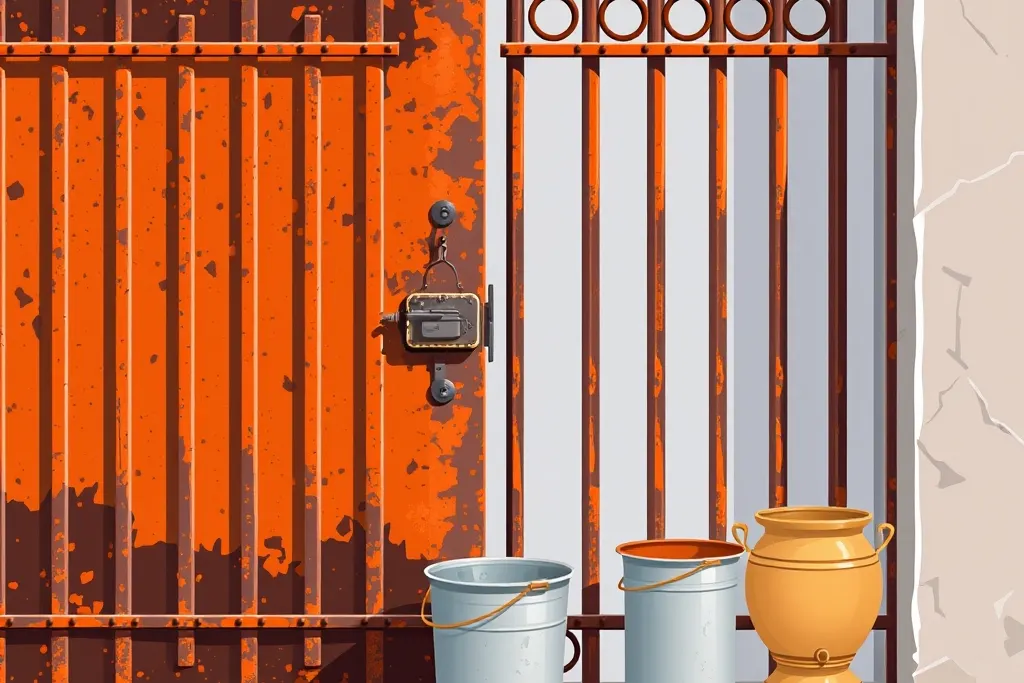
Corrosion is the slow eating away of a metal by air and moisture. Rusting of iron needs both oxygen and water, and forms hydrated iron(III) oxide, Fe₂O₃·xH₂O. It is prevented by painting, oiling, galvanisation (a coating of zinc, which protects even when scratched because zinc is more reactive and corrodes in preference), tin-plating and alloying. Silver tarnishes black from sulphur compounds in the air and copper turns green from a coating of basic copper carbonate.
- Painting, oiling
- GalvanisationZinc corrodes in preference
- Tin-plating
- Alloying
Metals are lustrous, malleable, ductile and good conductors of heat and electricity, with high melting points; non-metals are brittle, dull and poor conductors when solid. The exceptions…
Carbon Compounds and Everyday Materials
Carbon forms a vast number of compounds because it is tetravalent (four bonds) and shows catenation, the power to join to itself in long chains and rings. Its allotropes are different forms of the pure element: diamond (each atom bonded to four others, hardest, an insulator), graphite (layers, soft, conducts, used in pencils and electrodes), the fullerenes such as C₆₀, and graphene, a single layer of graphite. Hydrocarbons are compounds of carbon and hydrogen: the alkanes are saturated with the formula CₙH₂ₙ₊₂ (methane CH₄, ethane C₂H₆, butane C₄H₁₀), the alkenes have a double bond, CₙH₂ₙ, and the alkynes a triple bond, CₙH₂ₙ₋₂.
| Material | What it is |
|---|---|
| LPG | Mainly propane and butane under pressure; an odorant (ethyl mercaptan) is added so that leaks are smelt |
| CNG and natural gas | Mainly methane |
| Ethanol | Alcohol made by fermenting sugar; used in beverages and as a fuel blend; the industrial form is made unfit to drink (denatured) |
| Soap | Sodium or potassium salt of a fatty acid, made by saponification of fat with alkali; cleans by forming micelles that trap oil. In hard water it forms a scum with calcium and magnesium ions |
| Detergent | Synthetic cleaner, usually a sodium salt of a sulphonic acid, that works in hard water |
| Polythene, PVC, nylon | Polymers: very long molecules built from repeating small units; polythene and PVC are addition polymers, nylon a condensation polymer |
| Bakelite | A thermosetting plastic, which cannot be softened again by heating; used in switches and handles. Thermoplastics such as polythene soften on heating |
| Urea | A nitrogen fertiliser, CO(NH₂)₂, with about 46.7% nitrogen by mass (28 of its 60) |
| Glass and cement | Glass is made by fusing silica (sand) with soda ash and limestone; cement is made from limestone and clay, with gypsum added to slow its setting |
- Hardness of water: temporary hardness is from dissolved calcium and magnesium hydrogencarbonates and is removed by boiling; permanent hardness is from their sulphates and chlorides and is removed by washing soda or ion exchange.
- Fuels: the calorific value is the heat given by burning 1 kg of fuel; hydrogen has the highest of the common fuels. Incomplete burning gives carbon monoxide, a poison, and a sooty flame signals an unsaturated or carbon-rich fuel.
Carbon forms a vast number of compounds because it is tetravalent (four bonds) and shows catenation, the power to join to itself in long chains and rings. Its allotropes are different forms…
Numerical Routes: Moles, pH, Stoichiometry, Configurations and Bond Counts
Four calculations cover most chemistry numericals. Moles = mass ÷ molar mass. pH = −log[H⁺] and pH + pOH = 14. From a balanced equation, the mole ratio converts the mass of one substance into that of another. A valence-electron count gives the group, and for hydrocarbons CₙH₂ₙ₊₂ is an alkane while CₙH₂ₙ is an alkene.
| Question | Working | Answer |
|---|---|---|
| Moles in 88 g CO₂ (M = 44) | 88/44 | 2 mol |
| [OH⁻] = 10⁻³ M, find pH | pOH = 3, pH = 14 − 3 | 11 |
| Water formed from 4 g H₂ | 2H₂ + O₂ → 2H₂O; 2 mol H₂ → 2 mol H₂O | 36 g |
| Z = 17, configuration | 2, 8, 7 | Group 17, halogen |
| Bonds in ethene (C₂H₄) | 4 C–H + 2 in C=C | 6 covalent bonds |
Four calculations cover most chemistry numericals. Moles = mass ÷ molar mass. pH = −log[H⁺] and pH + pOH = 14. From a balanced equation, the mole ratio converts the mass of one substance…
Key takeaways
- Atomic number fixes the element and mass number defines isotopes; one mole holds 6.022 × 10²³ particles and has a mass in grams equal to the molecular mass, so 36 g of water is 2 mol.
- The modern periodic law is by atomic number: 7 periods and 18 groups; size falls across a period and rises down a group; only mercury and bromine are liquid at room temperature.
- Ionic compounds melt high and conduct when molten; covalent compounds melt low and mostly do not conduct; mass is conserved in every reaction, and combination, decomposition, displacement, double displacement and redox are the types.
- pH = −log₁₀[H⁺], neutral 7, each unit is tenfold; baking soda is NaHCO₃, washing soda Na₂CO₃·10H₂O, bleaching powder CaOCl₂, plaster of Paris CaSO₄·½H₂O; acid rain is below pH 5.6.
- Rusting needs oxygen and water and is prevented by galvanisation, painting and alloying; brass is copper and zinc, bronze copper and tin, steel iron and carbon.
- Carbon is tetravalent and catenates; alkanes are CₙH₂ₙ₊₂; LPG is propane and butane, CNG methane; soap is a fatty-acid salt that scums in hard water, a thermosetting plastic cannot be remoulded, and urea is about 46.7% nitrogen.
Practice questions (25)
Attempt each one before opening the answer. Every explanation names the tempting wrong option as well as the right one, because that is where marks are lost.
Isotopes of an element have:
Show answer
Answer: B — The same atomic number and different mass numbers
Isotopes differ only in the number of neutrons, so the atomic number is the same and the mass numbers differ. Atoms with the same mass number and different atomic numbers are called isobars, and the electrons, hence the chemistry, are the same for isotopes.How many molecules are there in 36 g of water (molar mass 18 g/mol, Avogadro's number 6.022 × 10²³)?
Show answer
Answer: B — 1.2 × 10²⁴
36 g / 18 g per mol = 2 mol, so the number of molecules is 2 × 6.022 × 10²³ ≈ 1.2 × 10²⁴. The first option is a single mole, and 3.0 × 10²³ is half a mole.The modern periodic table arranges elements in order of increasing:
Show answer
Answer: B — Atomic number
The modern law uses atomic number, the number of protons. Mendeleev's original table used atomic mass, which is the usual wrong answer.
Show the other 22 questions
Which of the following elements is a liquid at room temperature?
Show answer
Answer: B — Mercury
Mercury is the only metal and, with bromine, one of two elements that are liquid at room temperature. Sodium, iodine and sulphur are solids.Which is a property of ionic compounds?
Show answer
Answer: B — They conduct electricity when molten or dissolved
Ionic solids hold their ions rigidly in place, but molten or dissolved, the ions move and carry current. High melting points, solubility in water and electron transfer are the other properties, so the other options are properties of covalent compounds.A solution of pH 3 compared with one of pH 5 has hydrogen-ion concentration that is:
Show answer
Answer: C — Hundred times greater
The scale is logarithmic, so a difference of two units is 10² = 100 times. A single unit would be ten times, and the lower pH is the more acidic, so the concentration is greater, not smaller.The chemical name of baking soda is:
Show answer
Answer: B — Sodium hydrogencarbonate
Baking soda is NaHCO₃, sodium hydrogencarbonate. Sodium carbonate is washing soda, sodium hydroxide is caustic soda and sodium chloride is common salt.Iron is galvanised by coating it with:
Show answer
Answer: B — Zinc
Galvanisation uses zinc, which is more reactive than iron and corrodes in preference, protecting the iron even where the coating is scratched. Tin-plating protects only while the coat is unbroken.Brass is an alloy of:
Show answer
Answer: B — Copper and zinc
Brass is copper with zinc. Copper with tin is bronze, lead with tin is solder and iron with carbon is steel, the three commonest substitutions in this question.Which of the following is a thermosetting plastic?
Show answer
Answer: C — Bakelite
Bakelite sets permanently on first heating and cannot be softened again. Polythene, PVC and nylon are thermoplastics, which soften on heating and can be remoulded.The percentage of nitrogen by mass in urea, CO(NH₂)₂ (C = 12, O = 16, N = 14, H = 1), is nearest to:
Show answer
Answer: C — 47%
The molar mass is 12 + 16 + 2 × (14 + 2) = 60 and nitrogen contributes 28, which is 28/60 ≈ 46.7%. Counting only one nitrogen gives 23%, a common slip.Heating 100 g of limestone (CaCO₃, molar mass 100) completely gives quicklime (CaO, molar mass 56) and CO₂. The mass of quicklime obtained is:
Show answer
Answer: C — 56 g
One mole of CaCO₃ gives one mole of CaO, so 100 g gives 56 g, and the other 44 g leaves as carbon dioxide, which is why 44 g is a wrong answer for the solid and equals the gas.The number of moles in 88 g of carbon dioxide (C = 12, O = 16) is:
Show answer
Answer: A — 2
Molar mass of CO₂ = 12 + 32 = 44 g/mol, so moles = 88/44 = 2. Using 44 as the mass in the numerator instead would give 0.5.A solution has a hydroxide-ion concentration of 10⁻³ mol/L at 25 °C. Its pH is:
Show answer
Answer: A — 11
pOH = −log(10⁻³) = 3 and pH = 14 − pOH = 11, so the solution is basic. The value 3 is the pOH, not the pH.The mass of water formed when 4 g of hydrogen burns completely in oxygen is (H = 1, O = 16):
Show answer
Answer: A — 36 g
2H₂ + O₂ → 2H₂O: 4 g of H₂ is 2 mol and forms 2 mol of water = 36 g. The value 18 g would be the water from only 2 g of hydrogen.An element has atomic number 17. Its electronic configuration and group are:
Show answer
Answer: A — 2, 8, 7 and Group 17
Filling shells 2, 8, 7 gives seven valence electrons, so the element (chlorine) belongs to Group 17, the halogens, in the modern 18-group numbering. "Group 7" uses the old numbering and is not the modern group number.Consider the following statements about periodic trends:
1. Atomic radius decreases from left to right across a period.
2. Atomic radius decreases down a group.
Which of the statements is/are correct?Show answer
Answer: A — 1 only
Across a period nuclear charge rises while the shells stay the same, pulling electrons in, so radius falls. Down a group extra shells are added, so radius increases; statement 2 is reversed.Which of the following metals will not release hydrogen from dilute hydrochloric acid?
Show answer
Answer: A — Copper
Copper lies below hydrogen in the reactivity series and cannot displace it from acids, while zinc, iron and magnesium lie above hydrogen and do. Copper reacts only with oxidising acids such as nitric acid.The total number of covalent bonds in a molecule of ethene (C₂H₄) is:
Show answer
Answer: A — 6
There are four C–H single bonds plus the C=C double bond, which counts as two bonds (one sigma and one pi): 4 + 2 = 6. Counting the double bond as one gives 5.The number of hydrogen atoms in a molecule of hexane (C₆H₁₄) follows the general formula CₙH₂ₙ₊₂ for:
Show answer
Answer: A — Alkanes
For n = 6, 2n + 2 = 14, so C₆H₁₄ fits the saturated alkane series. Alkenes follow CₙH₂ₙ and alkynes follow CₙH₂ₙ₋₂.The pH of a 0.01 mol/L solution of the strong acid HCl is:
Show answer
Answer: B — 2
[H⁺] = 10⁻² mol/L, so pH = 2. Check: the concentration 0.1 mol/L would give 1. The 12 is the pH of a base of the same strength, the tempting reversal.The percentage of oxygen by mass in water (H = 1, O = 16) is about:
Show answer
Answer: C — 88.9%
The mass of oxygen is 16 out of 18, so 16 ÷ 18 = 88.9%. The 11.1% is the hydrogen share, the tempting complement.Arrange these metals in decreasing order of reactivity:
1. Copper
2. Magnesium
3. Iron
4. ZincShow answer
Answer: B — 2, 4, 3, 1
The reactivity series runs Mg > Zn > Fe > Cu: 2, 4, 3, 1. Placing iron above zinc is the tempting slip.Assertion (A): Sodium metal is stored under kerosene.
Reason (R): Sodium reacts vigorously with oxygen and moisture in the air.
Which one of the following is correct?Show answer
Answer: A — Both A and R are true, and R is the correct explanation of A
Kerosene keeps air and water away from the very reactive metal, so R explains A. Storing it in water is the tempting error, as it reacts violently.Consider the following statements about rusting of iron:
1. Both oxygen and moisture are needed for rusting.
2. Galvanising iron with zinc protects it from rusting.
Which of the statements given above is/are correct?Show answer
Answer: A — Both 1 and 2
Rusting needs both air and water, and zinc protects iron by acting as a barrier and sacrificially. Saying only water is needed is the tempting error.