Livestock, Dairy and Fisheries: The Economics of Animal Rearing
2. Dairy: the cooperative model and Operation Flood
Milk is perishable and small producers are many and scattered, so a farmer alone sells to whoever comes and takes the price offered. The Anand pattern fixes this by organising the chain from the village up. Farmers pool milk at a village society; village societies own a district union that processes and markets; district unions form a state federation. The system began in 1946 at Anand in Gujarat, as the Kaira District Cooperative Milk Producers’ Union, whose brand became Amul, under Tribhuvandas Patel and the engineer Verghese Kurien. Its principle is that the producer owns the processing and the profit, and that the farmer is paid fairly and regularly for the milk delivered.
| Step | What happened |
|---|---|
| National Dairy Development Board (1965) | Set up at Anand to replicate the cooperative pattern across the country; given a statutory footing by an Act of 1987. |
| Operation Flood (1970 to 1996) | Launched in 1970 and run in three phases (1970 to 1980, 1981 to 1985, 1985 to 1996), it linked village societies to a national milk grid and to urban markets, financed in its first phase by the sale of food aid in the form of skim milk powder and butter oil. It is called the White Revolution. |
| Later effort | The National Dairy Plan and the dairy infrastructure funds of recent years aim at higher yields per animal, better breeding and more processing capacity. |
- Farmers pool milk
- Village society
- District unionProcesses and markets; owned by village societies
- State federationFormed by district unions
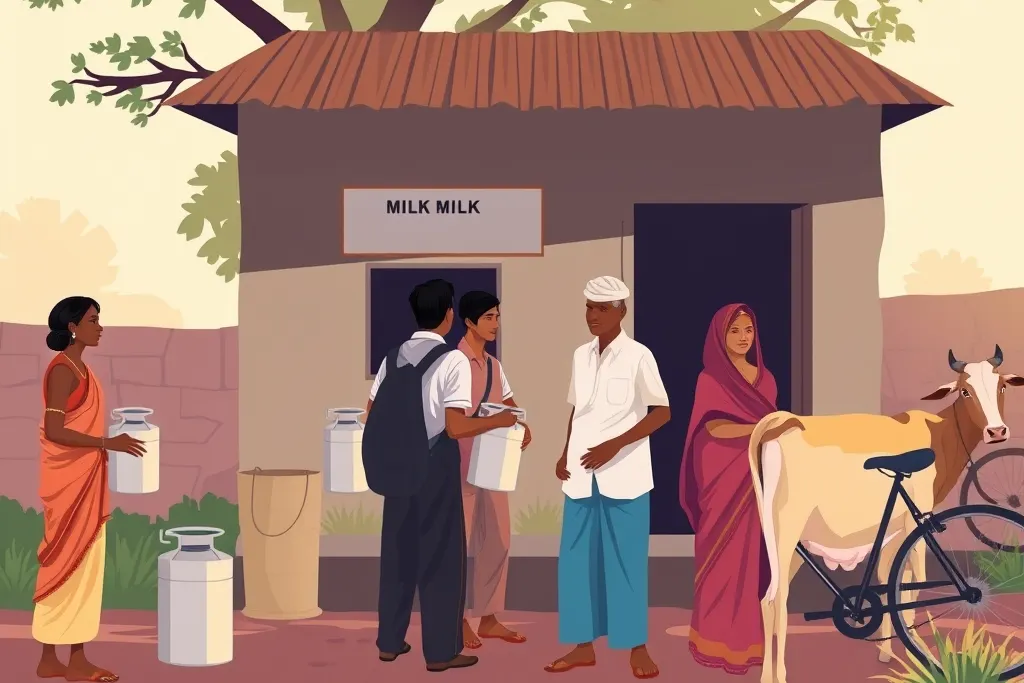
Milk is perishable and small producers are many and scattered, so a farmer alone sells to whoever comes and takes the price offered. The Anand pattern fixes this by organising the chain…
3. Breeding, animal health and fodder
- Breeding. Artificial insemination spreads superior genetics without keeping bulls; crossbreeding with exotic cattle raises milk yield but needs better feed and veterinary care, and loses the heat-tolerance and disease resistance of indigenous breeds. The Rashtriya Gokul Mission (2014) works to conserve and improve indigenous cattle breeds and sets up breeding centres, which is the policy reply to the crossbreeding trade-off.
- Animal health. Foot-and-mouth disease and brucellosis cut yield, restrict trade and harm farm families (brucellosis also passes to humans). The Foot-and-Mouth Disease Control Programme began in 2003 to 2004 with mass vaccination, and the National Animal Disease Control Programme of 2019 extends vaccination to foot-and-mouth disease and brucellosis with the aim of eliminating them. The delivery gap is in veterinary staff and the cold chain for vaccines.
- Fodder. Green and dry fodder are in deficit and compete with food crops for land. The remedies are fodder crops in rotation, silage and fodder banks, use of crop residue and common grazing land, and, where they exist, community fodder plots. Fodder is the bottleneck behind most claims for better yield.
Breeding. Artificial insemination spreads superior genetics without keeping bulls; crossbreeding with exotic cattle raises milk yield but needs better feed and veterinary care, and loses…
4. Poultry, small ruminants and fisheries
| Sector | Economic character | Constraint |
|---|---|---|
| Poultry | The most industrialised branch, with contract farming between large integrators and small growers, fast turnover and low land need. A route out of poverty for the landless. | Bird-flu outbreaks, feed prices and the fall in demand after scares. |
| Goats and sheep | Low-cost, hardy, flexible animals of the poorest households and of dry regions; meat, wool and manure. | Weak markets, no organised procurement, loss of grazing land. |
| Fisheries and aquaculture | Inland fisheries and pond aquaculture have grown fastest, and India is among the largest fish producers in the world. Marine fisheries employ coastal communities with traditional boats. | Cold chain and market access, over-fishing near the coast, disease in ponds, and the poverty of small fishers. |
Blue Revolution. The Blue Revolution scheme (2015) and, from 2020, the Pradhan Mantri Matsya Sampada Yojana aim to raise fish production and productivity, build cold chains and harbours and extend insurance and credit to fishers; a Fisheries and Aquaculture Infrastructure Development Fund finances the structure. The National Fisheries Development Board, set up in 2006 at Hyderabad, is the nodal agency. Sericulture (silk), apiculture (honey) and similar allied activities follow the same logic of small, labour-intensive, women-friendly income.
Blue Revolution. The Blue Revolution scheme (2015) and, from 2020, the Pradhan Mantri Matsya Sampada Yojana aim to raise fish production and productivity, build cold chains and harbours and…
5. Institutions, credit and the policy frame
| Instrument | Purpose |
|---|---|
| Ministry of Fisheries, Animal Husbandry and Dairying (2019) | Created in 2019 so that the allied sectors have a ministry of their own, apart from the Ministry of Agriculture. |
| Kisan Credit Card | Extended to animal husbandry and fisheries in 2018 to 2019, so that rearers can draw working capital for feed and care. |
| Animal Husbandry Infrastructure Development Fund (2020) | Supports private and cooperative investment in dairy and meat processing and in animal-feed plants. |
| Rashtriya Gokul Mission | Conservation and improvement of indigenous breeds. |
| National Animal Disease Control Programme | Mass vaccination against foot-and-mouth disease and brucellosis. |
| Pradhan Mantri Matsya Sampada Yojana | A package for fish production, cold chain and fishers’ welfare. |
Institutions and instruments to name in an answer
Breeds Worth Naming in an Answer
| Animal | Breeds | Use |
|---|---|---|
| Cattle (milch zebu) | Gir, Sahiwal, Red Sindhi, Tharparkar | High-yielding indigenous dairy breeds, heat tolerant |
| Cattle (draught) | Kangayam, Amritmahal, Hallikar | Strong bullocks for ploughing and carts |
| Buffalo | Murrah, Jaffarabadi, Mehsana, Surti | Murrah, from Haryana, is the best-known milch buffalo; buffaloes give a large share of India's milk |
| Goat | Jamunapari, Beetal, Barbari | Meat and milk; called the "poor man's cow" |
Indian breeds and their use
Operation Flood in Phases, and the Institutions Behind It
| Phase | Period | Focus |
|---|---|---|
| Phase I | 1970 to 1981 | Link milk producers with consumers in four metro cities; funded by sale of donated food aid commodities |
| Phase II | 1981 to 1985 | Expanded the milksheds and urban markets |
| Phase III | 1985 to 1996 | Strengthened the cooperative base and veterinary and breeding services |
| Institution | Point |
|---|---|
| National Dairy Development Board (NDDB) | Set up in 1965 at Anand to replicate the Anand pattern nationally; Verghese Kurien led it |
| Amul (Kaira District Cooperative Milk Producers' Union) | Started in 1946 under Tribhuvandas Patel; the model of a farmer-owned cooperative |
| Bihar State Milk Cooperative Federation (COMFED) | Markets milk and milk products in Bihar under the brand Sudha |
The phases of Operation Flood
Fisheries: Terms, Schemes and the Sector's Character
| Term or scheme | Meaning |
|---|---|
| Pisciculture | Rearing of fish in ponds and tanks |
| Mariculture | Farming of marine organisms in the sea or coastal waters |
| Inland versus marine | India's fish output today comes mainly from inland aquaculture, with marine catch the older source |
| Blue Revolution | Scheme (2015) to raise fish output and fisher incomes; carried into the Pradhan Mantri Matsya Sampada Yojana from 2020 |
| Fisheries and Aquaculture Infrastructure Development Fund | Created for harbours, cold chains and processing, from 2018 to 2019 |
- WhiteMilk (Operation Flood)
- BlueFish
- YellowOilseeds
- GreenFood grain, mainly wheat and rice
- PinkSometimes onion and prawn
Fisheries vocabulary and schemes
Key takeaways
- Livestock gives steady cash flow, includes the landless and women, and works as insurance. The 20th Livestock Census (2019) counted about 535.8 million animals; India is the largest milk producer and has the largest buffalo population.
- The Anand pattern is a three-tier cooperative: village society, district union, state federation. It began in 1946 (Amul, Tribhuvandas Patel, Verghese Kurien); the NDDB was set up in 1965; Operation Flood ran from 1970 to 1996 in three phases.
- Output is high but yield per animal is low because of breeding, fodder, disease and veterinary gaps. Rashtriya Gokul Mission (2014) conserves indigenous breeds; the Foot-and-Mouth Disease Control Programme (2003 to 2004) and the National Animal Disease Control Programme (2019) vaccinate.
- Poultry is the most industrialised branch; goats and sheep are the poor’s assets with weak markets; fisheries are driven by inland aquaculture. Blue Revolution (2015) and PMMSY (2020) are the fisheries schemes.
- The Ministry of Fisheries, Animal Husbandry and Dairying was created in 2019; Kisan Credit Card was extended to animal husbandry and fisheries in 2018 to 2019; the Animal Husbandry Infrastructure Development Fund dates from 2020.
- Milch breeds: cattle Gir, Sahiwal, Red Sindhi; buffalo Murrah; goat Jamunapari, Beetal. Crossing with exotic breeds raises yield but needs better fodder and care.
- Operation Flood: Phase I 1970 to 1981, II 1981 to 1985, III 1985 to 1996; NDDB set up in 1965; Amul began in 1946; Bihar's COMFED sells milk under Sudha.
- White Revolution = milk, Blue = fish, Yellow = oilseeds, Green = food grain. Fisheries output is now driven by inland aquaculture; PMMSY (2020) carries the Blue Revolution forward.
Practice questions (24)
Attempt each one before opening the answer. Every explanation names the tempting wrong option as well as the right one, because that is where marks are lost.
The Anand pattern of dairy cooperatives has which three tiers?
Show answer
Answer: A — Village society, district union, state federation
The pattern runs from the village society that pools milk, to the district union that processes and markets, to the state federation. The other options add a block tier, a national federation or private firms, none of which is part of the Anand structure.Operation Flood, called the White Revolution, was launched in:
Show answer
Answer: B — 1970
Operation Flood began in 1970 and ran in three phases up to 1996. The NDDB that ran it had been set up in 1965, and 1991 is the year of economic liberalisation, so those are the nearby dates that get mixed in.Which of the following is NOT a reason why India’s milk yield per animal is low?
Show answer
Answer: D — A very small number of milch animals in the country
India has a very large number of milch animals, which is why total output is high; the yield per animal is low for the reasons in the other three options. Reading low yield as a shortage of animals reverses the actual problem.
Show the other 21 questions
The Rashtriya Gokul Mission, launched in 2014, is concerned mainly with:
Show answer
Answer: A — Conservation and improvement of indigenous cattle breeds
The Gokul Mission targets the development and conservation of indigenous bovine breeds and sets up breeding centres. Fisheries, bird-flu vaccination and poultry credit fall under other schemes and programmes, which is why they only look plausible.Which diseases does the National Animal Disease Control Programme (2019) aim to control through mass vaccination?
Show answer
Answer: A — Foot-and-mouth disease and brucellosis
The 2019 programme extends the earlier foot-and-mouth disease effort and adds brucellosis. The other pairs are real animal or human diseases but are not the programme’s targets, and tuberculosis and leprosy are human-health programmes.The Kisan Credit Card was extended to animal husbandry and fisheries in:
Show answer
Answer: C — 2018 to 2019
The card, which began in 1998, was extended to animal husbandry and fisheries in 2018 to 2019. The earlier years are when the scheme began, which is the common mistake, and the last option is a later date for a different set of changes.Which of the following is the nodal agency for fisheries development set up in 2006 at Hyderabad?
Show answer
Answer: B — National Fisheries Development Board
The National Fisheries Development Board, at Hyderabad since 2006, is the nodal body for fisheries. The Dairy Board is at Anand and handles dairy, MPEDA promotes marine exports, and NABARD is the apex agricultural bank, which are plausible but not the right agency.Which of the following correctly describes the trade-off in crossbreeding indigenous cattle with exotic breeds?
Show answer
Answer: A — It raises milk yield but needs better feed and veterinary care, and may lose the heat tolerance and disease resistance of indigenous breeds
Crossbreds give more milk but demand more care and are less hardy in heat and disease; the policy reply is to conserve and improve indigenous breeds as well. The claims of lower yield with higher resistance, of no extra cost and of effects on meat only each misstate the trade-off.Who is associated with the cooperative dairy movement at Anand, whose brand became Amul?
Show answer
Answer: B — Verghese Kurien
Verghese Kurien led the Anand movement along with its founder Tribhuvandas Patel. Swaminathan and Borlaug are linked to the Green Revolution in crops, which is why they are the tempting wrong answers, and Ambedkar has no connection with dairying.Consider the following statements.
1. The Ministry of Fisheries, Animal Husbandry and Dairying was created in 2019.
2. The 20th Livestock Census was conducted in 2019.
Which is/are correct?Show answer
Answer: C — Both 1 and 2
Both are correct: the ministry was formed in 2019 and the 20th Livestock Census, the most recent in this chapter’s account, also dates from 2019. Choosing one alone treats the same year as a coincidence for only one of the two events.Which of the following is a milch buffalo breed from Haryana?
Show answer
Answer: A — Murrah
Murrah, from Haryana, is the best-known milch buffalo of India. Gir and Tharparkar are cattle breeds, and Kangayam is a draught cattle breed of Tamil Nadu.The National Dairy Development Board was established in:
Show answer
Answer: A — 1965
The NDDB was set up in 1965 at Anand under Verghese Kurien to replicate the Anand pattern across India. Amul began in 1946 and Operation Flood in 1970.Operation Flood Phase III covered the years:
Show answer
Answer: A — 1985 to 1996
Phase I ran from 1970 to 1981, Phase II from 1981 to 1985 and Phase III from 1985 to 1996, with the last phase consolidating the cooperative base and breeding and veterinary services.Bihar's milk cooperative federation, COMFED, markets its products under the brand:
Show answer
Answer: A — Sudha
COMFED, the Bihar State Milk Cooperative Federation, sells milk and milk products under the brand Sudha. Amul is Gujarat's brand, Nandini is Karnataka's and Vijaya is that of Telangana and Andhra Pradesh.The "Yellow Revolution" in India refers to the increase in the production of:
Show answer
Answer: A — Oilseeds
The Yellow Revolution is the growth in oilseed production, the White Revolution is milk, the Blue Revolution is fish and the Silver Revolution is sometimes used for eggs.Farming of marine organisms in the sea or coastal waters is called:
Show answer
Answer: A — Mariculture
Mariculture is the farming of marine organisms such as seaweed, mussels and fish in marine or coastal waters, while pisciculture is rearing fish in ponds. Sericulture is silk-worm rearing and apiculture is bee-keeping.Consider the following statements:
1. The Kaira District Cooperative Milk Producers' Union (Amul) began in 1946.
2. Operation Flood was designed to create a national milk grid linking producers with consumers.
Which of the statements given above is/are correct?Show answer
Answer: C — Both 1 and 2
Amul's parent union started at Anand in 1946 under Tribhuvandas Patel with Kurien's technical leadership, and Operation Flood scaled the model into a national milk grid. Both statements are correct.Assertion (A): Indian dairy farmers need cooperative marketing chains.
Reason (R): Milk is perishable and producers are numerous, small and scattered.
Which one of the following is correct?Show answer
Answer: A — Both A and R are true, and R is the correct explanation of A
A lone farmer sells to whoever comes and takes the price offered because milk spoils quickly; pooling collection, chilling and processing in cooperatives gives small producers bargaining power. R is the reason for A.Murrah is a well-known breed of:
Show answer
Answer: A — Buffalo
Murrah is a high-yielding milch buffalo from Haryana. Gir is a tempting indigenous breed, but it is a cattle breed from Gujarat.Which of the following is an Indian major carp?
Show answer
Answer: B — Catla
Catla, rohu and mrigal are the Indian major carps of inland aquaculture. Hilsa is tempting as a popular freshwater-river fish, but it is not a carp.The National Dairy Development Board (NDDB) was established in:
Show answer
Answer: C — 1965
The NDDB was set up in 1965 at Anand. 1970 is the tempting year, when Operation Flood was launched.The Pradhan Mantri Matsya Sampada Yojana (PMMSY) was launched in:
Show answer
Answer: D — 2020
PMMSY was launched in 2020. 2015 is the tempting year of the earlier Blue Revolution scheme.Consider the following statements about India's dairy sector:
1. India is the largest producer of milk in the world.
2. The bulk of India's milk is produced by large commercial dairy farms.
Which is/are correct?Show answer
Answer: A — Only 1
Only 1 is correct. Most milk comes from small and marginal households with a few animals. "Both" is the tempting answer for those who picture an industrial dairy sector.The Animal Husbandry Infrastructure Development Fund (AHIDF) of 2020 mainly supports:
Show answer
Answer: A — Investment in dairy and meat processing and animal feed plants
The fund gives interest subvention for processing and feed infrastructure. Direct cash transfers are tempting as farm-support schemes elsewhere work that way, but this is an investment fund.