Yoga: Suryanamaskar, Asanas, Kriyas, Bandhas, Pranayama and Yognidra
2. Suryanamaskar and the Asanas
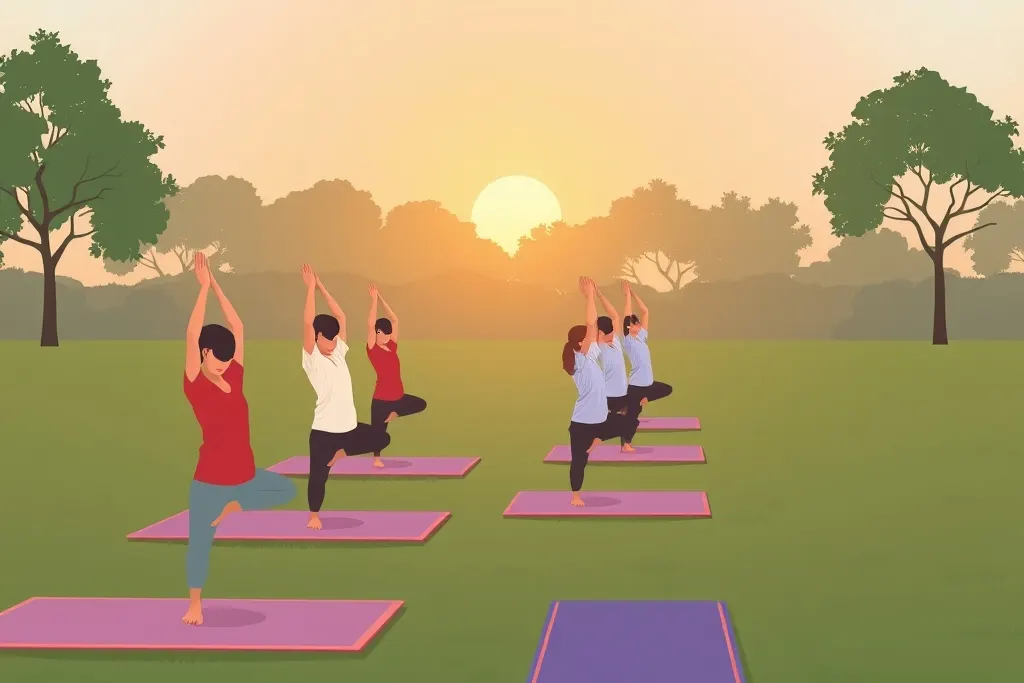
Suryanamaskar (sun salutation) is a sequence of twelve linked postures done in a flowing cycle with breath: Pranamasana (prayer pose), Hasta Uttanasana (raised arms), Padahastasana (hand to foot), Ashwa Sanchalanasana (equestrian), Parvatasana (mountain), Ashtanga Namaskara (eight-limbed salute), Bhujangasana (cobra), then back through Parvatasana, Ashwa Sanchalanasana, Padahastasana, Hasta Uttanasana and Pranamasana. It trains flexibility, strength, circulation and co-ordination, and is a warm-up that uses nearly every major muscle. An asana is a steady, comfortable posture held with awareness; the syllabus names them by position.
| Class | Asanas | Chief effect |
|---|---|---|
| Standing | Vrikshasana (tree), Trikonasana (triangle), Padahastasana, Utkatasana (chair), Ardhachakrasana (half wheel) | Balance, leg and spine strength, flexibility |
| Sitting | Parvatasana, Ustrasana (camel), Yogmudrasana, Simhasana (lion), Dhanurasana (bow), Sukhasana (easy) | Spinal flexibility, digestion, calm; Sukhasana is a meditative pose |
| Prone (lying on the stomach) | Makarasana (crocodile), Shalabhasana (locust), Bhujangasana (cobra) | Back strength; Makarasana relaxes |
| Supine (lying on the back) | Viparita Karani, Sarvangasana (shoulder stand) | Circulation, thyroid, relaxation of legs; inversions |
| Advanced | Kukutasana (cock), Mayurasana (peacock) | Arm and abdominal strength and balance; need training |
- Pranamasana
- Hasta Uttanasana
- Padahastasana
- Ashwa Sanchalanasana
- Parvatasana
- Ashtanga Namaskara
- Bhujangasana
Suryanamaskar (sun salutation) is a sequence of twelve linked postures done in a flowing cycle with breath: Pranamasana (prayer pose), Hasta Uttanasana (raised arms), Padahastasana (hand to…
3. Kriyas, Bandhas, Pranayama and Yognidra
| Practice | What it is | Effect |
|---|---|---|
| Kapalbhati (kriya) | Forceful exhalation with passive inhalation | Cleanses the air passages, energises the brain |
| Trataka (kriya) | Steady gazing at a point or candle flame without blinking | Concentration, eye health |
| Neti (kriya) | Cleansing of the nasal passage with warm salt water (jala neti) or a thread (sutra neti) | Clears the nose, helps against colds and sinus |
| Dhauti (kriya) | Cleansing of the alimentary canal, as in vaman dhauti | Cleans the stomach |
| Uddiyana bandha | Abdominal lock: pulling the belly in and up after exhaling | Tones abdominal organs |
| Jalandhar bandha | Throat lock: chin pressed to the chest | Regulates pulse, calms |
| Bhramari (pranayama) | Humming-bee breath | Calms the mind, reduces stress |
| Sheetali (pranayama) | Cooling breath through a curled tongue | Cools the body, reduces heat and thirst |
| Ujjayi (pranayama) | Victorious breath with slight throat constriction and a soft sound | Calms, builds endurance |
| Nadi Shodhana (pranayama) | Alternate-nostril breathing | Balances and purifies the energy channels, calms |
| Yognidra | Guided deep relaxation, "yogic sleep", done lying down | Reduces stress and fatigue, aids sleep |
Kriyas, bandhas, pranayama and Yognidra
4. Worked Reasoning
Question 1. "A breath in which the practitioner hums like a bee": Bhramari. Question 2. "A practice in which the eyes gaze steadily at a candle flame": Trataka, a kriya. Question 3. "Pressing the chin against the chest": Jalandhar bandha. Question 4. "Which of the following is a prone asana?" among Vrikshasana, Bhujangasana, Sarvangasana and Sukhasana: Bhujangasana, as the cobra is done lying on the stomach; Vrikshasana is standing, Sarvangasana supine and Sukhasana sitting. Question 5. The number of postures in one cycle of Suryanamaskar: twelve. Question 6. "A cooling breath through a curled tongue": Sheetali. The method is to link the name to the posture class or to the cue (gaze, hum, curl, alternate), and to remember that Yognidra is done lying down.
Question 1. "A breath in which the practitioner hums like a bee": Bhramari. Question 2. "A practice in which the eyes gaze steadily at a candle flame": Trataka, a kriya. Question 3.…
5. Matching Practice to Purpose, and Cautions
Yoga questions often describe a goal and ask which practice serves it. A balanced short answer links practice to effect: standing asanas build balance and leg strength, sitting asanas steady the mind for breathing and meditation, prone asanas such as Bhujangasana strengthen the back, supine asanas such as Pawanmuktasana ease the abdomen, and Shavasana relaxes the whole body at the end of a session. Pranayama steadies the breath, and the bandhas, being muscular locks, direct and hold the breath-energy during pranayama.
| Who | Caution |
|---|---|
| Beginners | Learn under a trained teacher; never force a posture or hold the breath beyond comfort |
| Heart or blood-pressure patients | Avoid forceful practices such as kapalbhati and long breath retention without medical advice |
| During pregnancy | Avoid strong abdominal and inverted practices; practise only with expert guidance |
| After a meal | Wait three to four hours before practice |
Yoga questions often describe a goal and ask which practice serves it. A balanced short answer links practice to effect: standing asanas build balance and leg strength, sitting asanas…
Answer Frame for Descriptive Questions
A descriptive question on any asana can be answered in four lines: name and meaning, the steps from starting position to final position, the benefits, and the cautions. For Suryanamaskar, remember that it has twelve postures in one cycle done with breath, and that practising it is often placed at the start of a session as a warm-up. For pranayama, state the method of breathing, the ratio if one is used, and who should avoid it. This frame turns a memory test into a structured answer.
A descriptive question on any asana can be answered in four lines: name and meaning, the steps from starting position to final position, the benefits, and the cautions. For Suryanamaskar…
Breath Ratios and Counting in Pranayama
Several pranayamas are taught with a ratio of inhalation, retention and exhalation. In anulom vilom, alternate nostril breathing, a beginner keeps the ratio 1:1 or 1:2 between breathing in and breathing out, adding retention only after long practice and expert guidance. The exhalation is kept at least as long as the inhalation, because a calm, slow breath-out soothes the nervous system. Counting with the heartbeat or a steady mental count keeps the rhythm even.
Several pranayamas are taught with a ratio of inhalation, retention and exhalation. In anulom vilom, alternate nostril breathing, a beginner keeps the ratio 1:1 or 1:2 between breathing in…
Key takeaways
- Patanjali's eight limbs are yama, niyama, asana, pranayama, pratyahara, dharana, dhyana and samadhi; the International Day of Yoga is 21 June.
- Practise on an empty stomach, in a clean airy place, slowly and without strain, and end with relaxation.
- Suryanamaskar has twelve postures; asanas are standing, sitting, prone, supine and advanced (Kukutasana, Mayurasana).
- Kriyas: Kapalbhati, Trataka, Neti, Dhauti; bandhas: Uddiyana and Jalandhar; pranayama: Bhramari, Sheetali, Ujjayi, Nadi Shodhana; Yognidra is guided relaxation.
Practice questions (24)
Attempt each one before opening the answer. Every explanation names the tempting wrong option as well as the right one, because that is where marks are lost.
How many postures make up one cycle of Suryanamaskar?
Show answer
Answer: A — 12
The classical sun salutation has twelve linked postures. Eight is the number of limbs of ashtanga yoga.Trataka is a:
Show answer
Answer: D — Kriya, a steady gazing practice
Trataka, steady gazing at a point or flame, is one of the six cleansing kriyas (shatkarma).Which is a pranayama?
Show answer
Answer: C — Nadi Shodhana
Nadi Shodhana is alternate-nostril breathing. Uddiyana is a bandha, Neti a kriya and Mayurasana an advanced asana.
Show the other 21 questions
The International Day of Yoga is observed on:
Show answer
Answer: B — 21 June
The UN adopted 21 June in 2014 on India's proposal. 29 August is National Sports Day.Which of these is a prone asana?
Show answer
Answer: A — Bhujangasana
Bhujangasana, the cobra, is done lying on the stomach. Vrikshasana is standing, Sarvangasana supine and Sukhasana sitting.Pressing the chin against the chest in a throat lock is:
Show answer
Answer: D — Jalandhar bandha
Jalandhar bandha is the throat lock. Uddiyana is the abdominal lock.Which instruction is correct for yogic practice?
Show answer
Answer: C — Practise on an empty stomach in a clean airy place
An empty stomach, a clean, airy place and unforced movement are standard. The other options are listed don'ts.Yognidra is best described as:
Show answer
Answer: B — Guided deep relaxation done lying down
Yognidra is "yogic sleep", a guided relaxation that reduces stress. Cleansing of the stomach is dhauti.Which list contains only kriyas?
Show answer
Answer: A — Kapalbhati, Trataka, Neti, Dhauti
The four kriyas in the syllabus are Kapalbhati, Trataka, Neti and Dhauti. Bhramari, Ujjayi and Sheetali are pranayamas and Uddiyana and Jalandhar are bandhas.Statement 1: Patanjali's asana is the third of the eight limbs. Statement 2: Pranayama comes before asana in the eight limbs. Which is correct?
Show answer
Answer: A — Only statement 1
The order is yama, niyama, asana (third), pranayama (fourth). Statement 2 reverses asana and pranayama.Patanjali's definition 'sthiram sukham asanam' describes asana as:
Show answer
Answer: A — A steady and comfortable posture
The sutra stresses steadiness and ease in the posture. A breathing exercise is the tempting wrong option, which is pranayama, the next limb.Which asana can be practised even after a meal?
Show answer
Answer: B — Vajrasana
Vajrasana is the one posture commonly allowed after eating. Halasana is the tempting wrong option, but forward and backward bends compress the abdomen and need an empty stomach.Bhramari pranayama is named after and produces the sound of a:
Show answer
Answer: C — Humming bee
Bhramari means humming bee, and the exhalation makes a humming note. Lion is the tempting wrong option, which belongs to Simhasana and its roaring breath.Neti is a kriya for the cleaning of the:
Show answer
Answer: D — Nasal passage
Neti cleans the nasal passages, usually with saline water or thread. Eyes is the tempting wrong option, which is the target of trataka.In Kapalabhati the emphasis is on:
Show answer
Answer: A — Forceful active exhalation with passive inhalation
The abdomen is pulled in sharply to expel air, and the inhalation follows passively. The reverse is the tempting wrong option, which is how most people breathe quickly.Shavasana is usually practised:
Show answer
Answer: B — Lying on the back to relax the body and mind
It is the supine relaxation posture used to finish a session. Lying on the stomach is the tempting wrong option, which describes prone asanas like Makarasana.About the three phases of pranayama, consider:
(1) Puraka is inhalation.
(2) Kumbhaka is retention of breath.
(3) Rechaka is inhalation.Show answer
Answer: C — 1 and 2 only
Puraka is inhalation and kumbhaka retention; rechaka is exhalation, so 3 is wrong. Option 4 is the tempting wrong option.Assertion (A): Shavasana is practised at the end of an asana session. Reason (R): It relaxes the body and mind after exertion.
Show answer
Answer: A — Both A and R are true, and R is the correct explanation of A
Both are true and R explains A: relaxation after effort is the reason for ending with the corpse pose. Option 2 is the tempting wrong option, though R states the purpose.Match the kriya with its purpose.
A. Neti – 1. Cleaning of nasal passage;
B. Dhauti – 2. Cleaning of the digestive tract;
C. Trataka – 3. Steady gazing to steady the mind;
D. Nauli – 4. Churning of abdominal muscles.Show answer
Answer: D — A-1, B-2, C-3, D-4
The fourth option is fully correct. Option 1 is the tempting wrong option, which swaps neti and dhauti.The number of shatkarmas (cleansing kriyas) in Hatha Yoga is:
Show answer
Answer: A — Six
Shat means six: neti, dhauti, nauli, basti, trataka and kapalabhati. Eight is the tempting wrong option, which is the number of limbs in Patanjali's ashtanga.Match the asana with its class by body position.
A. Trikonasana – 1. Standing;
B. Vakrasana – 2. Sitting;
C. Shalabhasana – 3. Prone;
D. Halasana – 4. Supine.Show answer
Answer: B — A-1, B-2, C-3, D-4
Trikonasana is standing, Vakrasana sitting, Shalabhasana prone and Halasana supine. Option 3 is the tempting wrong option, which swaps prone and supine, the pair most easily confused.Consider the classification of asanas:
(1) Bhujangasana is a prone asana.
(2) Pavanamuktasana is a supine asana.
(3) Ardha-chakrasana is a standing asana.
(4) Paschimottanasana is a prone asana.Show answer
Answer: C — 1, 2 and 3 only
Statements 1 to 3 are right; paschimottanasana is a sitting forward bend, so 4 is wrong. Option 1 is the tempting wrong option.About the bandhas, consider:
(1) Jalandhara bandha is the throat (chin) lock.
(2) Uddiyana bandha draws the abdomen upward and inward after exhalation.
(3) Moola bandha is the contraction of the perineal muscles.
(4) Maha bandha combines all three bandhas.Show answer
Answer: D — 1, 2, 3 and 4
All four statements are correct. Option 1 is the tempting wrong option, for anyone who doubts that maha bandha is the union of the other three.Which is the correct sequence of the last four limbs of Patanjali's ashtanga yoga?
Show answer
Answer: A — Pratyahara, Dharana, Dhyana, Samadhi
After pranayama come withdrawal of senses (pratyahara), concentration (dharana), meditation (dhyana) and absorption (samadhi). Dharana before pratyahara is the tempting wrong option, as concentration seems the natural first inner step but needs the senses withdrawn first.