Basics of Games and Sports: Play Fields, General Rules and Fundamental Skills of the Fifteen Games
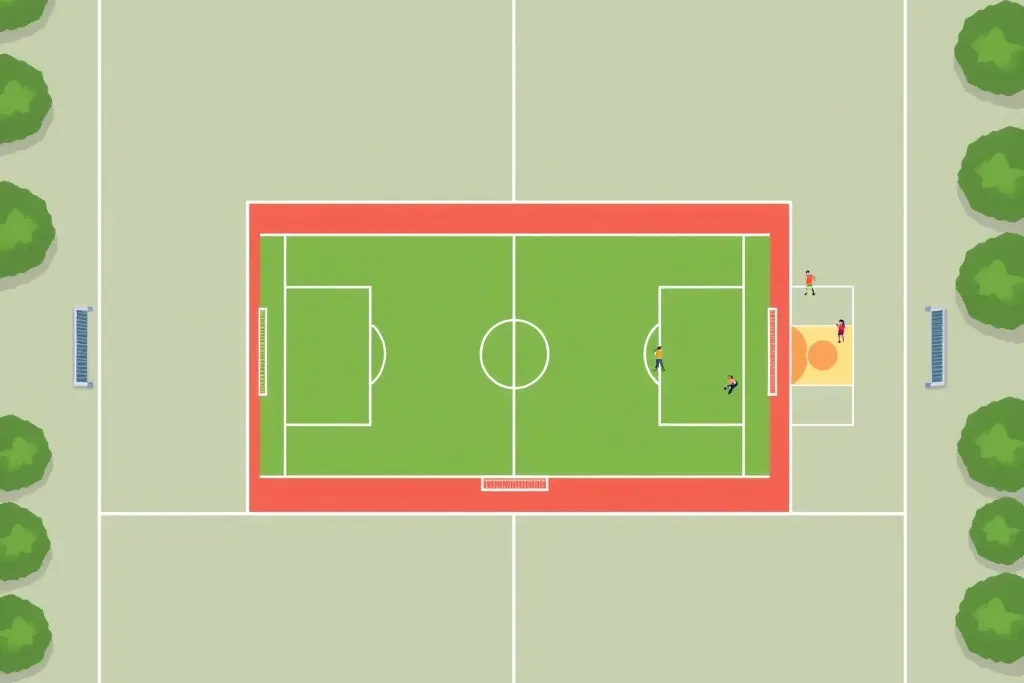
2. Racket, Table and Indigenous Games: Badminton, Table Tennis, Kabaddi and Kho-Kho
| Game | Court or table | Players; scoring |
|---|---|---|
| Badminton | 13.40 m × 6.10 m (doubles); net 1.55 m at the posts | Singles or doubles; rally point to 21, best of three games |
| Table tennis | Table 2.74 m × 1.525 m, 76 cm high; ball 40 mm | Singles or doubles; games to 11 points, two clear points |
| Kabaddi | Court 13 m × 10 m (men) | 7 a side; two halves of 20 minutes; raiders must chant "kabaddi" in a single breath |
| Kho-Kho | 27 m × 16 m with two posts | 9 players on the field a side; chasers sit in a row, runners dismissed by touch |
Skills: in badminton, the grip, serve (low and high), clear, drop, smash, net play and footwork; in table tennis, the grips (shakehand and penhold), serve, push, drive, loop, smash and chop; in kabaddi, the raider's touch, hand-touch, toe-touch, bonus line, and the defenders' ankle hold, thigh hold and chain tackle; in kho-kho, the sitting positions, giving "kho", the pole dive, sitting and running skills, and chain-running. Kabaddi and kho-kho are indigenous games of India, and kabaddi has been an Asian Games sport since 1990.
Skills: in badminton, the grip, serve (low and high), clear, drop, smash, net play and footwork; in table tennis, the grips (shakehand and penhold), serve, push, drive, loop, smash and…
3. Individual Sports: Athletics, Gymnastics, Judo, Swimming and Wrestling
| Sport | Arena or equipment | Events or rules |
|---|---|---|
| Athletics | 400 m oval track with 8 lanes | Track (sprints, middle and long distance, hurdles, relays), field (jumps and throws) |
| Gymnastics | Apparatus: floor, vault, bars, rings, beam, horse | Men six apparatus, women four; judged on difficulty and execution |
| Judo | Mat contest area 8 to 10 m square | Throws and holds; ippon (full point), waza-ari; weight categories; founded by Jigoro Kano |
| Swimming | 50 m pool (Olympic), 8 lanes | Four strokes: freestyle, backstroke, breaststroke, butterfly; medley |
| Wrestling | Mat 12 m square with a 9 m circle | Freestyle and Greco-Roman; win by fall or points; bouts of two three-minute periods |
Fundamental skills are, in athletics, the sprint start (crouch start), running, hurdling, baton exchange, jumping and throwing techniques; in gymnastics, balance, rolls, cartwheels, handstand, vault and swing; in judo, falling safely (ukemi), gripping, throws (nage-waza) and holds (katame-waza); in swimming, breathing, floating, kicks, arm pull, starts and turns; and in wrestling, stance, takedown, escape, bridge and pinning. The questions on this unit are about standard figures, so it helps to remember in pairs: Kabaddi 13 m × 10 m with 7 players; Kho-Kho 27 m × 16 m with 9 on field; Handball 40 m × 20 m with 7; Volleyball 18 m × 9 m with 6; Basketball 28 m × 15 m with 5.
Fundamental skills are, in athletics, the sprint start (crouch start), running, hurdling, baton exchange, jumping and throwing techniques; in gymnastics, balance, rolls, cartwheels…
4. Worked Reasoning: Matching Figures to Games
Question 1. "A court 18 m long and 9 m wide with a net 2.43 m high for men": volleyball. Question 2. "Goal posts 3.66 m apart and a crossbar 2.14 m high": hockey; "7.32 m wide and 2.44 m high": football. Question 3. "Seven players a side, two halves of 20 minutes, a raider chanting in one breath": kabaddi. Question 4. "A game where chasers sit in a row and runners are tagged": kho-kho. Question 5. "The 22-yard pitch": cricket. Question 6. Which game has the most players on the field for one team among basketball, handball, volleyball and football? Football, with 11. The best way to prepare is to put these figures in a table and test yourself in both directions, from game to figure and from figure to game.
Question 1. "A court 18 m long and 9 m wide with a net 2.43 m high for men": volleyball. Question 2. "Goal posts 3.66 m apart and a crossbar 2.14 m high": hockey; "7.32 m wide and 2.44 m…
5. Computing Areas to Compare the Games
Because the paper tests standard figures, it helps to turn the dimensions into areas, which makes the differences between games concrete. A basketball court of 28 m × 15 m covers 420 m²; a handball court of 40 m × 20 m covers 800 m²; a volleyball court of 18 m × 9 m covers only 162 m²; the men's kabaddi court of 13 m × 10 m is 130 m² and a kho-kho court of 27 m × 16 m is 432 m². A badminton doubles court of 13.40 m × 6.10 m is about 81.7 m². Goal mouths follow the same logic: a football goal of 7.32 m × 2.44 m is about 17.9 m², a hockey goal of 3.66 m × 2.14 m about 7.8 m² and a handball goal of 3 m × 2 m exactly 6 m².
| Game | Dimensions | Area |
|---|---|---|
| Handball court | 40 m × 20 m | 800 m² |
| Kho-kho court | 27 m × 16 m | 432 m² |
| Basketball court | 28 m × 15 m | 420 m² |
| Volleyball court | 18 m × 9 m | 162 m² |
| Kabaddi court (men) | 13 m × 10 m | 130 m² |
Because the paper tests standard figures, it helps to turn the dimensions into areas, which makes the differences between games concrete. A basketball court of 28 m × 15 m covers 420 m²; a…
Key takeaways
- Team games: basketball 28 × 15 m, 5 players; football 11 a side, goal 7.32 × 2.44 m; handball 40 × 20 m, 7 players; hockey 91.4 × 55 m, goal 3.66 × 2.14 m; volleyball 18 × 9 m, 6 players; cricket pitch 22 yards.
- Badminton court 13.40 × 6.10 m and net 1.55 m; table tennis table 2.74 × 1.525 m; kabaddi 13 × 10 m with 7 players; kho-kho 27 × 16 m with 9 on field.
- Athletics uses a 400 m track; swimming has four strokes in a 50 m pool; judo scores ippon and waza-ari; wrestling is freestyle or Greco-Roman.
- Learn each game's fundamental skills: dribble, pass, shoot, serve, smash, raid, tackle, start and stroke.
Practice questions (24)
Attempt each one before opening the answer. Every explanation names the tempting wrong option as well as the right one, because that is where marks are lost.
The standard volleyball court measures:
Show answer
Answer: B — 18 m × 9 m
Volleyball is 18 m by 9 m. 28 × 15 is basketball, 40 × 20 handball and 13 × 10 kabaddi.How many players of a kabaddi team take the court at one time?
Show answer
Answer: A — 7
Seven a side play kabaddi. Kho-kho has nine on the field, volleyball six and football eleven.The length of a cricket pitch is:
Show answer
Answer: D — 22 yards (20.12 m)
The pitch between the wickets is 22 yards, or 20.12 m.
Show the other 21 questions
The height of the basketball ring above the floor is:
Show answer
Answer: C — 3.05 m
The ring is 3.05 m (10 feet) high. 2.43 m is the men's volleyball net and 2.44 m the height of a football goal.The hockey goal measures:
Show answer
Answer: B — 3.66 m wide and 2.14 m high
Hockey: 3.66 m by 2.14 m. Football is 7.32 m by 2.44 m and handball 3 m by 2 m.In table tennis a game is played to:
Show answer
Answer: A — 11 points, with a lead of two
Games go to 11 with at least a two-point margin. Badminton uses 21 and volleyball sets 25.Which sport has the scores ippon and waza-ari?
Show answer
Answer: D — Judo
Judo is scored in ippon (full point) and waza-ari (half). Wrestling is by fall or technical points.How many strokes are contested in competitive swimming?
Show answer
Answer: C — Four
Freestyle, backstroke, breaststroke and butterfly; the medley combines them.Which pairing of game and arena is correct?
Show answer
Answer: B — Handball with 40 m × 20 m
Handball is 40 m by 20 m. Kho-kho is 27 × 16, kabaddi 13 × 10 and basketball 28 × 15; the other pairs swap those.Statement 1: Football is played 11 a side. Statement 2: Handball is played 11 a side. Which is correct?
Show answer
Answer: A — Only statement 1
Statement 1 is correct. Statement 2 is false: handball has seven players, six and a goalkeeper, a side.The goal in football measures:
Show answer
Answer: C — 7.32 m wide and 2.44 m high
A football goal is 7.32 m between posts and 2.44 m to the crossbar. 3.66 m by 2.14 m is the tempting wrong option, which is the hockey goal.How many players of one team are on the court at a time in basketball?
Show answer
Answer: D — 5
Each basketball team has five players on court. 6 is the tempting wrong option, which is the number for volleyball.How many players of a hockey team are on the field at a time?
Show answer
Answer: A — 11
A hockey side fields eleven players including the goalkeeper. 7 is the tempting wrong option, which is the kabaddi team on court.The height of the volleyball net for men is:
Show answer
Answer: B — 2.43 m
The men's net is 2.43 m high. 2.24 m is the tempting wrong option, which is the women's net height.In badminton under the rally-point system, a game is normally won by reaching:
Show answer
Answer: C — 21 points with a 2-point lead
A game goes to 21, with a two-point lead needed, capped at 30. 11 points is the tempting wrong option, which is the table tennis game score.The weight of the men's shot in athletics is:
Show answer
Answer: D — 7.26 kg
The men's shot weighs 7.26 kg. 4 kg is the tempting wrong option, which is the women's shot.About volleyball, consider:
(1) A team has six players on court.
(2) A normal set is played to 25 points.
(3) The women's net is 2.43 m high.Show answer
Answer: A — 1 and 2 only
Statements 1 and 2 are correct; 2.43 m is the men's net, the women's being 2.24 m. Option 4 is the tempting wrong option.Assertion (A): In kabaddi a raider must keep chanting 'kabaddi' continuously during the raid. Reason (R): The continuous chant shows that the raider has not taken a fresh breath.
Show answer
Answer: A — Both A and R are true, and R is the correct explanation of A
Both are true and R explains A: the cant is the proof of a single breath. Option 2 is the tempting wrong option, but R states the very reason for the rule.Match the game with the number of players of a side on court or field.
A. Volleyball – 1. 6;
B. Basketball – 2. 5;
C. Kho-kho (on the field) – 3. 9;
D. Hockey – 4. 11.Show answer
Answer: B — A-1, B-2, C-3, D-4
The second option gives the standard numbers 6, 5, 9 and 11. Option 1 is the tempting wrong option, which swaps volleyball and basketball.The weight of the javelin used by women in athletics is:
Show answer
Answer: C — 600 g
The women's javelin weighs 600 g. 800 g is the tempting wrong option, which is the men's javelin.In badminton the score reaches 29–29 in a game. The game is decided by:
Show answer
Answer: D — The next point, the side reaching 30 wins
The game is capped at 30, so the next point wins. Leading by 2 is the tempting wrong option, which applies up to 29-all but is overridden by the cap.A basketball team scores 12 field goals worth two points, 3 three-point shots and 5 free throws. Its total score is:
Show answer
Answer: A — 38
12 × 2 = 24; 3 × 3 = 9; 5 × 1 = 5; total 38. 41 is the tempting wrong option, which counts each free throw as two points.In a volleyball deciding fifth set (played to 15 points) the score is 14–14. The minimum winning score is:
Show answer
Answer: B — 16–14
A set needs a two-point lead, so from 14–14 the earliest win is 16–14. 15–14 is the tempting wrong option, which ignores the two-point margin.The height of each hurdle in the men's 110 m hurdles race is:
Show answer
Answer: C — 106.7 cm
The men's 110 m hurdles are 1.067 m high. 91.4 cm is the tempting wrong option, which is the height of the men's 400 m hurdles.