Dance: A Survey, Classical and Folk Forms (Unit 3)
2. Folk dance forms by region
Folk dance belongs to a community and an occasion: bihu to the Assamese spring festival, garba and dandiya to Navaratri in Gujarat, bhangra to the Punjab harvest, rauf to the women of Kashmir, ghumar and kalbelia to Rajasthan, lavani to Maharashtra, padayani to the Bhagavati temples of Kerala, dollu kunitha to Karnataka, chaufla to Uttarakhand and the bamboo dance (cheraw) to Mizoram. Chau, from Odisha, Jharkhand and West Bengal, is a martial and mask dance.
| Folk dance | Region |
|---|---|
| Chau | Odisha, Jharkhand and West Bengal |
| Bihu | Assam |
| Rauf | Jammu and Kashmir |
| Padayani | Kerala |
| Dollu Kunitha | Karnataka |
| Dandiya | Gujarat |
| Garba | Gujarat |
| Ghumar | Rajasthan |
| Kalbelia | Rajasthan |
| Chaufla | Uttarakhand |
| Bhangra | Punjab and Haryana |
| Giddha | Punjab and Haryana |
| Lavani | Maharashtra |
| Bamboo dance (Cheraw) | Mizoram |
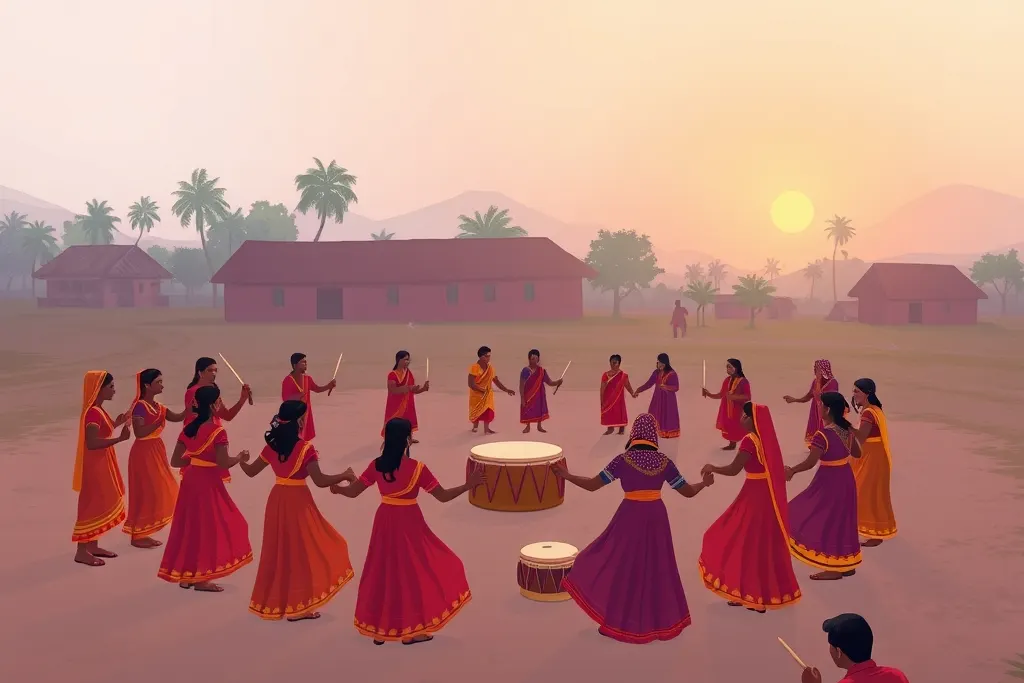
Folk dance belongs to a community and an occasion: bihu to the Assamese spring festival, garba and dandiya to Navaratri in Gujarat, bhangra to the Punjab harvest, rauf to the women of…
3. Reading the survey
The syllabus is a survey and is tested by recognition: which state a dance belongs to, which is classical and which folk, and the mark by which a classical form is known.
The syllabus is a survey and is tested by recognition: which state a dance belongs to, which is classical and which folk, and the mark by which a classical form is known.
4. Classical and folk compared
Classical forms have a codified grammar traced to the Natyashastra, a long training under a guru and a written repertoire; folk forms are learnt in the community, performed at festivals and seasons, and vary from village to village.
- Codified grammar from the Natyashastra
- Long training under a guru
- Written repertoire
- Learnt in the community
- Performed at festivals and seasons
- Varies from village to village
Classical forms have a codified grammar traced to the Natyashastra, a long training under a guru and a written repertoire; folk forms are learnt in the community, performed at festivals and…
5. The shared grammar of classical dance
The seven classical forms look different on stage but share one vocabulary that the survey traces to the Natyashastra, the treatise attributed to Bharata. It divides dance into three kinds. Nritta is pure movement, rhythm and pattern with no story; nritya is dance that expresses a feeling or a verse through gesture and face; natya is drama, the acting of a story. A single recital usually moves through all three, which is why a question about "pure dance" and a question about "expressive dance" have different answers.
| Term | Meaning |
|---|---|
| Nritta | Pure dance of rhythm and pattern, without meaning |
| Nritya | Expressive dance that conveys a theme or verse |
| Natya | Dramatic enactment of a story |
| Angika abhinaya | Expression through the limbs and body |
| Vachika abhinaya | Expression through speech and song |
| Aharya abhinaya | Expression through costume, make-up and ornament |
| Sattvika abhinaya | Expression of inner states such as tears or trembling |
| Rasa | The aesthetic flavour the audience tastes; eight in the Natyashastra, with shanta added later as the ninth |
The Natyashastra is not the only text. The Abhinaya Darpana, ascribed to Nandikeshvara, is the best-known manual of gesture and is the usual source for the hand-gestures (hastas) taught in Bharatanatyam, and the Sangita Ratnakara of Sharngadeva (thirteenth century) carries the survey into the middle period. When a question names a primary text, ask what kind of knowledge the text carries: drama and aesthetics (Natyashastra), gesture (Abhinaya Darpana) or the wider system of music and dance (Sangita Ratnakara).
- NrittaPure movement, rhythm, pattern; no story
- NrityaFeeling or verse through gesture and face
- NatyaDrama: acting a story
The seven classical forms look different on stage but share one vocabulary that the survey traces to the Natyashastra, the treatise attributed to Bharata. It divides dance into three kinds.…
6. Telling look-alikes apart: classical, folk and the exam
Three tests separate a classical form from a folk form quickly. First, codification: a classical form has a named grammar and a repertoire taught step by step under a guru, while a folk form is learnt by joining the community at the festival. Second, occasion: folk dances are tied to a season, harvest or ritual (bihu to spring, bhangra to the harvest, garba and dandiya to Navaratri), while a classical recital stands on its own. Third, the performer: folk dances are often performed by the whole village or group, while a classical form is trained for a soloist or a troupe.
| Pair | How to keep them apart |
|---|---|
| Garba and Dandiya | Both Gujarat and Navaratri; garba is the circling dance around a lamp or image, dandiya is the stick dance |
| Bhangra and Giddha | Both Punjab and Haryana in the chapter; bhangra is the men's harvest dance, giddha the women's |
| Ghumar and Kalbelia | Both Rajasthan; they are two different dances of two different groups |
| Kathakali and Kuchipudi | Kerala dance-drama with painted faces; Andhra dance-drama from the village of Kuchipudi |
| Kathak and Manipuri | Storytellers' dance of the north with chakkars; soft Raslila movement of Manipur |
To revise efficiently, make two lists of seven items and fourteen items: the classical forms with state and one mark, and the folk dances with region and occasion. Test yourself by covering one column. Because the exam is recognition, the second skill is elimination: remove any option from the wrong category first (a folk dance in a question about classical forms), and the surviving options usually differ by region or mark only.
Three tests separate a classical form from a folk form quickly. First, codification: a classical form has a named grammar and a repertoire taught step by step under a guru, while a folk…
Key takeaways
- Seven named classical forms: Bharatanatyam, Kathakali, Kathak, Kuchipudi, Manipuri, Odissi, Sattriya.
- Sattriya was recognised as classical in 2000.
- Bihu: Assam; garba and dandiya: Gujarat; bhangra and giddha: Punjab; lavani: Maharashtra.
- Chau, rauf, chaufla and cheraw come from Odisha-Jharkhand-Bengal, Kashmir, Uttarakhand and Mizoram.
Practice questions (38)
Attempt each one before opening the answer. Every explanation names the tempting wrong option as well as the right one, because that is where marks are lost.
Bharatanatyam: which description fits?
Show answer
Answer: C — Tamil Nadu; from the temple dance sadir; adavus and the araimandi
Bharatanatyam: Tamil Nadu; from the temple dance sadir; adavus and the araimandi. The tempting "North India; storytellers' dance with chakkars and footwork; Jaipur, Lucknow, Banaras" goes with Kathak, and "Manipur; Raslila of Radha and Krishna, soft movement" with Manipuri.Which fits: Tamil Nadu; from the temple dance sadir; adavus and the araimandi?
Show answer
Answer: B — Bharatanatyam
Bharatanatyam: Tamil Nadu; from the temple dance sadir; adavus and the araimandi. The tempting "Odissi" is linked with Odisha; the Mahari tradition and the tribhanga posture, and "Kathakali" with Kerala; a dance-drama with painted faces and gesture language.Kathakali: which description fits?
Show answer
Answer: B — Kerala; a dance-drama with painted faces and gesture language
Kathakali: Kerala; a dance-drama with painted faces and gesture language. The tempting "Odisha; the Mahari tradition and the tribhanga posture" goes with Odissi, and "Assam; created by Sankardev in the sattras" with Sattriya.
Show the other 35 questions
Kathak: which description fits?
Show answer
Answer: D — North India; storytellers' dance with chakkars and footwork; Jaipur, Lucknow, Banaras
Kathak: North India; storytellers' dance with chakkars and footwork; Jaipur, Lucknow, Banaras. The tempting "Odisha; the Mahari tradition and the tribhanga posture" goes with Odissi, and "Assam; created by Sankardev in the sattras" with Sattriya.Which fits: North India; storytellers' dance with chakkars and footwork; Jaipur, Lucknow, Banaras?
Show answer
Answer: D — Kathak
Kathak: North India; storytellers' dance with chakkars and footwork; Jaipur, Lucknow, Banaras. The tempting "Odissi" is linked with Odisha; the Mahari tradition and the tribhanga posture, and "Bharatanatyam" with Tamil Nadu; from the temple dance sadir; adavus and the araimandi.Which fits: Andhra Pradesh; a dance-drama of the Kuchipudi village?
Show answer
Answer: D — Kuchipudi
Kuchipudi: Andhra Pradesh; a dance-drama of the Kuchipudi village. The tempting "Kathakali" is linked with Kerala; a dance-drama with painted faces and gesture language, and "Manipuri" with Manipur; Raslila of Radha and Krishna, soft movement.Manipuri: which description fits?
Show answer
Answer: C — Manipur; Raslila of Radha and Krishna, soft movement
Manipuri: Manipur; Raslila of Radha and Krishna, soft movement. The tempting "Odisha; the Mahari tradition and the tribhanga posture" goes with Odissi, and "Assam; created by Sankardev in the sattras" with Sattriya.Odissi: which description fits?
Show answer
Answer: A — Odisha; the Mahari tradition and the tribhanga posture
Odissi: Odisha; the Mahari tradition and the tribhanga posture. The tempting "North India; storytellers' dance with chakkars and footwork; Jaipur, Lucknow, Banaras" goes with Kathak, and "Andhra Pradesh; a dance-drama of the Kuchipudi village" with Kuchipudi.Which fits: Odisha; the Mahari tradition and the tribhanga posture?
Show answer
Answer: C — Odissi
Odissi: Odisha; the Mahari tradition and the tribhanga posture. The tempting "Manipuri" is linked with Manipur; Raslila of Radha and Krishna, soft movement, and "Sattriya" with Assam; created by Sankardev in the sattras.Which fits: Assam; created by Sankardev in the sattras?
Show answer
Answer: B — Sattriya
Sattriya: Assam; created by Sankardev in the sattras. The tempting "Kathakali" is linked with Kerala; a dance-drama with painted faces and gesture language, and "Kathak" with North India; storytellers' dance with chakkars and footwork; Jaipur, Lucknow, Banaras.Region of Chau: which is it?
Show answer
Answer: A — Odisha, Jharkhand and West Bengal
Chau is Odisha, Jharkhand and West Bengal. The tempting "Karnataka" fits Dollu Kunitha instead.Region of Bihu: which is it?
Show answer
Answer: C — Assam
Bihu is Assam. The tempting "Gujarat" fits Dandiya instead. The tempting option "Gujarat" does not fit.Region of Padayani: which is it?
Show answer
Answer: D — Kerala
Padayani is Kerala. The tempting "Maharashtra" fits Lavani instead. The tempting option "Maharashtra" does not fit.Region of Dollu Kunitha: which is it?
Show answer
Answer: B — Karnataka
Dollu Kunitha is Karnataka. The tempting "Jammu and Kashmir" fits Rauf instead. The tempting option "Jammu and Kashmir" does not fit.Region of Garba: which is it?
Show answer
Answer: A — Gujarat
Garba is Gujarat. The tempting "Rajasthan" fits Ghumar instead. The tempting option "Rajasthan" does not fit.Region of Ghumar: which is it?
Show answer
Answer: C — Rajasthan
Ghumar is Rajasthan. The tempting "Maharashtra" fits Lavani instead. The tempting option "Maharashtra" does not fit.Region of Chaufla: which is it?
Show answer
Answer: B — Uttarakhand
Chaufla is Uttarakhand. The tempting "Kerala" fits Padayani instead. The tempting option "Kerala" does not fit.Region of Bhangra: which is it?
Show answer
Answer: C — Punjab and Haryana
Bhangra is Punjab and Haryana. The tempting "Mizoram" fits Bamboo dance (Cheraw) instead.Region of Lavani: which is it?
Show answer
Answer: C — Maharashtra
Lavani is Maharashtra. The tempting "Gujarat" fits Dandiya instead. The tempting option "Gujarat" does not fit.Region of Bamboo dance (Cheraw): which is it?
Show answer
Answer: D — Mizoram
Bamboo dance (Cheraw) is Mizoram. The tempting "Punjab and Haryana" fits Bhangra instead.Which of these dances is Punjab and Haryana?
Show answer
Answer: A — Bhangra
Bhangra is Punjab and Haryana. The tempting "Dandiya" is Gujarat. The tempting option "Dandiya" does not fit.Which of these dances is Assam?
Show answer
Answer: C — Bihu
Bihu is Assam. The tempting "Dollu Kunitha" is Karnataka. The tempting option "Dollu Kunitha" does not fit.Which of these dances is Maharashtra?
Show answer
Answer: B — Lavani
Lavani is Maharashtra. The tempting "Ghumar" is Rajasthan. The tempting option "Ghumar" does not fit.Which of these dances is Kerala?
Show answer
Answer: C — Padayani
Padayani is Kerala. The tempting "Garba" is Gujarat. The tempting option "Garba" does not fit.Which of these dances is Karnataka?
Show answer
Answer: C — Dollu Kunitha
Dollu Kunitha is Karnataka. The tempting "Giddha" is Punjab and Haryana. The tempting option "Giddha" does not fit.Which of these dances is Uttarakhand?
Show answer
Answer: B — Chaufla
Chaufla is Uttarakhand. The tempting "Dandiya" is Gujarat. The tempting option "Dandiya" does not fit.Which of these dances is Mizoram?
Show answer
Answer: A — Bamboo dance (Cheraw)
Bamboo dance (Cheraw) is Mizoram. The tempting "Padayani" is Kerala. The tempting option "Padayani" does not fit.How many of these dances are Punjab and Haryana: Ghumar, Bhangra, Giddha?
Show answer
Answer: A — Two
Punjab and Haryana: Giddha, Bhangra. Others: Ghumar is Rajasthan. The tempting option "None" does not fit.How many of these dances are Punjab and Haryana: Bhangra, Chau, Giddha?
Show answer
Answer: A — Two
Punjab and Haryana: Bhangra, Giddha. Others: Chau is Odisha, Jharkhand and West Bengal.How many of these dances are Punjab and Haryana: Dollu Kunitha, Bhangra, Giddha?
Show answer
Answer: A — Two
Punjab and Haryana: Bhangra, Giddha. Others: Dollu Kunitha is Karnataka. The tempting option "None" does not fit.How many of these dances are Gujarat: Ghumar, Dandiya, Bihu?
Show answer
Answer: A — One
Gujarat: Dandiya. Others: Bihu is Assam; Ghumar is Rajasthan. The tempting option "None" does not fit.How many of these dances are Assam: Bihu, Kalbelia, Lavani?
Show answer
Answer: B — One
Assam: Bihu. Others: Kalbelia is Rajasthan; Lavani is Maharashtra. The tempting option "None" does not fit.How many of these dances are Maharashtra: Bihu, Chau, Dandiya?
Show answer
Answer: D — None
Maharashtra: none of the three. Others: Bihu is Assam; Chau is Odisha, Jharkhand and West Bengal; Dandiya is Gujarat.How many of these dances are Rajasthan: Dandiya, Dollu Kunitha, Rauf?
Show answer
Answer: D — None
Rajasthan: none of the three. Others: Dandiya is Gujarat; Dollu Kunitha is Karnataka; Rauf is Jammu and Kashmir.How many of these dances are Rajasthan: Giddha, Dollu Kunitha, Lavani?
Show answer
Answer: A — None
Rajasthan: none of the three. Others: Lavani is Maharashtra; Giddha is Punjab and Haryana; Dollu Kunitha is Karnataka.How many of these dances are Kerala: Chaufla, Bhangra, Padayani?
Show answer
Answer: A — One
Kerala: Padayani. Others: Chaufla is Uttarakhand; Bhangra is Punjab and Haryana.How many of these dances are Mizoram: Dollu Kunitha, Bamboo dance (Cheraw), Ghumar?
Show answer
Answer: B — One
Mizoram: Bamboo dance (Cheraw). Others: Ghumar is Rajasthan; Dollu Kunitha is Karnataka.How many of these dances are Mizoram: Bhangra, Garba, Chaufla?
Show answer
Answer: C — None
Mizoram: none of the three. Others: Garba is Gujarat; Chaufla is Uttarakhand; Bhangra is Punjab and Haryana.