Human Development and Family Studies: Early Childhood Care and Education, and Support Services for Children, Youth and the Elderly
2. Services and Programmes for Children and Youth
The State supports children through ICDS (anganwadis for under-sixes), the Right to Education Act, 2009 (free and compulsory education from 6 to 14, with a 25 per cent reservation for disadvantaged children in private schools), Samagra Shiksha, the Mid-Day Meal scheme, the Juvenile Justice (Care and Protection of Children) Act, 2015, which provides for children in need of care (children's homes, foster care, adoption) and for children in conflict with the law, Childline 1098, the Protection of Children from Sexual Offences (POCSO) Act, 2012, and the Prohibition of Child Marriage Act, 2006. Voluntary bodies and institutions such as children's homes, creches and special schools supply services under these laws and need trained staff, funds, premises that meet safety rules, records and regular inspection.
For youth (broadly 15 to 29 in national youth policy), services include the National Service Scheme (NSS, 1969), Nehru Yuva Kendra Sangathan (NYKS, 1972), the National Cadet Corps (NCC, 1948), skill development under Skill India, and the National Youth Policy; the aims are employability, civic participation, health and protection from drugs and exploitation.
The State supports children through ICDS (anganwadis for under-sixes), the Right to Education Act, 2009 (free and compulsory education from 6 to 14, with a 25 per cent reservation for…
3. Services and Programmes for the Elderly
An older person (60 and over in Indian law and policy) faces declining health, loss of income and role, and sometimes neglect. India's responses include the Maintenance and Welfare of Parents and Senior Citizens Act, 2007, which makes it a legal duty of children and relatives to maintain parents and provides tribunals and old-age homes; the National Policy for Older Persons (1999), replaced in discussion by later drafts; pensions under the Indira Gandhi National Old Age Pension Scheme (IGNOAPS) for the poor; the Integrated Programme for Senior Citizens, which funds old-age homes, day-care centres and mobile medicare units run by NGOs; and concessions on travel and tax. Good institutional care for the elderly provides safe housing, nutritious food, medical care, recreation and companionship, respects dignity and choice, and keeps contact with family.
| Group | Scheme or law | Year |
|---|---|---|
| Children | ICDS; Right to Education Act; Juvenile Justice Act; POCSO Act | 1975; 2009; 2015; 2012 |
| Youth | NCC; NSS; Nehru Yuva Kendra Sangathan; Skill India | 1948; 1969; 1972; 2015 |
| Elderly | Senior Citizens Act; National Policy for Older Persons; IGNOAPS | 2007; 1999; pension scheme |
An older person (60 and over in Indian law and policy) faces declining health, loss of income and role, and sometimes neglect. India's responses include the Maintenance and Welfare of…
4. Worked Examples
Example 1. A four-year-old who says "the moon follows me" or who believes a tall thin glass holds more water than a short wide one shows pre-operational thinking (animism, no conservation); a teacher should use concrete play (pouring water between containers), not abstract explanation. Example 2. A pre-school planner designs a morning: free play (choice), circle time with songs (language), a story (listening), an art activity (fine motor and creativity) and outdoor play (gross motor), with a snack and rest: this meets the holistic, play-based principles. Example 3. A 14-year-old is found working in a roadside eatery: the right response is to inform Childline 1098 or the child welfare committee under the Juvenile Justice Act, and to enrol the child in school under the RTE Act. Example 4. An elderly widow is neglected by her son: she may apply to the maintenance tribunal under the 2007 Act.
Example 1. A four-year-old who says "the moon follows me" or who believes a tall thin glass holds more water than a short wide one shows pre-operational thinking (animism, no conservation)…
5. Age Thresholds in Law and Services: a Reference
Many questions in this field depend on knowing who is covered by a scheme or a law, which is decided by age. A child under the Juvenile Justice Act and under the POCSO Act is anyone below 18 years. The Right to Education Act covers children from 6 to 14 years, the age group of Classes I to VIII. The Integrated Child Development Services (ICDS) serves children below 6, together with pregnant and lactating women, through the anganwadi centre. A senior citizen is a person of 60 years or above, which is the age used for old-age schemes and for the Maintenance and Welfare of Parents and Senior Citizens Act, 2007. Voting begins at 18.
| Law or service | Age covered |
|---|---|
| ICDS (anganwadi) | Below 6 years; pregnant and lactating women |
| Right to Education Act | 6 to 14 years |
| Juvenile Justice and POCSO | Below 18 years |
| Senior citizens | 60 years and above |
Many questions in this field depend on knowing who is covered by a scheme or a law, which is decided by age. A child under the Juvenile Justice Act and under the POCSO Act is anyone below…
The Aims of Early Childhood Care and Education
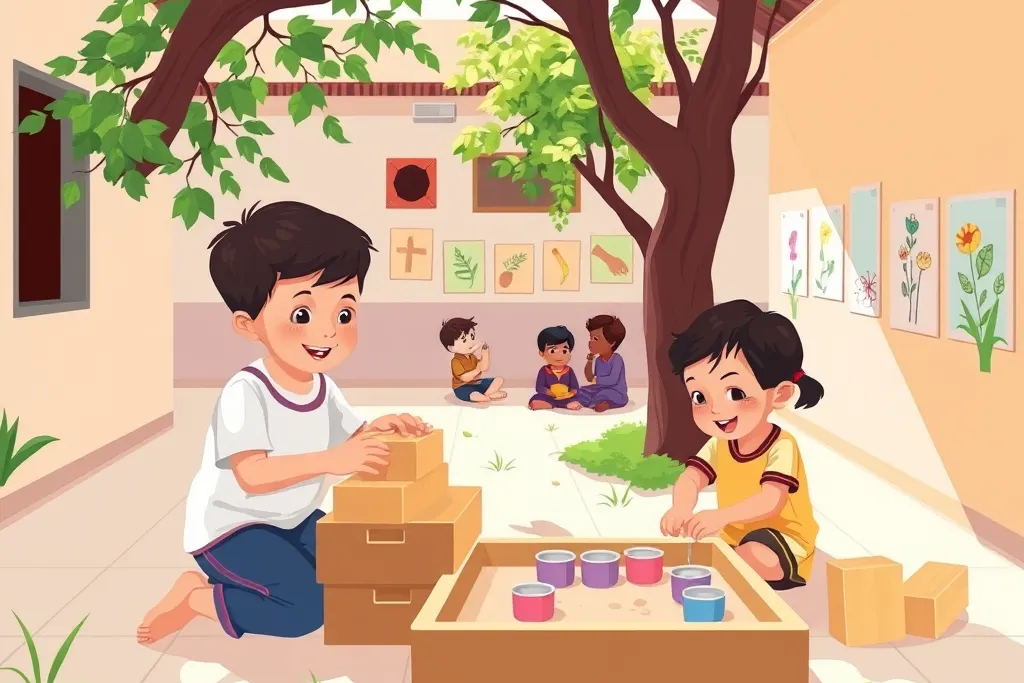
Early childhood care and education covers the years from birth to six, when the brain develops fastest. Its aims are healthy growth, language and thinking skills, social and emotional security, and readiness for school, and the methods are play-based, with songs, stories, drawing and free play rather than formal lessons.
Early childhood care and education covers the years from birth to six, when the brain develops fastest. Its aims are healthy growth, language and thinking skills, social and emotional…
Key takeaways
- ECCE is child-centred, play-based, holistic and inclusive; brain development is fastest in the first three years; NEP 2020 treats ages 3 to 8 as the foundational stage.
- Piaget's stages are sensorimotor, pre-operational, concrete operational and formal operational.
- Child services: ICDS (1975), RTE (2009), POCSO (2012), Juvenile Justice Act (2015) and Childline 1098.
- Youth services include NCC (1948), NSS (1969), NYKS (1972) and Skill India.
- The Senior Citizens Act, 2007 makes maintenance of parents a legal duty and provides tribunals; IGNOAPS gives pensions to the poor.
Practice questions (24)
Attempt each one before opening the answer. Every explanation names the tempting wrong option as well as the right one, because that is where marks are lost.
According to Piaget, a child aged 2 to 7 is in the:
Show answer
Answer: B — Pre-operational stage
Ages 2 to 7 are pre-operational. Sensorimotor is 0 to 2, concrete operational 7 to 11 and formal operational 11 onward.Which Act provides for the maintenance of parents and senior citizens?
Show answer
Answer: A — Maintenance and Welfare of Parents and Senior Citizens Act, 2007
The 2007 Act makes parental maintenance a legal duty. The others concern child protection, schooling and pay.Childline, the helpline for children in need, has the number:
Show answer
Answer: D — 1098
Childline is 1098. 100 is the police, 108 ambulance and 112 the emergency number.
Show the other 21 questions
The National Service Scheme was launched in:
Show answer
Answer: C — 1969
NSS began in 1969. NCC is of 1948 and NYKS of 1972.A pre-school gives children building blocks, sand, stories and role play. This reflects the principle that young children:
Show answer
Answer: B — Learn best through play and concrete experience
Play-based, child-centred learning with concrete materials suits the pre-operational stage.Which Act provides for children in need of care and protection and for children in conflict with law?
Show answer
Answer: A — Juvenile Justice (Care and Protection of Children) Act, 2015
The Juvenile Justice Act of 2015 covers both groups. The Child Marriage Act deals only with marriage below the legal age.A child who thinks a tall thin glass holds more water than a short wide one, though the amounts are equal, lacks:
Show answer
Answer: D — Conservation
Failure of conservation is typical of the pre-operational stage. Object permanence is gained in infancy.The National Education Policy, 2020 treats which ages as the foundational stage?
Show answer
Answer: C — 3 to 8
The foundational stage is 3 to 8 years (three of pre-school and classes 1 and 2). 6 to 14 is the RTE age range.An elderly woman is neglected by her son who lives in her house. Her best legal remedy is to:
Show answer
Answer: B — Apply to the maintenance tribunal under the 2007 Act
The Senior Citizens Act of 2007 provides tribunals for maintenance and protection. RTE and Juvenile Justice concern children.Statement 1: Brain development is fastest in the first three years. Statement 2: Early deprivation is easy to reverse later. Which is correct?
Show answer
Answer: A — Only statement 1
Statement 1 is the reason ECCE matters. Statement 2 is false: early deprivation is hard to reverse.In Piaget's theory, a child aged 7 to 11 years is in the stage of:
Show answer
Answer: C — Concrete operational
From 7 to 11 children think logically about concrete things and grasp conservation. Pre-operational is the tempting wrong option for those who recall that conservation is the key idea of this period of childhood, but that stage lacks conservation.Under the Juvenile Justice Act and the POCSO Act, a "child" is a person below the age of:
Show answer
Answer: D — 18 years
Both Acts treat anyone below 18 as a child. Fourteen is the tempting wrong option because it is the limit in the Right to Education Act, but that Act is about schooling, not about protection.The National Cadet Corps (NCC) was established in:
Show answer
Answer: A — 1948
The NCC dates from 1948. The year 1969 is the tempting wrong option because it is the year of the National Service Scheme, the other youth programme in the chapter.Match the Piaget stage with its feature. List I: A. Sensorimotor B. Pre-operational C. Concrete operational D. Formal operational List II: 1. Abstract reasoning from about 11 years 2. Learning through senses and movement, with object permanence 3. Logical thinking about concrete things, with conservation 4. Language and symbolic play, but egocentric thinking
Show answer
Answer: A — A-2, B-4, C-3, D-1
Sensorimotor is 2, pre-operational 4, concrete operational 3 and formal operational 1. The pair B-3, C-4 is the tempting swap of the two middle stages, but conservation arrives only at the concrete stage while egocentrism marks the pre-operational one.Match the law with what it provides for. List I: A. POCSO Act, 2012 B. Prohibition of Child Marriage Act, 2006 C. Juvenile Justice Act, 2015 D. Maintenance and Welfare of Parents and Senior Citizens Act, 2007 List II: 1. Care and protection of children in need and those in conflict with law 2. Protection of children from sexual offences 3. Duty of children and relatives to maintain parents 4. Prevention of marriage of children
Show answer
Answer: B — A-2, B-4, C-1, D-3
POCSO is 2, child marriage 4, Juvenile Justice 1 and the senior citizens Act 3. The pair C-3, D-1 is the tempting swap, because both Acts concern the care of vulnerable people, but one is for children and the other for the old.Read the statements on ages in laws and services.
(1) A senior citizen in Indian law and policy is a person aged 60 years or above.
(2) ICDS begins at the age of six years.Show answer
Answer: A — 1 only
Statement 1 is true. Statement 2 is false: ICDS serves children below six, and it is the RTE Act that begins at six. "Both" tempts for those who swap the two services.A 14-year-old is found washing dishes in a roadside eatery. The best first response is to:
Show answer
Answer: B — Inform Childline 1098 or the child welfare authorities
The child needs rescue and enrolment in school, which Childline and the child welfare system arrange. Raising his wages is the tempting wrong option because it sounds kind, but it keeps a child at work.A nine-year-old understands that pouring water into a taller glass does not change the amount and can sort objects by size, but cannot handle abstract algebra. She is in the:
Show answer
Answer: C — Concrete operational stage
Conservation with concrete things but no abstract reasoning marks the concrete operational stage. Formal operational is the tempting wrong option because she reasons well, but abstract thinking is its hallmark and she lacks it.Assertion (A): Young children should learn mainly through play. Reason (R): Play lets them explore, use language and build social skills.
Show answer
Answer: A — Both A and R are true, and R is the correct explanation of A
Both are true and R explains A. The second option tempts since R sounds like a separate list of benefits, but those benefits are exactly why play is the main method.A pre-school teacher invites grandparents to tell stories in the children's home language and asks parents to share local songs. Which principles of ECCE does this reflect?
Show answer
Answer: D — Use of the mother tongue and involvement of parents and community
Home-language stories and family involvement reflect the mother-tongue and community principles. Formal drill is the tempting wrong option for those who think any pre-school activity prepares for school work, but ECCE is play-based.Consider the statements on youth programmes.
(1) The National Service Scheme was launched in 1969.
(2) The National Cadet Corps was established in 1969.
(3) Nehru Yuva Kendra Sangathan dates from 1972.Show answer
Answer: C — 1 and 3 only
Statements 1 and 3 are correct. Statement 2 is false: the NCC was established in 1948. "1, 2 and 3" tempts for those who place all youth schemes in the same decade.Assertion (A): A pre-operational child cannot yet grasp conservation. Reason (R): Children in this stage think logically about abstract ideas.
Show answer
Answer: C — A is true, but R is false
A is true: the tall-glass test shows the lack of conservation. R is false: logical abstract thought belongs to the formal operational stage. The first option is the tempting wrong choice as R seems to link thinking to conservation, but it states the opposite of the stage's limit.Which of the following persons is covered by BOTH the Right to Education Act, 2009 and the definition of a "child" in the Juvenile Justice Act?
Show answer
Answer: A — A 12-year-old
A 12-year-old is within 6 to 14 for RTE and below 18 for the Juvenile Justice Act. The 16-year-old is the tempting wrong option because he is a child in the Juvenile Justice Act, but he is above the RTE limit of 14.Assertion (A): The Maintenance and Welfare of Parents and Senior Citizens Act, 2007 makes maintenance of parents a legal duty of children. Reason (R): The Act provides for maintenance tribunals and old-age homes.
Show answer
Answer: B — Both A and R are true, but R is not the correct explanation of A
Both are true, but R is not the reason for A: the duty exists because the Act declares it, while tribunals and homes are the machinery to enforce and support it. The first option tempts since both belong to the Act, but a feature is not a cause.