Economics for Classes 6–8 — Needs, Production, Money, Banks and Markets
Sectors of the economy
Economic activities are grouped by what they do. The primary sector takes directly from nature — farming, fishing, mining, forestry. The secondary sector turns raw materials into other goods — making cloth, steel, sugar, bread. The tertiary sector (the service sector) produces services — transport, banking, teaching, trade, communication. The same product can cross all three: cotton is grown (primary), spun and woven (secondary), and sold by a shop (tertiary).
- Cotton grownPrimary
- Spun and woven into clothSecondary
- Sold through a shopTertiary
| Basis | Groups | Meaning |
|---|---|---|
| Ownership | Public and private | Public: owned or run by the government; private: owned by individuals or companies |
| Conditions of work | Organised and unorganised | Organised: registered, regular terms and protections; unorganised: irregular, small, little protection |
Economic activities are grouped by what they do. The primary sector takes directly from nature — farming, fishing, mining, forestry. The secondary sector turns raw materials into other…
From barter to money
Before money, people practised barter: goods exchanged directly for goods. Barter needs a double coincidence of wants — you must find someone who has what you want and wants what you have — and it has no common measure of value. Money removes both problems. It performs four functions: a medium of exchange, a unit of account (prices are stated in it), a store of value (you can save it) and a standard of deferred payment (debts can be settled later in it). In India, currency notes are issued by the Reserve Bank of India, except the one-rupee note and coins, which are issued by the Government of India. Notes and coins are accepted as payment by law, so they are called legal tender; a cheque is not legal tender.
- Goods for goods
- Needs double coincidence of wants
- No common measure of value
- Goods for money, then money for goods
- No need to match wants
- Prices stated in one unit
Before money, people practised barter: goods exchanged directly for goods. Barter needs a double coincidence of wants — you must find someone who has what you want and wants what you have…
Banking basics
A bank accepts deposits from people who have spare money and lends it as loans to those who need it. It pays a lower rate of interest to depositors and charges a higher one to borrowers; the difference covers its costs and gives its income. People deposit in a savings account (withdrawn freely, earns modest interest), a current account (for businesses, many transactions), a fixed deposit (money locked for a fixed period at a higher rate) or a recurring deposit (a fixed sum added every month). Only a small part of the deposits is needed back on any day, so banks can lend most of the rest. A loan is secured by collateral — an asset such as land or a house that the lender can claim if the loan is not repaid.
The Reserve Bank of India is the central bank. It was set up in 1935 and nationalised in 1949; it issues notes, regulates other banks and supervises credit. Banks are commercial banks that serve the public; NABARD (1982) serves agriculture and rural credit. Formal credit comes from banks and cooperatives, which are regulated; informal credit comes from moneylenders and others, usually at a higher rate with no supervision. Self-help groups pool the small savings of members, usually women, and lend to each other.
A bank accepts deposits from people who have spare money and lends it as loans to those who need it. It pays a lower rate of interest to depositors and charges a higher one to borrowers…
Markets and trade
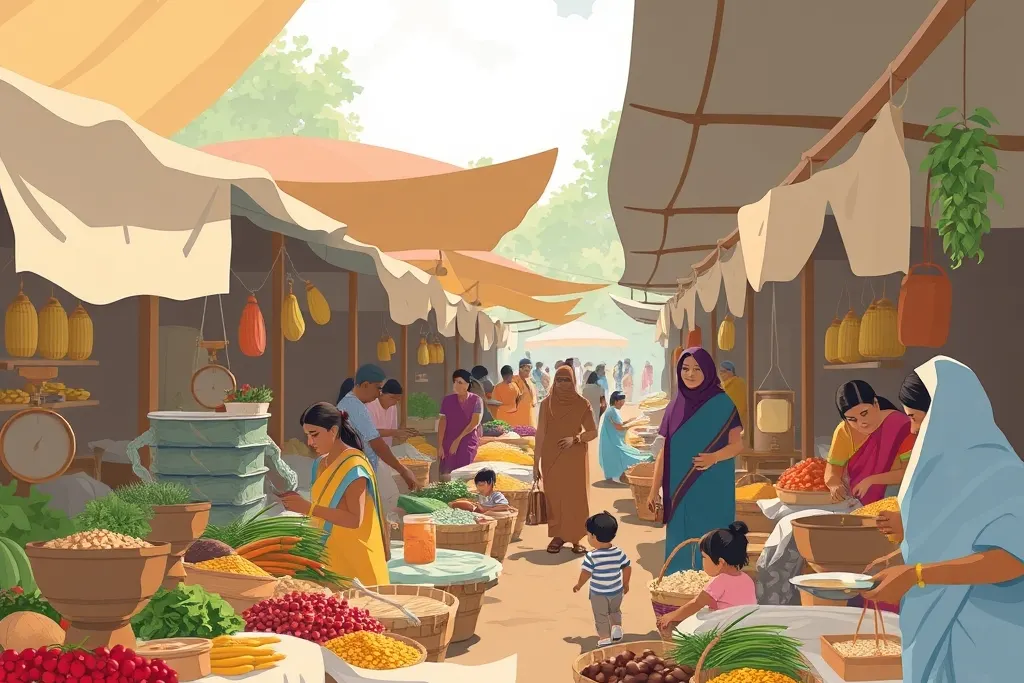
A market is any arrangement in which buyers and sellers meet to exchange goods and services — a weekly village market, a shopping complex or a website. The price is set by demand (how much buyers want at each price) and supply (how much sellers offer at each price). When the price rises, buyers want less and sellers offer more; where the two meet, the market is in balance. If many want a thing that is scarce, the price rises; if sellers have too much, it falls. Goods usually reach the consumer through a chain: the producer sells to a trader, who sells to a retailer, who sells to you; each link adds cost and takes a margin.
Trade within a country is domestic trade; between countries it is international trade. What a country sells abroad are exports; what it buys are imports. If exports exceed imports the balance of trade is favourable (a surplus); if imports exceed exports there is a deficit. Countries trade because no country produces everything efficiently. A tariff is a tax on imports. The World Trade Organization (1995, Geneva) sets rules for trade between countries. Consumers have rights too: India's consumer protection law gives the rights to safety, information, choice and to be heard, and National Consumer Day is observed on 24 December.
A market is any arrangement in which buyers and sellers meet to exchange goods and services — a weekly village market, a shopping complex or a website. The price is set by demand (how much…
Key takeaways
- A need is essential to live; a want is beyond that. Scarcity forces choice, and what is given up is the opportunity cost. Goods are things, services are work done for you.
- Factors of production and their rewards: land — rent, labour — wages, capital — interest, enterprise — profit.
- Primary takes from nature, secondary makes goods from materials, tertiary gives services. Public sector is government-owned; private is owned by individuals or companies; organised work has regular protected terms.
- Barter needs a double coincidence of wants. Money serves as medium, unit, store and deferred payment. RBI issues notes; the one-rupee note and coins come from the Government of India.
- Banks take deposits and lend; they charge more on loans than they pay on deposits. RBI (1935) is the central bank, NABARD (1982) serves rural credit, and informal credit is unregulated.
- Price is set where demand and supply meet. Exports minus imports gives the balance of trade; the WTO (1995, Geneva) sets trade rules.
Practice questions (24)
Attempt each one before opening the answer. Every explanation names the tempting wrong option as well as the right one, because that is where marks are lost.
Which of the following is a need rather than a want?
Show answer
Answer: C — Drinking water
Water is essential to live; the rest are wants.Scarcity arises because:
Show answer
Answer: A — Wants are unlimited while resources are limited
The gap between unlimited wants and limited means forces choice.What we give up when we choose one option over another is called:
Show answer
Answer: B — Opportunity cost
That is the definition of opportunity cost.
Show the other 21 questions
Which of these is a service?
Show answer
Answer: C — A teacher's lesson
A teachers lesson is a service because it is work done for others rather than a physical good; a book, rice and a table are goods you can touch and carry.The reward for the factor "labour" is:
Show answer
Answer: B — Wages
Labour is rewarded with wages; rent, interest and profit are the rewards of land, capital and enterprise, so each is a tempting but wrong match for labour.Interest is the reward for:
Show answer
Answer: C — Capital
Interest is the reward for capital; land earns rent and labour earns wages, so those are the tempting wrong factors for this reward.The factor that organises the others and bears risk is:
Show answer
Answer: B — Enterprise
Enterprise is the factor that organises the others and bears risk, and the entrepreneur earns profit; capital only supplies funds and earns interest, so it is the tempting wrong choice.Which of these is capital in the economic sense?
Show answer
Answer: A — A loom used to weave cloth
A loom is man-made and used again and again; a river is land and effort is labour.Fishing and mining belong to the:
Show answer
Answer: A — Primary sector
Fishing and mining take directly from nature, which is the mark of the primary sector; the secondary sector turns raw materials into goods, so it is the wrong sector here.A factory making sugar from sugarcane is in the:
Show answer
Answer: B — Secondary sector
It turns raw material into another good.A bank clerk and a bus driver belong to the:
Show answer
Answer: C — Tertiary sector
A bank clerk and a bus driver both provide services, which places them in the tertiary sector; the primary sector takes from nature and the secondary sector makes goods, so neither fits.The public sector means activities that are:
Show answer
Answer: A — Owned or run by the government
Public means government-owned or government-run.Barter requires:
Show answer
Answer: B — A double coincidence of wants
Barter needs a double coincidence of wants, meaning each side must want what the other has; currency, a bank account or a cheque are money-based tools that barter does without.Currency notes in India, other than the one-rupee note, are issued by:
Show answer
Answer: B — The Reserve Bank of India
The RBI issues notes; the one-rupee note and coins come from the Government.Which is a function of money?
Show answer
Answer: A — Medium of exchange
Money is a medium of exchange, unit of account, store of value and standard of deferred payment.Select the correct statements.
Show answer
Answer: B — Notes and coins are legal tender; C — Money is a store of value; D — Prices are stated in money, the unit of account
A cheque is an order to a bank, not legal tender.A bank earns mainly because it charges:
Show answer
Answer: B — More on loans than it pays on deposits
The gap between the loan rate and the deposit rate is its income.The Reserve Bank of India was set up in:
Show answer
Answer: A — 1935
1935; it was nationalised in 1949. NABARD is 1982.A fixed deposit is money that is:
Show answer
Answer: B — Locked for a fixed period at a higher rate
It is locked for a period and earns more.An asset such as land that a lender can claim if a loan is not repaid is:
Show answer
Answer: B — Collateral
Collateral is an asset such as land that the lender can claim if the loan is not repaid, so it secures the loan; a deposit is money placed with a bank, which is the tempting but different idea.Price in a market is set by:
Show answer
Answer: A — Demand and supply
Price in a market is set where demand and supply meet; only the sellers wish or only the buyers wish is a one-sided view, since both sides together decide the price.What a country sells to other countries is called:
Show answer
Answer: B — Exports
What a country sells to other countries is called exports; imports are the opposite, goods bought from abroad, and that reversal is the common trap.A trade deficit means:
Show answer
Answer: B — Imports exceed exports
A deficit is when imports exceed exports.The World Trade Organization was established in 1995 and is headquartered at:
Show answer
Answer: B — Geneva
The World Trade Organization, set up in 1995, is headquartered at Geneva; Washington, Paris and New York are well-known world cities, so they tempt, but none of them hosts the WTO.