Public Policy in Practice: Health, Water and Sanitation, Food Security, Housing, MGNREGA and the Right to Education
2. Health, drinking water and sanitation: the NRHM and its successors
The National Rural Health Mission was launched in April 2005 to strengthen rural public health systems, especially in states with the weakest indicators. Its characteristic features were the ASHA (Accredited Social Health Activist), a village woman trained to link households with the health system and paid by incentives; Village Health and Sanitation Committees under the panchayat; untied funds to sub-centres and hospitals; and the Janani Suraksha Yojana, a cash incentive for institutional delivery, launched in 2005. The mission aimed at reducing maternal and infant mortality, and at community ownership, and it merged with a new urban component to become the National Health Mission in 2013. Later, the Ayushman Bharat scheme (2018) added a health-insurance cover for hospitalisation of poor families (PM-JAY) and health and wellness centres.
In drinking water, policy moved from supply to community management: the Accelerated Rural Water Supply Programme (1972–73), the National Drinking Water Mission (1986), then reforms that gave panchayats and user committees the role (Swajaldhara, 2002) and the Jal Jeevan Mission (2019), which aims at a functional household tap connection to every rural home. In sanitation, the Central Rural Sanitation Programme (1986) was followed by the Total Sanitation Campaign (1999), which made it demand-driven, Nirmal Bharat Abhiyan (2012) and the Swachh Bharat Mission (2014), which focused on toilet use and open-defecation-free status. The lesson in each is the same shift: from subsidy and construction by the state to behaviour change and ownership by the community, with sustaining the asset the hard part.
| Area | Milestone | Year |
|---|---|---|
| Health | National Rural Health Mission; ASHA; Janani Suraksha Yojana | 2005 |
| Health | National Health Mission (rural plus urban) | 2013 |
| Health | Ayushman Bharat, PM-JAY | 2018 |
| Drinking water | National Drinking Water Mission | 1986 |
| Drinking water | Jal Jeevan Mission | 2019 |
| Sanitation | Total Sanitation Campaign | 1999 |
| Sanitation | Swachh Bharat Mission | 2014 |
- Accelerated Rural Water Supply Programme1972–73
- National Drinking Water Mission1986
- Swajaldhara2002: role for panchayats and user committees
- Jal Jeevan Mission2019: a tap connection to every rural home
The National Rural Health Mission was launched in April 2005 to strengthen rural public health systems, especially in states with the weakest indicators. Its characteristic features were…
3. Food security and housing: the PDS, the National Food Security Act and rural and urban housing
The Public Distribution System (PDS) sells foodgrains at subsidised prices through fair-price shops, with the Food Corporation of India procuring and storing grain at the minimum support price and the states distributing it. It was universal in design before 1997, targeted from 1997 (the Targeted PDS, separating households below and above the poverty line) and given a legal basis by the National Food Security Act, 2013, which moved food from a welfare scheme to a legal entitlement. The Act covers up to 75 per cent of the rural and 50 per cent of the urban population, gives priority households 5 kg of grain per person per month at ₹3 (rice), ₹2 (wheat) and ₹1 (coarse grains), keeps the poorest Antyodaya households at 35 kg per household, gives pregnant and lactating women a maternity benefit and a hot meal, and supports children under the ICDS and the mid-day meal. The judicial push came from the writ petition in PUCL v. Union of India (2001), which turned the right to food into court orders.
Housing policy runs on two tracks. In rural areas the Indira Awaas Yojana (1985) gave grants to build a house for poor households and was restructured as the Pradhan Mantri Awas Yojana (Gramin) in 2016; in urban areas the national housing schemes concentrate on slum rehabilitation, credit-linked subsidies and affordable rental or ownership. The common criticisms are land, since housing needs a title and services, targeting errors, and the exclusion of the landless and migrants. Both housing and food security illustrate how the same state is a provider, regulator and buyer, which is the main analytical point for a paper that treats public policy as an instrument.
| Beneficiary | Entitlement |
|---|---|
| Priority households (up to 75% rural, 50% urban) | 5 kg per person per month at ₹3, ₹2 and ₹1 |
| Antyodaya households | 35 kg per household per month |
| Pregnant and lactating women | Meal and maternity benefit |
| Children | Meals through ICDS and school (mid-day meal) |
- Universal PDSBefore 1997
- Targeted PDSFrom 1997: below and above the poverty line
- National Food Security Act, 2013Food becomes a legal entitlement
The Public Distribution System (PDS) sells foodgrains at subsidised prices through fair-price shops, with the Food Corporation of India procuring and storing grain at the minimum support…
4. MGNREGA: a legal guarantee of work and the role of the Gram Sabha
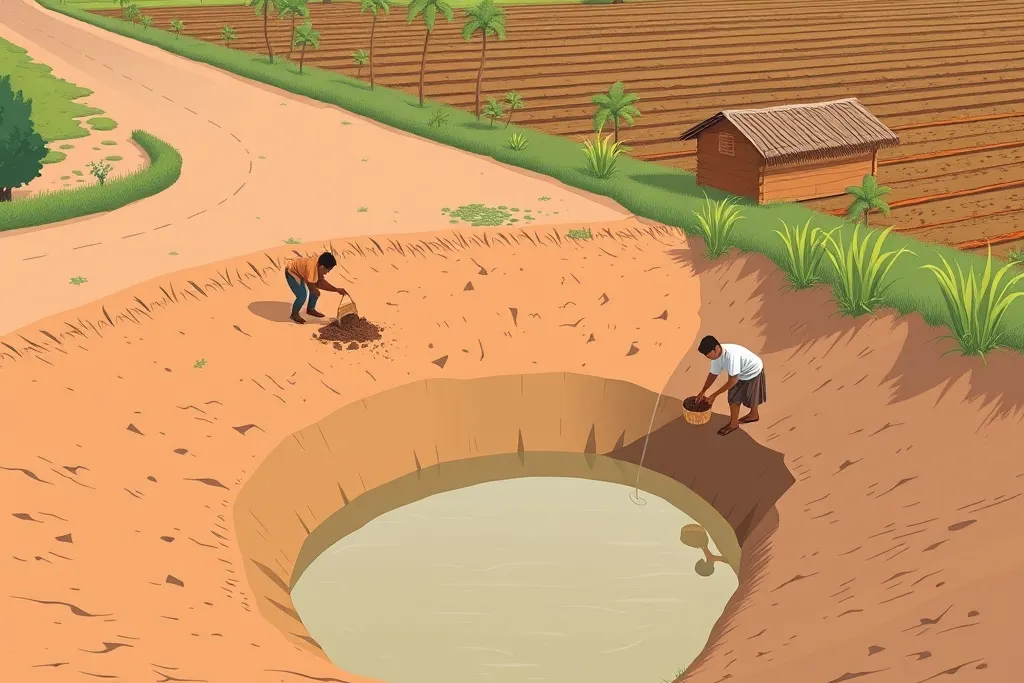
The Mahatma Gandhi National Rural Employment Guarantee Act, 2005 (NREGA, renamed MGNREGA in 2009) was notified in 2006 for 200 districts and extended to every rural district by 2008. Its core is a legal guarantee of at least 100 days of unskilled manual work a year to every rural household whose adult members volunteer for it, at the statutory wage. Work is demand-driven: a household applies, and if work is not provided within 15 days, it is entitled to an unemployment allowance from the state. At least one-third of the beneficiaries must be women. The programme is implemented by the Gram Panchayat, which must execute at least half of the works by value, and the work is to create durable assets such as water conservation structures, rural roads and drought-proofing.
Accountability is built in through social audit by the Gram Sabha, public display of muster rolls and wage payment through bank or post-office accounts. The arguments for are that it acts as an insurance against rural distress, raises the bargaining power of landless labourers and women, and builds assets; the arguments against are delays in wage payment, leakages, uneven performance across states and the quality of assets. In answers on public policy, MGNREGA is the standard example of a rights-based scheme whose demand-driven design differs from a budget-capped programme. Note that the Act has been the subject of proposals and legislation to restructure it, so a student should check its current form from the Ministry of Rural Development.
| Feature | Provision |
|---|---|
| Guarantee | 100 days of unskilled work per rural household per year |
| Trigger | Household demand; work within 15 days or unemployment allowance |
| Women | At least one-third of beneficiaries |
| Implementing body | Gram Panchayat, at least half the works by value |
| Accountability | Social audit by the Gram Sabha |
The Mahatma Gandhi National Rural Employment Guarantee Act, 2005 (NREGA, renamed MGNREGA in 2009) was notified in 2006 for 200 districts and extended to every rural district by 2008. Its…
5. The Right to Education: Article 21A and the 2009 Act
The 86th Constitutional Amendment (2002) inserted Article 21A, which makes free and compulsory education a fundamental right for children aged 6 to 14, and the Right of Children to Free and Compulsory Education Act, 2009 (the RTE Act) came into force on 1 April 2010 to give effect to it. It makes the State and local authorities responsible for free elementary education in a neighbourhood school; sets norms for schools, including pupil-teacher ratios of 30:1 at the primary stage and 35:1 at the upper primary stage, buildings and teacher qualifications; prohibits capitation fees, screening at admission and physical punishment; and requires private unaided schools to reserve 25 per cent of entry-level seats for children from disadvantaged groups, with the State reimbursing the cost. The Supreme Court upheld the 25 per cent provision in 2012.
The Act is also known for what it left out: it covers the 6 to 14 range, not early childhood or secondary education, though the Constitution separately asks the State, in Article 45, to provide early childhood care. It is another rights-based law, but its implementation depends on the supply of teachers and facilities, and its monitoring uses the National Commission for Protection of Child Rights and state commissions. The Act's rules on the detention of children in the elementary stage were amended in 2019 to allow states to hold back children in classes V and VIII after a regular examination and remedial teaching, and a student should check how a given state has applied this.
| Item | Fact |
|---|---|
| Constitutional basis | Article 21A, inserted by the 86th Amendment, 2002 |
| Age group | 6 to 14 years |
| Act in force | 1 April 2010 |
| Pupil-teacher ratio | 30:1 (primary), 35:1 (upper primary) |
| Private school seats | 25% for disadvantaged children |
- A fundamental right
- Ages 6 to 14
- Enforceable
- A directive principle
- Children below six
- Early childhood care and education
The 86th Constitutional Amendment (2002) inserted Article 21A, which makes free and compulsory education a fundamental right for children aged 6 to 14, and the Right of Children to Free and…
Key takeaways
- Any public policy answer should state the problem, the constitutional basis, the entitlement, the implementing agency and the monitoring mechanism; rights-based laws (RTE, NFSA, MGNREGA) differ from budget-capped programmes.
- The National Rural Health Mission began in 2005 with ASHAs, village health committees and the Janani Suraksha Yojana, and became the National Health Mission in 2013.
- Drinking-water and sanitation policy moved from state supply to community management, from Swajaldhara and the Total Sanitation Campaign to the Jal Jeevan and Swachh Bharat Missions.
- The National Food Security Act, 2013 covers up to 75% of rural and 50% of urban people with 5 kg of grain per person a month at ₹3, ₹2 and ₹1, and 35 kg for Antyodaya households.
- MGNREGA guarantees 100 days of unskilled work to a rural household on demand, with an unemployment allowance if work is not given in 15 days, one-third women and Gram Sabha social audit.
- Article 21A, inserted in 2002, makes education a fundamental right for ages 6 to 14, and the RTE Act, 2009 (in force 1 April 2010) reserves 25% of entry-level private school seats for disadvantaged children.
Practice questions (24)
Attempt each one before opening the answer. Every explanation names the tempting wrong option as well as the right one, because that is where marks are lost.
The 'NHRM' named in the syllabus is the:
Show answer
Answer: B — National Rural Health Mission
The Mission was launched in 2005 to strengthen rural public health, and the common abbreviation is NRHM. In 2013 it became part of the National Health Mission.The worker who links households with the health system under the NRHM is the:
Show answer
Answer: C — ASHA
The Accredited Social Health Activist is a village woman paid by performance-based incentives. The Anganwadi worker belongs to the ICDS.Under the National Food Security Act, 2013, an Antyodaya household is entitled to grain of:
Show answer
Answer: D — 35 kg per household per month
The poorest households keep the 35 kg per household entitlement, while priority households get 5 kg per person. The Act covers up to 75% of the rural and 50% of the urban population.
Show the other 21 questions
MGNREGA gives a rural household who demands work an unemployment allowance if work is not provided within:
Show answer
Answer: A — 15 days
The Act sets a fifteen-day limit, which is what makes the guarantee demand-driven and legally enforceable. The allowance is paid by the state government.The social audit of MGNREGA works is carried out by the:
Show answer
Answer: B — Gram Sabha
The Gram Sabha audits works and muster rolls in public. It is a Panchayati Raj accountability mechanism.Article 21A of the Constitution makes education a fundamental right for children in the age group:
Show answer
Answer: C — 6 to 14 years
The 86th Amendment of 2002 inserted Article 21A for ages 6 to 14. Early childhood care for children below six is a directive principle under Article 45.The RTE Act, 2009 requires private unaided schools to reserve entry-level seats for disadvantaged children at the rate of:
Show answer
Answer: D — 25 per cent
Section 12(1)(c) provides the 25 per cent reservation, with the state reimbursing the cost, and the Supreme Court upheld it in 2012.Which of these is best described as a rights-based statute rather than a budget-capped programme?
Show answer
Answer: A — The National Food Security Act, 2013
The Act creates legal entitlements to grain that can be enforced in court. The other three are schemes whose coverage depends on allocations.Drinking water and health and sanitation are listed among the subjects that states may devolve to panchayats in the:
Show answer
Answer: B — Eleventh Schedule
The Eleventh Schedule lists twenty-nine matters under Article 243G, including drinking water and health and sanitation. The Twelfth Schedule is for municipalities.The Janani Suraksha Yojana, launched under the NRHM in 2005, gives a cash incentive for:
Show answer
Answer: C — Institutional delivery
The scheme aimed at cutting maternal and infant deaths by encouraging births in health facilities. It is paired with the ASHA's role in taking women there.The National Rural Employment Guarantee Act of 2005 was renamed after Mahatma Gandhi in:
Show answer
Answer: C — 2009
NREGA became MGNREGA by an amendment in 2009. 2006 is the tempting option because the Act first came into force in 200 districts on 2 February 2006, under its original name.The Pradhan Mantri Awas Yojana, launched in 2015, mainly aims at:
Show answer
Answer: D — Housing for all
PMAY (urban and rural) provides assistance to build or buy pucca houses. Rural road connectivity is the tempting option because it is another "Pradhan Mantri" scheme, but that is PMGSY (2000).The Jal Jeevan Mission, launched in 2019, aims to provide:
Show answer
Answer: A — A functional household tap connection to every rural household
Jal Jeevan Mission ("Har Ghar Jal") seeks tap water supply to every rural home. Toilets in every school is the tempting option because it belongs to the sanitation agenda, but that was the Swachh Vidyalaya campaign.Under Ayushman Bharat - Pradhan Mantri Jan Arogya Yojana (2018), an eligible family receives hospital cover of up to:
Show answer
Answer: B — Rs 5 lakh per family per year
PM-JAY covers secondary and tertiary hospitalisation up to Rs 5 lakh per family per year. Rs 50,000 is the tempting option because the older Rashtriya Swasthya Bima Yojana gave far smaller cover, about Rs 30,000 per family.The mid-day meal scheme for school children was renamed in 2021 as:
Show answer
Answer: C — PM POSHAN
The scheme became PM POSHAN (Pradhan Mantri Poshan Shakti Nirman) in 2021. POSHAN Abhiyaan is the tempting option because of the shared word, but it is the 2018 National Nutrition Mission for children under six and mothers.Under the National Food Security Act, 2013, each person in a "priority household" is entitled to subsidised foodgrain of:
Show answer
Answer: D — 5 kg per month
Priority households get 5 kg per person per month. 35 kg is the tempting figure because it is the per-household entitlement of Antyodaya Anna Yojana families, not a per-person amount.Under the National Food Security Act, 2013, every pregnant woman and lactating mother is entitled to a maternity benefit of not less than:
Show answer
Answer: A — Rs 6,000
Section 4 of the NFSA provides maternity benefit of at least Rs 6,000 along with a free meal during pregnancy and six months after childbirth. Rs 1,400 is the tempting figure because it is the Janani Suraksha Yojana cash incentive for rural institutional delivery in low-performing states.MGNREGA requires that, as far as possible, what share of the beneficiaries be women?
Show answer
Answer: B — At least one-third
Schedule II of the Act gives priority to women so that at least one-third of beneficiaries are women; actual participation has often exceeded half. One-half is the tempting option because women's share in person-days has frequently crossed 50 per cent, but that is an outcome, not the legal floor.The RTE Act, 2009 lays down a pupil-teacher ratio for primary classes (I-V) of:
Show answer
Answer: C — 30 : 1
The RTE Schedule fixes 30:1 for primary and 35:1 for upper primary classes. 35:1 is the tempting option because it is the upper-primary norm in the same Schedule.The National Health Mission, formed in 2013, brought together the National Rural Health Mission and the:
Show answer
Answer: D — National Urban Health Mission
NHM has two sub-missions, NRHM (2005) and NUHM (2013). Ayushman Bharat is the tempting option because it is the newer flagship health scheme, but it was launched only in 2018.Match List I (programme or law) with List II (year of launch or enactment). List I:
(A) MGNREGA
(B) National Food Security Act
(C) Swachh Bharat Mission
(D) Jal Jeevan Mission — List II:
(I) 2014
(II) 2019
(III) 2005
(IV) 2013Show answer
Answer: A — A-III, B-IV, C-I, D-II
MGNREGA was enacted in 2005, the NFSA in 2013, Swachh Bharat began in 2014 and Jal Jeevan in 2019. Swapping MGNREGA and the NFSA is the usual slip, since both are rights-based laws of the same government era.Assertion (A): The National Food Security Act requires the eldest woman, aged 18 or above, to be treated as head of the household for issuing ration cards. Reason (R): This provision was included to strengthen women's control over household food entitlements and so promote women's empowerment. Choose the correct option.
Show answer
Answer: A — Both A and R are true, and R is the correct explanation of A
Both hold, and R explains A: Section 13 makes the eldest woman head of household for ration cards explicitly for women's empowerment. The tempting choice is "R is not the correct explanation", but the Act's own heading for the section is "women empowerment".Given below are two statements. Statement I: The Right of Children to Free and Compulsory Education Act, 2009 came into force on 1 April 2010. Statement II: A 2019 amendment allowed states to hold regular examinations in classes V and VIII and to detain children who fail even after a re-examination. In the light of the above statements, choose the correct answer.
Show answer
Answer: A — Both Statement I and Statement II are true
Both statements are true. The 2019 amendment diluted the original no-detention policy of Section 16 at the states' option. Assuming the no-detention rule is still absolute and marking Statement II false is the trap.Which of the following are features of MGNREGA?
(A) Up to 100 days of guaranteed wage employment per rural household in a financial year
(B) Wages to be paid within fifteen days of the work being done
(C) Work to be provided within five kilometres of the residence, failing which extra wages are payable
(D) Eligibility restricted to households below the poverty line Choose the correct answer from the options given below.Show answer
Answer: B — A, B and C only
A, B and C are features of the Act (beyond 5 km, 10 per cent extra wages are payable). D is false: any rural household whose adult members volunteer for unskilled manual work may apply, which is what makes the scheme self-targeting rather than BPL-based.