Work, Energy, Collisions and Rotation in Depth: Variable Force, 2-D Collisions, Radius of Gyration, Rigid-Body Equilibrium
2. Collisions in Two Dimensions
In a two-dimensional collision momentum is conserved separately along each axis, and kinetic energy is conserved only for an elastic collision. A 2 kg ball moving at 6 m/s strikes an identical stationary ball elastically and is deflected 30° from its original line. Momentum along the original line: 2(6) = 2v₁cos 30° + 2v₂cos φ, and across it: 0 = 2v₁ sin 30° − 2v₂ sin φ. For equal masses in an elastic collision with one at rest the two balls leave at 90° to each other, so φ = 60° and v₁ = 6 cos 30° = 5.20 m/s and v₂ = 6 sin 30° = 3.00 m/s. The kinetic energy confirms it: ½ × 2 × 36 = 36 J before, and ½ × 2 × (27 + 9) = 36 J after. In an inelastic collision the kinetic energy falls and the 90° rule fails; if the bodies stick together, one momentum equation gives the common velocity and the loss is the difference of kinetic energies.
- Momentum along each axis separately
- Equal masses, one at rest, elasticThey leave at 90°: φ = 60°
- Speedsv₁ = 6 cos 30° = 5.20 m/s, v₂ = 6 sin 30° = 3.00 m/s
- Check kinetic energy36 J before, 36 J after
In a two-dimensional collision momentum is conserved separately along each axis, and kinetic energy is conserved only for an elastic collision. A 2 kg ball moving at 6 m/s strikes an…
3. Moment of Inertia and the Radius of Gyration
The radius of gyration k is the distance from the axis at which the whole mass M could be placed to give the same moment of inertia: I = Mk², so k = √(I/M). It depends on the body and the axis. For a ring about its axis k = R; for a disc k = R/√2; for a solid sphere about a diameter k = √(2/5) R ≈ 0.632 R; for a thin rod about its centre k = L/√12. A disc of mass 2 kg and radius 0.30 m has I = ½MR² = 0.09 kg m² and k = 0.30/√2 = 0.212 m. With the parallel-axis theorem I = I_cm + Md² the radius of gyration about the new axis is k² = k_cm² + d². A larger k means the mass is spread farther from the axis and the body resists angular acceleration more.
| Body and axis | I | k |
|---|---|---|
| Thin ring, through centre perpendicular to plane | MR² | R |
| Disc, through centre perpendicular to plane | ½MR² | R/√2 |
| Solid sphere, diameter | (2/5)MR² | √(2/5) R |
| Thin rod, through centre perpendicular | ML²/12 | L/√12 |
The radius of gyration k is the distance from the axis at which the whole mass M could be placed to give the same moment of inertia: I = Mk², so k = √(I/M). It depends on the body and the…
4. Equilibrium of a Rigid Body
A rigid body is in equilibrium when both the net force and the net torque about any point are zero: ΣF = 0 and Στ = 0. Take torques about the point where an unknown force acts, so that force drops out. A uniform 6 m plank of mass 20 kg rests on supports at its ends, with a 30 kg person standing 2 m from the left. Torques about the left end give R_right × 6 = 20g(3) + 30g(2) = 120g, so R_right = 20g = 196 N, and the vertical balance R_left = 50g − 196 = 294 N. The ladder problem is the second standard case. A uniform ladder of mass m leans at angle θ to the ground against a smooth wall. The wall gives only a horizontal push N_w, the floor gives N = mg upwards and friction f horizontally, and torques about the foot give N_w L sin θ = mg (L/2) cos θ, so N_w = ½ mg cot θ and therefore f = ½ mg cot θ. For m = 10 kg and θ = 60°, f = 28.3 N and the least coefficient of friction is f/N = ½ cot θ = 0.289.
- Take torques about the left endThe unknown R_left drops out
- R_right × 6 = 20g(3) + 30g(2) = 120gR_right = 20g = 196 N
- Vertical balanceR_left = 50g − 196 = 294 N
A rigid body is in equilibrium when both the net force and the net torque about any point are zero: ΣF = 0 and Στ = 0. Take torques about the point where an unknown force acts, so that…
Worked Numericals: Variable Force, Springs and the Radius of Gyration
| Problem | Working | Result |
|---|---|---|
| Spring k = 100 N m⁻¹ stretched 0.2 m from natural length | ½kx² = ½ × 100 × 0.04 | 2 J |
| Further stretch from 0.2 m to 0.4 m | ½ × 100 × (0.16 − 0.04) | 6 J (three times the first) |
| Force F = 3x² N acting from x = 0 to x = 2 m | ∫3x² dx = x³ from 0 to 2 | 8 J |
| Radius of gyration of a solid sphere about a diameter | k = √(I/M) = √(2/5) R | 0.632 R |
| Radius of gyration of a disc about its axis | √(1/2) R | 0.707 R |
Work-energy in depth, numbers
A Ladder in Equilibrium: Torque and Friction
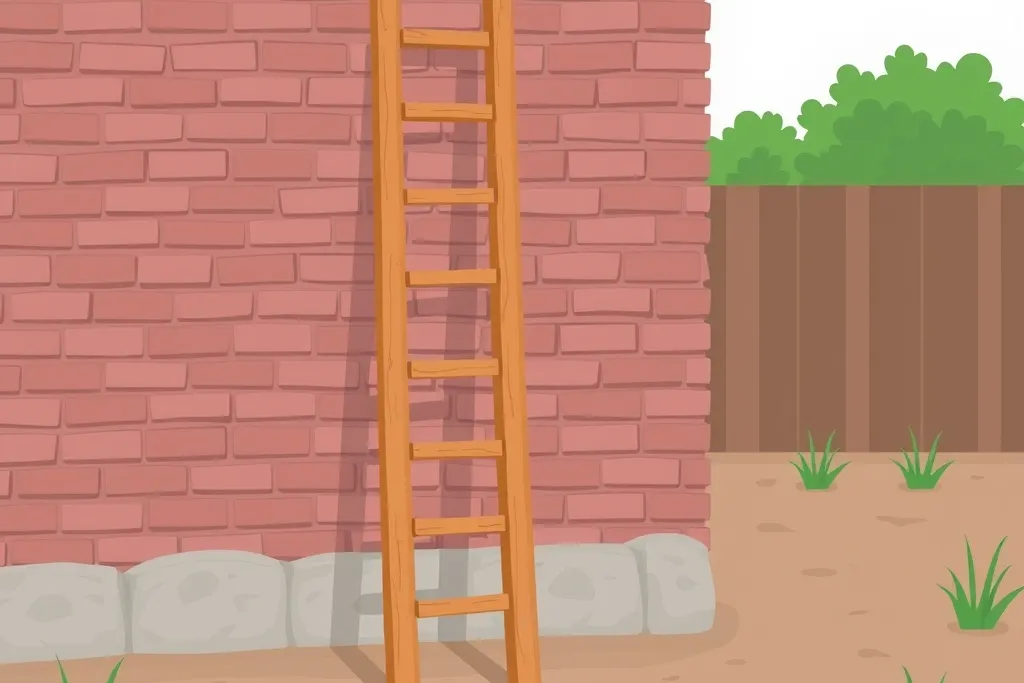
Worked example. A uniform ladder of length 5 m and weight 100 N leans against a smooth vertical wall, with its top 4 m above the floor, so its foot is 3 m from the wall. The wall gives only a horizontal reaction N_w, the floor gives a vertical reaction N = 100 N and a friction force f. Taking torques about the foot, the weight acts 1.5 m horizontally from the foot: 100 × 1.5 = N_w × 4, so N_w = 37.5 N. Balancing horizontal forces, f = N_w = 37.5 N, so the coefficient of friction must be at least 37.5/100 = 0.375 for the ladder to stand. Choosing the foot as the pivot removes the unknown floor forces from the torque equation, which is why it is the best pivot.
- Torques about the foot100 × 1.5 = N_w × 4
- Wall reactionN_w = 37.5 N
- Horizontal balancef = N_w = 37.5 N
- Least coefficient of friction37.5/100 = 0.375
Worked example. A uniform ladder of length 5 m and weight 100 N leans against a smooth vertical wall, with its top 4 m above the floor, so its foot is 3 m from the wall. The wall gives only…
Key takeaways
- Work by a variable force is the area under the F–x graph, ∫F dx; a spring stores ½kx², so doubling the extension quadruples the energy.
- In two dimensions momentum is conserved along each axis separately; an elastic collision of equal masses with one at rest sends them out at 90°.
- I = Mk²; k is R for a ring, R/√2 for a disc, √(2/5) R for a solid sphere and L/√12 for a rod about its centre.
- A rigid body is in equilibrium when ΣF = 0 and Στ = 0; take torques about the point of an unknown force.
- A ladder on a smooth wall needs friction f = ½ mg cot θ, with θ measured from the ground.
- Spring work scales as x², so the second half of a stretch costs three times the first; equal-mass elastic glancing collisions leave the bodies at 90°.
- Take torques about the point where most unknown forces act; for a ladder this is the foot, giving μ ≥ N_wall/N_floor.
Practice questions (24)
Attempt each one before opening the answer. Every explanation names the tempting wrong option as well as the right one, because that is where marks are lost.
The work done by a force F = 3x² (in newtons, x in metres) in moving a body from x = 0 to x = 2 m is:
Show answer
Answer: A — 8 J
W = ∫₀² 3x² dx = [x³]₀² = 8 J. Multiplying the end force (12 N) by the 2 m would wrongly give 24 J.A spring of constant 200 N/m is stretched from 0.1 m to 0.2 m. The extra work done is:
Show answer
Answer: A — 3.0 J
½k(0.2² − 0.1²) = 100 × 0.03 = 3.0 J. 1.0 J is the energy stored at 0.1 m, and the energy at 0.2 m is 4.0 J.In a two-dimensional elastic collision of identical masses, one initially at rest, the angle between the final velocities is:
Show answer
Answer: A — 90°
Momentum conservation gives v = v₁ + v₂ and energy conservation gives v² = v₁² + v₂², so v₁·v₂ = 0 and the velocities are perpendicular.
Show the other 21 questions
A 2 kg ball at 6 m/s strikes an identical stationary ball elastically and goes off at 30° to its original line. Its speed after the collision is:
Show answer
Answer: A — 5.20 m/s
The balls leave at 90°, so v₁ = 6 cos 30° = 5.20 m/s and the other moves at 6 sin 30° = 3.00 m/s. The energies 27 + 9 = 36 (in units of the mass factor) match.The radius of gyration of a uniform disc of radius R about its central axis perpendicular to its plane is:
Show answer
Answer: A — R/√2
I = ½MR² = Mk², so k = R/√2. k = R is the ring and √(2/5) R is the solid sphere.A disc of mass 2 kg and radius 0.30 m has a moment of inertia about its axis of:
Show answer
Answer: A — 0.09 kg m²
I = ½MR² = ½ × 2 × 0.09 = 0.09 kg m². 0.18 is MR², the value for a ring.A uniform 6 m plank of mass 20 kg rests on supports at its two ends and a 30 kg person stands 2 m from the left end. The reaction at the right end is (g = 9.8 m/s²):
Show answer
Answer: A — 196 N
Torques about the left end: R × 6 = 20g × 3 + 30g × 2 = 120g, so R = 20g = 196 N. The left reaction is the remaining 294 N.A uniform ladder leans against a smooth wall at 60° to the ground. The least coefficient of friction at the floor for it not to slip is:
Show answer
Answer: A — 0.289
μ = f/N = ½ cot θ = ½ × 0.577 = 0.289. 0.577 is cot 60° without the factor ½ that comes from the weight acting at the middle of the ladder.A spring (k = 100 N m⁻¹) is stretched by 0.2 m and then by a further 0.2 m. The work done during the second stretch is:
Show answer
Answer: A — 6 J
The total energy at 0.4 m is ½ × 100 × 0.16 = 8 J and at 0.2 m it is 2 J, so the second stretch takes 6 J. The 2 J is the first stretch alone.The work done by a force F = 3x² (in newtons, x in metres) in moving a body from x = 0 to x = 2 m is:
Show answer
Answer: A — 8 J
W = ∫₀² 3x² dx = [x³]₀² = 8 J. Taking the force at the end point (12 N) times 2 m would give 24 J, which ignores that the force varies.A uniform 5 m ladder of weight 100 N rests against a smooth wall with its top 4 m above the floor. The minimum coefficient of friction at the floor is:
Show answer
Answer: A — 0.375
Torques about the foot give N_w × 4 = 100 × 1.5, so N_w = 37.5 N, which equals the required friction; μ = 37.5/100 = 0.375. The value 0.75 would come from using the full 3 m instead of 1.5 m for the weight's lever arm.A 2 kg body initially at rest has 10 J of net work done on it. Its final speed is closest to:
Show answer
Answer: A — 3.2 m s⁻¹
Work–energy theorem: W = ½mv², so v = √(2W/m) = √10 ≈ 3.2 m s⁻¹. 5 m s⁻¹ = W/m ignores the square root; 2.2 m s⁻¹ = √(W/m) drops the factor 2.A constant force of 10 N acts on a body moving at 5 m s⁻¹ in the direction of the force. The instantaneous power delivered is:
Show answer
Answer: A — 50 W
P = F · v = 10 × 5 = 50 W. 2 W inverts the product to F/v; 15 W adds the numbers, which have different units.The radius of gyration of a thin ring of radius R about its central axis perpendicular to its plane is:
Show answer
Answer: A — R
All the ring's mass lies at distance R, so I = MR² = Mk² and k = R. R/√2 is the radius of gyration of a uniform disc about the same axis.The moment of inertia of a uniform rod of mass M and length L about an axis through its centre perpendicular to its length is:
Show answer
Answer: A — ML²/12
About the centre I = ML²/12; moving the axis to an end adds M(L/2)² and gives ML²/3 by the parallel-axis theorem. ML²/3 is the tempting answer if the axis position in the question is overlooked.Two point masses of 2 kg and 3 kg are at perpendicular distances 0.5 m and 1 m from an axis. Their combined moment of inertia about that axis is:
Show answer
Answer: A — 3.5 kg m²
I = Σmr² = 2(0.5)² + 3(1)² = 0.5 + 3 = 3.5 kg m². Using Σmr (without squaring) gives 4; 2.5 = (2 + 3)/2 averages the masses.A ball collides head-on and elastically with an identical stationary ball. After the collision:
Show answer
Answer: A — The two balls exchange velocities
Momentum and kinetic-energy conservation for equal masses give v₁′ = 0 and v₂′ = u. "Both with half speed" conserves momentum but not kinetic energy (it is the perfectly inelastic result, with the balls moving together).A spring of constant 100 N m⁻¹ is stretched from an extension of 0.1 m to 0.3 m. The work done is:
Show answer
Answer: A — 4 J
W = ½k(x₂² − x₁²) = 50(0.09 − 0.01) = 4 J. 2 J = ½k(x₂ − x₁)² forgets the squares separately; 9 J is ½kx₂² from zero, 5 J would be ½k times the plain difference.A 1 kg body moving east at 3 m s⁻¹ collides with a 1 kg body moving north at 4 m s⁻¹ and the two stick together. The speed of the combination is:
Show answer
Answer: A — 2.5 m s⁻¹
Momentum is conserved as a vector: p = √(3² + 4²) = 5 kg m s⁻¹ shared by 2 kg, so v = 2.5 m s⁻¹. 3.5 m s⁻¹ = (3 + 4)/2 adds the speeds arithmetically; 5 m s⁻¹ ignores the doubling of mass.A uniform rod of mass 3 kg and length 2 m is made to rotate about an axis through one end, perpendicular to the rod. Its moment of inertia is:
Show answer
Answer: A — 4 kg m²
I = ML²/3 = 3 × 4/3 = 4 kg m². 1 kg m² = ML²/12 is the value about the centre; 12 kg m² is ML² (a point mass at the end).A uniform beam of weight 100 N and length 4 m rests on supports at its two ends. A 200 N load is placed 1 m from the left end. The reaction at the left support is:
Show answer
Answer: A — 200 N
Take moments about the right end: R_L × 4 = 100 × 2 + 200 × 3 = 800, so R_L = 200 N (check: R_R = 300 − 200 = 100 N). 100 N is the reaction at the RIGHT support, the common mix-up of which end is heavier loaded.The radius of gyration of a uniform solid sphere of radius R about a diameter is:
Show answer
Answer: A — √(2/5) R ≈ 0.63R
I = ⅖MR² = Mk², so k = R√(2/5) ≈ 0.63R. √(2/3)R is the radius of gyration of a hollow sphere (I = ⅔MR²) and R/√2 that of a disc.A 5 kg block is pulled up a smooth 30° incline through a length of 4 m at constant speed (g = 10 m s⁻²). The work done by the pulling force is:
Show answer
Answer: A — 100 J
At constant speed the pull equals mg sin θ = 25 N along the incline, so W = 25 × 4 = 100 J (= mgh with h = 2 m). 200 J forgets the sin 30° (using mgL); 173 J uses cos 30°.P: Friction can do positive work on a body. Q: Work done by the centripetal force in uniform circular motion is zero. R: The kinetic energy of a system equals the kinetic energy of its centre of mass plus the kinetic energy relative to the centre of mass. S: Elastic collisions conserve momentum but not kinetic energy. Which are correct?
Show answer
Answer: A — P, Q and R
P (static friction accelerates a block on an accelerating conveyor), Q (force ⟂ displacement) and R (König's theorem) are correct. S is false: an elastic collision is defined by conserving kinetic energy as well as momentum.