Magnetic Effects of Current and Magnetism in Depth — Biot-Savart, Ampere, Moving-Coil Galvanometer and Magnetic Materials
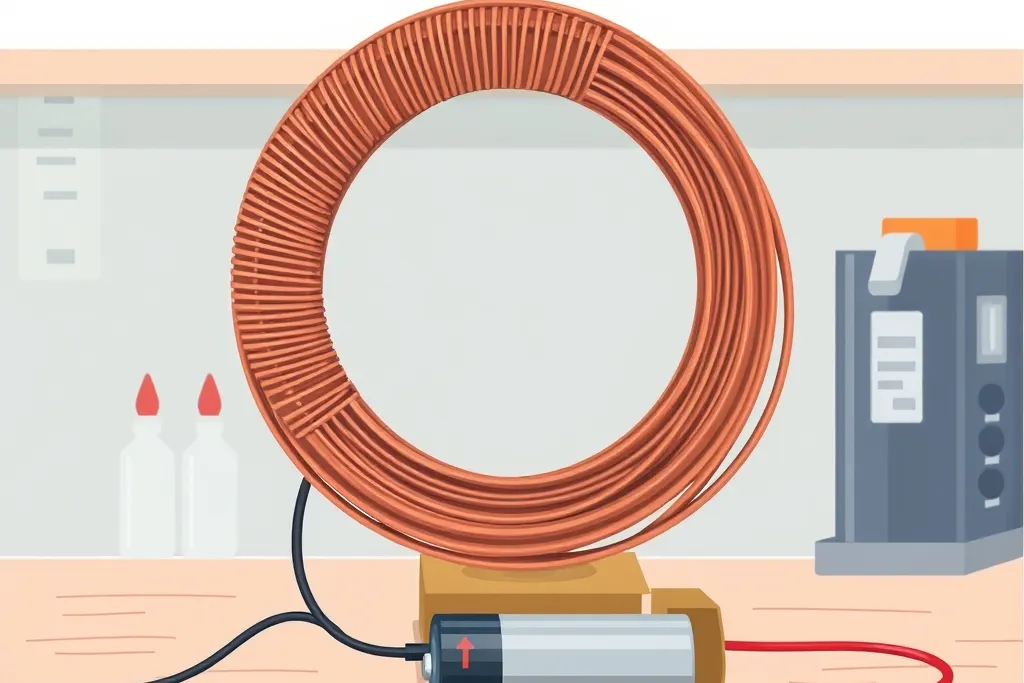
2. Forces — Charges in E and B, Wires and Parallel Currents
A charge q moving at v in electric field E and magnetic field B feels the Lorentz force F = q(E + v × B). In a uniform B alone it moves on a circle of radius r = mv/qB with period T = 2πm/qB. A proton at 2 × 10⁶ m/s in 0.5 T has r = 4.2 cm and T = 1.31 × 10⁻⁷ s; an alpha particle at the same speed (mass 4m_p, charge 2e) has r = 8.4 cm, twice as large. A proton accelerated through 1 kV gains speed 4.4 × 10⁵ m/s and then circles with r = 2.3 cm in a field of 0.2 T. If E and B are crossed so that qE = qvB, the charge goes straight: v = E/B, whatever its charge or mass, which is the principle of the velocity selector. For E = 3 × 10⁴ V/m and B = 0.1 T the selected speed is 3 × 10⁵ m/s.
A wire of length L carrying I in a field B feels F = BIL sin θ; for L = 0.2 m, I = 5 A, B = 0.4 T at 30° that is 0.2 N. Two long parallel wires carrying I₁ and I₂ at separation d exert on each other a force per unit length F/L = μ₀I₁I₂/2πd = 2 × 10⁻⁷ I₁I₂/d (N/m): attraction for currents in the same direction, repulsion for opposite directions. For 5 A and 8 A at 10 cm that is 8 × 10⁻⁵ N/m. The textbook definition of the ampere is the steady current which, in two infinitely long thin parallel wires 1 m apart in vacuum, produces 2 × 10⁻⁷ N per metre of length. (Since 2019 the SI fixes the elementary charge instead and derives the ampere from it, but the wire force still equals 2 × 10⁻⁷ N/m to extraordinary accuracy, and the syllabus line refers to the force definition.)
A charge q moving at v in electric field E and magnetic field B feels the Lorentz force F = q(E + v × B). In a uniform B alone it moves on a circle of radius r = mv/qB with period T =…
3. Torque on a Loop and the Moving-Coil Galvanometer
A planar loop of N turns, area A and current I has magnetic moment m = NIA, directed along its normal by the right-hand rule. In a uniform field B it feels no net force but a torque τ = m × B, of magnitude NIAB sin θ with θ the angle between the normal and B. For N = 50, A = 2 × 10⁻³ m², I = 0.5 A and B = 0.2 T the maximum torque is 0.010 N m and at θ = 60° it is 0.0087 N m. In a moving-coil galvanometer a coil in a radial field (so the torque stays NIAB) turns against a torsion spring with restoring torque kφ. At balance NIAB = kφ, so the deflection is φ = (NAB/k) I: it is proportional to the current, and the scale is uniform. The current sensitivity φ/I = NAB/k rises with more turns, a stronger field and a weaker spring, and the voltage sensitivity φ/V = NAB/(kR) also depends on the coil resistance R.
Conversion. A galvanometer of resistance G = 50 Ω that gives full scale at I_g = 2 mA is made into an ammeter by a low shunt S in parallel, with S = I_gG/(I − I_g). For 0–1 A, S = 0.002 × 50/0.998 = 0.100 Ω, and the ammeter's resistance GS/(G + S) is about 0.1 Ω, so it disturbs the circuit very little. It is made into a voltmeter by a large resistance R in series, with R = V/I_g − G. For 0–10 V, R = 10/0.002 − 50 = 4950 Ω, and the voltmeter's resistance is 5000 Ω, so it draws almost no current. An ideal ammeter has zero resistance and an ideal voltmeter infinite resistance, and every real instrument errs in the direction of the conversion that built it.
- Low shunt S in parallel
- S = I_gG/(I − I_g) = 0.100 Ω
- Ideal: zero resistance
- Large R in series
- R = V/I_g − G = 4950 Ω
- Ideal: infinite resistance
- Curved pole pieces, soft-iron cylinderMake the field radial
- Coil plane always contains B
- Torque is NIAB at every angle
- NIAB = kφφ = (NAB/k) I: uniform scale
A planar loop of N turns, area A and current I has magnetic moment m = NIA, directed along its normal by the right-hand rule. In a uniform field B it feels no net force but a torque τ = m ×…
4. The Bar Magnet, Earth's Field and Magnetic Materials
A current loop is a magnetic dipole, and a bar magnet is equivalent to a solenoid of the same moment. Far from a short magnet of moment m, the field on the axis is B = (μ₀/4π)(2m/r³) and on the equatorial line it is (μ₀/4π)(m/r³): exactly half, and in the opposite direction to m. For m = 1.2 A m² at r = 10 cm these are 2.4 × 10⁻⁴ T and 1.2 × 10⁻⁴ T. In a uniform field the torque is τ = mB sin θ and the potential energy U = −mB cos θ, so turning a dipole of 0.5 J/T from alignment to opposition in 0.2 T costs 2mB = 0.2 J. Field lines of a magnet are closed loops, and there is no isolated pole, so ∮B·dA = 0 over any closed surface.
Earth's field is described by three elements: the declination (angle between geographic and magnetic meridians), the dip δ (angle the field makes with the horizontal) and the horizontal component B_H. They are linked by B_H = B cos δ and B_V = B sin δ, so tan δ = B_V/B_H. With B_H = 0.30 G and δ = 60° the total field is 0.60 G and the vertical component 0.52 G; dip is 0° at the magnetic equator and 90° at the magnetic poles.
| Property | Diamagnetic | Paramagnetic | Ferromagnetic |
|---|---|---|---|
| Susceptibility χ | Small and negative | Small and positive | Large and positive |
| In a field | Weakly repelled | Weakly attracted | Strongly attracted |
| Effect of temperature | Almost none | χ falls as 1/T (Curie law) | Becomes paramagnetic above the Curie temperature |
| Examples | Bismuth, copper, lead, water | Aluminium, sodium, oxygen, calcium | Iron, cobalt, nickel, Alnico |
By Curie's law, χ ∝ 1/T for a paramagnet, so a sample with χ = 2.4 × 10⁻⁵ at 300 K has χ = 1.8 × 10⁻⁵ at 400 K. A ferromagnet is made of aligned domains, and its B–H curve shows retentivity and coercivity and encloses a loop whose area is the energy lost per cycle. Soft iron has low retentivity and coercivity, so it suits electromagnets, transformer cores and the galvanometer's cylinder; steel and Alnico have high values, so they make permanent magnets.
A current loop is a magnetic dipole, and a bar magnet is equivalent to a solenoid of the same moment. Far from a short magnet of moment m, the field on the axis is B = (μ₀/4π)(2m/r³) and on…
Key takeaways
- Loop: μ₀NI/2R at the centre and μ₀NIR²/[2(R² + x²)3/2] on the axis; wire: μ₀I/2πr; solenoid: μ₀nI inside.
- A charge in B circles with r = mv/qB and T = 2πm/qB; crossed E and B pass only v = E/B, whatever q and m are.
- Parallel currents in the same direction attract with F/L = 2 × 10⁻⁷ I₁I₂/d N/m; the ampere is defined by this force.
- Torque on a loop is NIAB sin θ; a galvanometer deflects φ = (NAB/k)I; a shunt S = I_gG/(I − I_g) makes an ammeter and a series R = V/I_g − G a voltmeter.
- A short bar magnet's axial field is twice its equatorial field; τ = mB sin θ and U = −mB cos θ; Earth's elements obey B_H = B cos δ.
- Diamagnets have small negative χ, paramagnets small positive χ that falls as 1/T, and ferromagnets large χ and a Curie temperature above which they turn paramagnetic.
Practice questions (24)
Attempt each one before opening the answer. Every explanation names the tempting wrong option as well as the right one, because that is where marks are lost.
A circular coil of 10 turns and radius 5 cm carries 2 A. The magnetic field at its centre is closest to (μ₀ = 4π × 10⁻⁷ T m/A):
Show answer
Answer: A — 2.5 × 10⁻⁴ T
B = μ₀NI/2R = 4π × 10⁻⁷ × 10 × 2/(2 × 0.05) = 2.51 × 10⁻⁴ T. Using 2πR in the denominator instead of 2R gives 8 × 10⁻⁵ T; omitting the factor of 2 gives 5.0 × 10⁻⁴ T, and using R in metres as centimetres shifts the decimal.The magnetic field on the axis of a circular loop, at a distance x = R√3 from its centre, compared with the field at the centre is:
Show answer
Answer: A — 1/8 of it
B(x)/B(0) = [R²/(R² + x²)]3/2 = [1/(1 + 3)]3/2 = (1/4)3/2 = 1/8. The value 1/4 forgets the 3/2 power and 1/16 squares instead of raising to 3/2.Two long parallel wires 10 cm apart carry 5 A and 8 A in the same direction. The force per unit length between them is:
Show answer
Answer: A — 8 × 10⁻⁵ N/m, attractive
F/L = 2 × 10⁻⁷ × 5 × 8/0.10 = 8 × 10⁻⁵ N/m, and currents in the same direction attract. Choosing repulsive confuses this with like charges; 8 × 10⁻⁷ uses d = 10 instead of 0.10 m, and 4 × 10⁻⁵ uses μ₀/4π where μ₀/2π belongs.
Show the other 21 questions
In a velocity selector with E = 3 × 10⁴ V/m and B = 0.1 T crossed at right angles, particles pass undeflected if their speed is:
Show answer
Answer: A — 3 × 10⁵ m/s, whatever their charge and mass
For no deflection qE = qvB, so v = E/B = 3 × 10⁴/0.1 = 3 × 10⁵ m/s. The charge q cancels, and the mass never enters, so the selector passes any particle at that speed. Inverting the ratio gives 3 × 10⁻⁶ m/s, which is absurd, and the other two values are decimal-place slips in B.A proton moving at 2 × 10⁶ m/s enters a uniform field of 0.5 T at right angles to it. (m_p = 1.67 × 10⁻²⁷ kg, e = 1.6 × 10⁻¹⁹ C.) The radius of its circular path is closest to:
Show answer
Answer: A — 4.2 cm
r = mv/(qB) = 1.67 × 10⁻²⁷ × 2 × 10⁶/(1.6 × 10⁻¹⁹ × 0.5) = 4.2 × 10⁻² m. An alpha particle at the same speed would give 8.4 cm, because its mass-to-charge ratio is twice as large; 2.1 cm corresponds to doubling the field.A galvanometer of resistance 50 Ω gives full-scale deflection for 2 mA. The shunt needed to convert it into a 0–1 A ammeter is closest to:
Show answer
Answer: A — 0.10 Ω in parallel
S = I_gG/(I − I_g) = 0.002 × 50/0.998 = 0.100 Ω, in parallel so that almost all the current bypasses the coil. The value 4950 Ω in series is the multiplier for a 0–10 V voltmeter, and 25 kΩ results from I/I_g × G instead of the reciprocal ratio.The same 50 Ω, 2 mA galvanometer is to be made into a voltmeter reading 0–10 V. The resistance to be connected in series is:
Show answer
Answer: A — 4950 Ω
The total resistance must be V/I_g = 10/0.002 = 5000 Ω, of which 50 Ω is the coil, so R = 4950 Ω. The value 5000 Ω is the voltmeter's total resistance, not the series addition; 5050 Ω adds the coil instead of subtracting it.For a short bar magnet the magnetic field at a point on its axis, compared with the field at an equal distance on its equatorial line, is:
Show answer
Answer: A — twice as large and in the same direction as m
Axial B = (μ₀/4π)(2m/r³) points along m; equatorial B = (μ₀/4π)(m/r³) points against m. So the axial field is twice as large, in the direction of m. The second option gives the axial field the equatorial direction, and the third inverts the ratio.A paramagnetic sample has susceptibility 2.4 × 10⁻⁵ at 300 K. Its susceptibility at 400 K is:
Show answer
Answer: A — 1.8 × 10⁻⁵
Curie's law gives χ ∝ 1/T, so χ = 2.4 × 10⁻⁵ × 300/400 = 1.8 × 10⁻⁵. Raising the susceptibility to 3.2 × 10⁻⁵ inverts the ratio, and 2.4 × 10⁻⁵ treats the sample as diamagnetic, whose susceptibility is nearly temperature-independent.At a place the horizontal component of Earth's field is 0.30 G and the angle of dip is 60°. The total field is:
Show answer
Answer: A — 0.60 G
B_H = B cos δ, so B = 0.30/cos 60° = 0.60 G. The value 0.52 G is the vertical component B sin δ; 0.15 G multiplies B_H by cos 60° instead of dividing, and 0.26 G is B_H × sin 60°.A rectangular coil of 50 turns and area 2 × 10⁻³ m² carries 0.5 A in a uniform field of 0.2 T. The maximum torque on it is:
Show answer
Answer: A — 0.010 N m
τ_max = NIAB = 50 × 0.5 × 2 × 10⁻³ × 0.2 = 0.010 N m, when the plane of the coil is parallel to B. The 0.0087 N m value is the torque when the normal makes 60° with B, and zero occurs when the plane is perpendicular to B.The magnetic field at the centre of a single circular loop of radius 10 cm carrying 5 A is closest to (μ₀ = 4π × 10⁻⁷ T m A⁻¹):
Show answer
Answer: A — 3.1 × 10⁻⁵ T
B = μ₀I/2R = 4π × 10⁻⁷ × 5/(2 × 0.1) = π × 10⁻⁵ ≈ 3.1 × 10⁻⁵ T. 6.3 × 10⁻⁵ T forgets the 2 in the denominator; 1.6 × 10⁻⁵ T would be the field of a semicircle.A long straight wire carries 10 A. The magnetic field at a distance of 5 cm from it is:
Show answer
Answer: A — 4 × 10⁻⁵ T
B = μ₀I/2πr = 2 × 10⁻⁷ × 10/0.05 = 4 × 10⁻⁵ T. Using 5 cm as 5 m or forgetting to convert to metres leads to the other values; 8 × 10⁻⁵ T uses μ₀I/πr.A solenoid has 1000 turns per metre and carries 2 A. The magnetic field inside it (far from the ends) is closest to:
Show answer
Answer: A — 2.5 × 10⁻³ T
B = μ₀nI = 4π × 10⁻⁷ × 1000 × 2 ≈ 2.5 × 10⁻³ T. At the very end of a long solenoid the field is half of this (1.3 × 10⁻³ T), the common trap.A coil of 10 turns, each of area 0.01 m², carries 2 A. Its magnetic dipole moment is:
Show answer
Answer: A — 0.2 A m²
m = NIA = 10 × 2 × 0.01 = 0.2 A m². Omitting N gives 0.02 A m², a very common slip when the coil has several turns.Which of the following materials is diamagnetic?
Show answer
Answer: A — Bismuth
Bismuth (like copper, water and gold) has a small negative susceptibility and is weakly repelled by a magnet. Aluminium and oxygen are paramagnetic and iron is ferromagnetic.Two long parallel wires 5 cm apart each carry 10 A in opposite directions. The force per unit length between them is:
Show answer
Answer: A — 4 × 10⁻⁴ N m⁻¹, repulsive
F/L = μ₀I₁I₂/2πd = 2 × 10⁻⁷ × 100/0.05 = 4 × 10⁻⁴ N m⁻¹. Opposite currents repel (parallel currents attract), so "attractive" is the tempting wrong sign; the magnitude has no extra factor ½.A toroid has 500 turns and a mean radius of 10 cm, and carries 2 A. The magnetic field inside the core (air) is:
Show answer
Answer: A — 2 × 10⁻³ T
B = μ₀NI/2πr = 4π × 10⁻⁷ × 500 × 2/(2π × 0.1) = 2 × 10⁻³ T, the same as μ₀nI with n = N/2πr. 4 × 10⁻³ T results from dropping the factor 2 in 2πr.A proton moves in a uniform magnetic field of 1 T perpendicular to its velocity. Its cyclotron frequency is closest to (m = 1.67 × 10⁻²⁷ kg, q = 1.6 × 10⁻¹⁹ C):
Show answer
Answer: A — 15 MHz
f = qB/2πm = 1.6 × 10⁻¹⁹/(2π × 1.67 × 10⁻²⁷) ≈ 1.5 × 10⁷ Hz, independent of the speed. 96 MHz is the angular frequency ω = qB/m in rad s⁻¹ read as a frequency; the 2π matters.P: An ammeter should have a very low resistance. Q: A voltmeter should have a very high resistance. R: An ideal ammeter is connected in parallel with the circuit element. S: A shunt connected across a galvanometer reduces the resistance of the instrument. Which are correct?
Show answer
Answer: A — P, Q and S
P, Q and S are correct. R is false: an ammeter is connected in SERIES so that the whole current passes through it; placing a very low resistance in parallel would short the element.Two long parallel wires carrying 10 A and 20 A in the same direction are 30 cm apart. The point between them where the net magnetic field is zero lies ____ cm from the 10 A wire.
Numerical answer — type the value.
Show answer
Answer: 10
Between same-direction currents the two fields oppose, so zero requires μ₀I₁/2πx = μ₀I₂/2π(30 − x): 10/x = 20/(30 − x), giving x = 10 cm (check: 10/10 = 1 and 20/20 = 1). The midpoint (15 cm) is wrong, as the stronger wire must be farther away.A proton moves with speed 2 × 10⁶ m s⁻¹ at 60° to a uniform magnetic field of 0.5 T. The pitch of its helical path is closest to (m = 1.67 × 10⁻²⁷ kg, q = 1.6 × 10⁻¹⁹ C):
Show answer
Answer: A — 0.13 m
Period T = 2πm/qB = 1.31 × 10⁻⁷ s. Only the component along B advances the particle: v∥ = v cos 60° = 10⁶ m s⁻¹, so pitch = v∥T ≈ 0.13 m. 0.23 m uses v sin 60° (the perpendicular component); 0.036 m is the radius of the circular projection.A semicircular wire of radius 0.1 m carries 5 A. The magnetic field at its centre of curvature is ____ μT (μ₀ = 4π × 10⁻⁷ T m A⁻¹; one decimal place).
Numerical answer — type the value.
Show answer
Answer: 15.7
A semicircle gives half the field of a full loop: B = μ₀I/4R = 4π × 10⁻⁷ × 5/(4 × 0.1) = 1.57 × 10⁻⁵ T = 15.7 μT. Check: the full loop gives 31.4 μT, so half is 15.7 μT. Quoting the full-loop value 31.4 μT is the typical slip.A galvanometer of resistance 1000 Ω gives full-scale deflection for 50 μA. The shunt resistance needed to convert it into an ammeter reading 0 to 5 mA is ____ Ω (one decimal place).
Numerical answer — type the value.
Show answer
Answer: 10.1
The shunt carries I − I_g = 5 mA − 0.05 mA = 4.95 mA and shares the same voltage as the galvanometer: I_g G = (I − I_g)S, so S = 0.05 × 1000/4.95 ≈ 10.1 Ω. Using S = G I_g/I (10 Ω) ignores that the galvanometer's own share of the current is subtracted.