Practical Chemistry: Titrations, Enthalpy Experiments, Sols and the Iodide–Peroxide Kinetics
2. Permanganate Titrations: Oxalic Acid and Mohr’s Salt
| Titration | Ionic equation | Ratio MnO₄⁻ : analyte |
|---|---|---|
| Oxalic acid, warmed to 60–70 °C | 2MnO₄⁻ + 5C₂O₄²⁻ + 16H⁺ → 2Mn²⁺ + 10CO₂ + 8H₂O | 2 : 5 |
| Mohr’s salt, at room temperature | MnO₄⁻ + 5Fe²⁺ + 8H⁺ → Mn²⁺ + 5Fe³⁺ + 4H₂O | 1 : 5 |
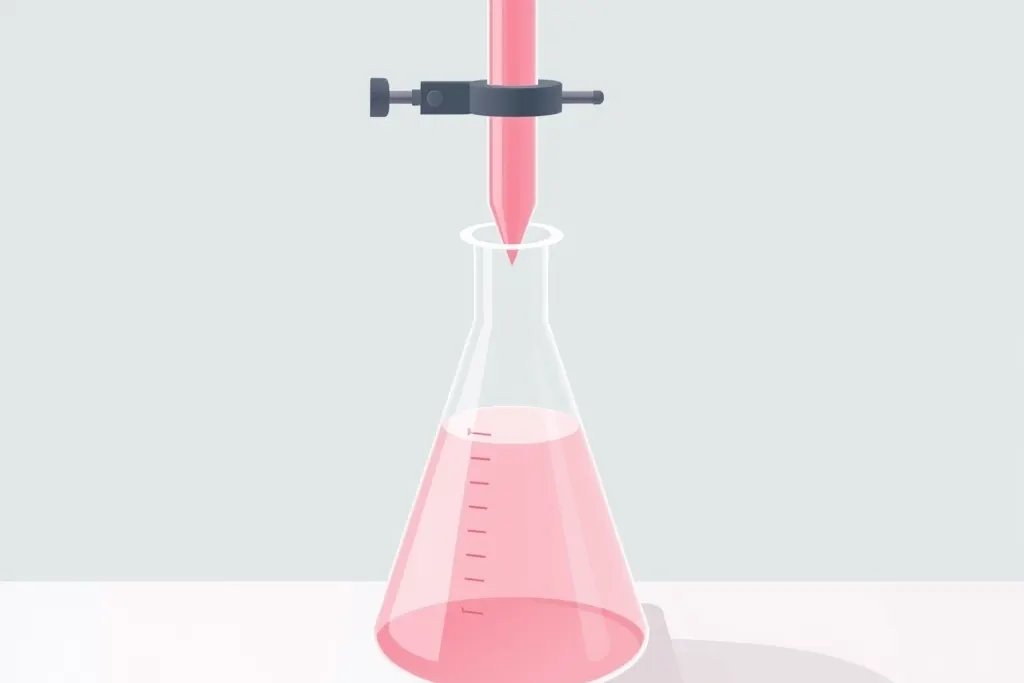
Permanganate is its own indicator: the purple MnO₄⁻ is reduced to almost colourless Mn²⁺, so the end point is the first permanent faint pink from one excess drop. The medium must be dilute sulphuric acid: hydrochloric acid would be oxidised by permanganate to chlorine, and nitric acid is itself an oxidant. The oxalic acid titration is warmed because it is slow at first, then autocatalysed by the Mn²⁺ formed, so the first drops decolourise slowly and later ones instantly. Read the burette at the top of the meniscus here, since the solution is too dark to see its bottom.
Worked (oxalic acid). 25.0 mL of 0.0500 M oxalic acid contains 1.25 mmol; the ratio 2 : 5 needs 1.25 × 2/5 = 0.50 mmol of permanganate, which is 25.0 mL of 0.0200 M KMnO₄. In normality terms the equivalent weight of the dihydrate H₂C₂O₄·2H₂O is 126.06/2 = 63.03 and that of KMnO₄ in acid is 158.03/5 = 31.61. Worked (Mohr’s salt). 1.96 g of Mohr’s salt in 250 mL is 0.0200 M in Fe²⁺; a 25.0 mL portion holds 0.500 mmol and needs 0.100 mmol of MnO₄⁻, which is 10.0 mL of 0.0100 M permanganate. Because Fe²⁺ is oxidised by air, the Mohr’s salt solution is acidified with dilute H₂SO₄ and titrated promptly.
Permanganate is its own indicator: the purple MnO₄⁻ is reduced to almost colourless Mn²⁺, so the end point is the first permanent faint pink from one excess drop. The medium must be dilute…
3. The Two Enthalpy Experiments
Enthalpy of neutralisation. Equal volumes of strong acid and strong base are mixed in an insulated cup and the temperature rise ΔT is read: ΔH = −(m c ΔT)/n, with m the total mass of solution, c = 4.18 J/g K and n the moles of water formed. For a strong acid and strong base the value is about −57.1 kJ/mol, the same for every pair, because all of them reduce to H⁺ + OH⁻ → H₂O. Worked. 50 mL of 1.0 M HCl with 50 mL of 1.0 M NaOH gives n = 0.050 mol and, for ΔT = 6.8 K, ΔH = −(100 × 4.18 × 6.8)/0.050 = −56.8 kJ/mol, close to −57.1; a weak acid gives a smaller magnitude, because part of the energy goes into ionising the acid.
Enthalpy of solution of CuSO₄. Anhydrous CuSO₄ dissolves with the release of heat, about −66.5 kJ/mol, while the pentahydrate CuSO₄·5H₂O dissolves with absorption, about +11.7 kJ/mol, which is why a cold-feeling solution follows. The difference is the enthalpy of hydration of the anhydrous salt: −66.5 − 11.7 = −78.2 kJ/mol. Worked. 1.596 g of anhydrous CuSO₄ (0.0100 mol) in 50 g of water releases 665 J, a rise of about 3.2 K if the calorimeter’s own heat capacity is ignored, which a real experiment must correct for by a water equivalent.
Enthalpy of neutralisation. Equal volumes of strong acid and strong base are mixed in an insulated cup and the temperature rise ΔT is read: ΔH = −(m c ΔT)/n, with m the total mass of…
4. Lyophilic and Lyophobic Sols
| Sol | Kind | Preparation | Charge |
|---|---|---|---|
| Starch | Lyophilic | Make a paste with cold water, pour into boiling water | Slight (stable by hydration) |
| Ferric hydroxide | Lyophobic | FeCl₃ + 3H₂O → Fe(OH)₃ + 3HCl in boiling water | positive |
| Arsenious sulphide | Lyophobic | H₂S passed through As₂O₃ solution | negative |
Lyophilic (solvent-loving) sols are stable because the particles are hydrated, and they can be recovered after coagulation by adding the solvent back. Lyophobic sols are stable only by their charge, and are coagulated by a small amount of electrolyte, the Hardy–Schulze rule: the ion that matters is the one of opposite charge to the sol, and the greater its charge, the smaller the concentration needed. For the positive Fe(OH)₃ sol the anions rank Cl⁻ < SO₄²⁻ < PO₄³⁻ < [Fe(CN)₆]⁴⁻ in coagulating power; for the negative As₂S₃ sol the cations rank Na⁺ < Ba²⁺ < Al³⁺. A lyophilic sol added to a lyophobic one protects it against coagulation.
- Starch
- Stable because the particles are hydrated
- Recovered by adding the solvent back
- Protects a lyophobic sol
- Fe(OH)₃ (positive), As₂S₃ (negative)
- Stable only by their charge
- Coagulated by a little electrolyte
- Hardy–Schulze: opposite charge matters
Lyophilic (solvent-loving) sols are stable because the particles are hydrated, and they can be recovered after coagulation by adding the solvent back. Lyophobic sols are stable only by…
5. Kinetics of Iodide with Hydrogen Peroxide
The reaction is H₂O₂ + 2I⁻ + 2H⁺ → I₂ + 2H₂O. A fixed small amount of thiosulphate and starch are added; as soon as I₂ forms it is removed by I₂ + 2S₂O₃²⁻ → 2I⁻ + S₄O₆²⁻, and only when all the thiosulphate is used up does I₂ accumulate and turn the starch blue. The time to the blue colour is therefore the time to make a fixed amount of I₂, so the initial rate is proportional to 1/time. Repeating with different concentrations gives the order.
| Run | [H₂O₂] | [I⁻] | Time to blue (s) | Relative rate (1/t) |
|---|---|---|---|---|
| 1 | x | y | 80 | 1 |
| 2 | 2x | y | 40 | 2 |
| 3 | x | 2y | 40 | 2 |
Doubling either concentration doubles the rate, so the reaction is first order in H₂O₂ and first order in I⁻, rate = k[H₂O₂][I⁻], second order overall. The acid does not appear in the rate law, which shows that the molecularity cannot be read off the equation: the slow step involves H₂O₂ and I⁻ only, and the stoichiometric coefficients 2 for I⁻ and H⁺ do not become exponents. The experiment is done at room temperature and a few degrees’ change visibly alters the time, in line with the rule that rate roughly doubles for 10 K.
- H₂O₂ oxidises I⁻ to I₂
- Thiosulphate removes I₂ at once
- All the thiosulphate is used up
- I₂ accumulates; starch turns blue
- Initial rate ∝ 1/timeRepeat at other concentrations for the order
The reaction is H₂O₂ + 2I⁻ + 2H⁺ → I₂ + 2H₂O. A fixed small amount of thiosulphate and starch are added; as soon as I₂ forms it is removed by I₂ + 2S₂O₃²⁻ → 2I⁻ + S₄O₆²⁻, and only when all…
Titration Calculations Worked, with the Usual Slips
| Problem | Working | Result |
|---|---|---|
| 20 mL of 0.1 N oxalic acid needs 25 mL of NaOH | N₁V₁ = N₂V₂: N = 20 × 0.1/25 | 0.08 N NaOH |
| 20 mL of 0.05 M oxalic acid needs 20 mL of KMnO₄ in hot acid | oxalic is 0.1 N (2 e⁻); KMnO₄ has n = 5 | KMnO₄ is 0.1 N = 0.02 M |
| Molarity of Mohr's salt from KMnO₄ 0.02 M, 10 mL, with 25 mL salt | moles Fe²⁺ = 5 × 0.02 × 10 × 10⁻³ = 10⁻³ | 0.04 M |
Volumetric calculations
Key takeaways
- M₁V₁/n₁ = M₂V₂/n₂ with the end point near the equivalence point; indicator by equivalence pH: phenolphthalein for weak acid–strong base, methyl orange for strong acid–weak base.
- KMnO₄ is its own indicator, used in dilute H₂SO₄ only; MnO₄⁻ : C₂O₄²⁻ = 2 : 5 (warm, autocatalysed) and MnO₄⁻ : Fe²⁺ = 1 : 5.
- ΔH = −mcΔT/n; strong acid–strong base neutralisation is about −57.1 kJ/mol, and CuSO₄ anhydrous −66.5, pentahydrate +11.7 kJ/mol.
- Lyophilic sols are stable by hydration, lyophobic ones by charge and are coagulated by the opposite ion in the order of its charge (Hardy–Schulze).
- In the iodide–peroxide clock the time to blue ∝ 1/rate; the reaction is first order in each reactant and the order is not the stoichiometric coefficient.
- Permanganate is self-indicating; acidify with dilute H₂SO₄, never HCl; one mole of MnO₄⁻ oxidises 5 mol Fe²⁺ or 2.5 mol oxalate.
Practice questions (26)
Attempt each one before opening the answer. Every explanation names the tempting wrong option as well as the right one, because that is where marks are lost.
20.00 mL of NaOH solution needs 18.50 mL of 0.100 M HCl for neutralisation. The molarity of the NaOH is:
Show answer
Answer: A — 0.0925 M
M₁V₁ = M₂V₂ gives M(NaOH) = 0.100 × 18.50/20.00 = 0.0925 M. The 0.108 M result comes from inverting the volume ratio.The best indicator for titrating acetic acid against sodium hydroxide is:
Show answer
Answer: A — Phenolphthalein
The equivalence point is above pH 7 because sodium acetate hydrolyses, and phenolphthalein (8.2–10.0) changes in exactly that range; methyl orange changes far too early.Potassium permanganate titrations are carried out in dilute sulphuric acid rather than hydrochloric acid because:
Show answer
Answer: A — Permanganate would oxidise chloride to chlorine
MnO₄⁻ is strong enough to oxidise Cl⁻, so some permanganate would be consumed by the acid itself and the titre would be too large. Sulphate is inert to it.
Show the other 23 questions
In the titration of oxalic acid with KMnO₄, the mole ratio MnO₄⁻ : C₂O₄²⁻ in the balanced equation is:
Show answer
Answer: A — 2 : 5
Each MnO₄⁻ takes 5 electrons and each oxalate gives 2, so the balanced equation has 2MnO₄⁻ for 5C₂O₄²⁻. The 1 : 5 ratio belongs to Fe²⁺, which gives one electron.25.0 mL of 0.0500 M oxalic acid is titrated with KMnO₄. The volume of 0.0200 M KMnO₄ required is:
Show answer
Answer: A — 25.0 mL
Oxalic acid is 1.25 mmol, MnO₄⁻ is 2/5 of that, 0.50 mmol, and 0.50 mmol/0.0200 M = 25.0 mL. The 62.5 mL uses the inverted ratio 5 : 2.In the titration of Mohr’s salt with KMnO₄, the equivalent weight of Mohr’s salt (M = 392) is:
Show answer
Answer: A — 392
Each Fe²⁺ loses one electron, so one mole is one equivalent and the equivalent weight equals the molar mass, 392. Dividing by 5 would be the equivalent weight of KMnO₄, not of the iron salt.50 mL of 1.0 M HCl and 50 mL of 1.0 M NaOH, mixed, raise the temperature by 6.8 K. Taking c = 4.18 J/g K and 100 g of solution, the enthalpy of neutralisation is nearly:
Show answer
Answer: A — −56.8 kJ/mol
Heat = 100 × 4.18 × 6.8 = 2,842 J for 0.050 mol, so ΔH = −56.8 kJ/mol. Using the volume of one solution as the mass, or dividing by 0.10 mol, gives the wrong factor of 2; the sign is negative because heat is released.Dissolving anhydrous CuSO₄ (−66.5 kJ/mol) and CuSO₄·5H₂O (+11.7 kJ/mol) in water gives a hydration enthalpy for the anhydrous salt of:
Show answer
Answer: A — −78.2 kJ/mol
Anhydrous → solution is −66.5; the hydrate → solution is +11.7; so anhydrous → hydrate = −66.5 − (+11.7) = −78.2 kJ/mol. Adding the two figures instead gives −54.8, a sign error.Which electrolyte is most effective at coagulating a positively charged Fe(OH)₃ sol?
Show answer
Answer: A — K₃[Fe(CN)₆]
By the Hardy–Schulze rule the effective ion is the one of opposite charge to the sol, the anion, and the one with the highest charge is [Fe(CN)₆]³⁻ here; the cations in the other salts, Na⁺, Ba²⁺, Al³⁺, are of the same sign as the sol and do not coagulate it.In the iodide–peroxide clock reaction, doubling [H₂O₂] halves the time to the blue colour, and doubling [I⁻] also halves it. The rate law is:
Show answer
Answer: A — rate = k[H₂O₂][I⁻]
Time to blue ∝ 1/rate, so halving the time doubles the rate for each doubling; the order in each is one. The exponent of I⁻ is not 2 despite the coefficient in the equation, because the order comes from experiment.20 mL of 0.05 M oxalic acid is titrated with KMnO₄ in hot acidic solution and needs 20 mL. The molarity of the KMnO₄ is:
Show answer
Answer: A — 0.02 M
Moles of oxalic acid = 1 mmol, which equals 0.4 mmol of MnO₄⁻ (2 mol MnO₄⁻ per 5 mol oxalic acid), so the molarity is 0.4/20 = 0.02 M. The value 0.1 M is the normality.Which acid should be used to acidify a permanganate titration?
Show answer
Answer: A — Dilute sulphuric acid
Sulphuric acid does not react with permanganate. Hydrochloric acid is oxidised to chlorine and nitric acid is itself an oxidant, which would both alter the stoichiometry.Which of the following is a primary standard?
Show answer
Answer: D — Oxalic acid dihydrate
A primary standard is pure, stable and non-hygroscopic with a known formula, as oxalic acid is. NaOH is the tempting answer, but it absorbs moisture and CO2.The suitable indicator for titrating a strong acid against a weak base, such as HCl against NH3, is:
Show answer
Answer: B — Methyl orange
The equivalence point is acidic (pH about 5), within the range of methyl orange. Phenolphthalein changes at pH 8-10 and is the tempting indicator for titrations with strong bases.In permanganate titrations, KMnO4 acts as a self-indicator because:
Show answer
Answer: D — MnO4- is deep purple and its reduction product Mn2+ is nearly colourless
The first excess drop of MnO4- gives a permanent faint pink colour at the end point. Mn2+ is the tempting colour source, but its colour is very pale.25.0 mL of 0.100 M HCl neutralises 20.0 mL of NaOH solution. The molarity of the NaOH solution is:
Show answer
Answer: A — 0.125 M
M1V1 = M2V2 gives M2 = 0.100 x 25.0/20.0 = 0.125 M. The 0.080 M answer inverts the volume ratio, the usual slip.20.0 mL of 0.0200 M KMnO4 is required in acidic medium for the titration of a Mohr's salt sample (M = 392). The mass of Mohr's salt in the sample is:
Show answer
Answer: B — 0.784 g
MnO4- = 0.4 mmol, which oxidises 5 x 0.4 = 2.0 mmol Fe2+, and 2.0 mmol x 392 = 0.784 g; check: 0.020 x 0.0200 x 5 x 392 = 0.784. The 0.157 g answer forgets the factor 5.10 mL of 0.05 M oxalic acid (a dibasic acid) is titrated with 0.1 M NaOH. The volume of NaOH required is:
Show answer
Answer: C — 10 mL
Oxalic acid gives 2 x 10 x 0.05 = 1.0 mmol of H+, which needs 1.0/0.1 = 10 mL of NaOH. The 5 mL answer counts only one proton of the acid.When 0.1 mol of a salt dissolves in 200 g of water, the temperature falls by 1.5 K. Taking c = 4.18 J/g K and neglecting the heat capacity of the salt and calorimeter, the enthalpy of solution is closest to:
Show answer
Answer: D — +12.5 kJ/mol
q = 200 x 4.18 x 1.5 = 1254 J absorbed per 0.1 mol, so Delta H = +12.5 kJ/mol; the temperature fall means the process is endothermic. The negative sign would apply to a rise in temperature.For a KMnO4 titration, the burette reading is taken at the:
Show answer
Answer: B — Upper meniscus, because the solution is dark purple and opaque
The deeply coloured permanganate solution makes the lower meniscus hard to see, so the upper edge is read. The lower meniscus is the tempting convention for colourless solutions.In the iodide-peroxide clock reaction, doubling [H2O2] halves the time and doubling [I-] also halves the time. If both concentrations are tripled together, the time changes by a factor of:
Show answer
Answer: C — 1/9
The rate is first order in each, so tripling both multiplies the rate by 3 x 3 = 9 and the time is divided by 9. The 1/6 answer adds the two effects instead of multiplying.A 0.5 g sample of impure CaCO3 is treated with 50 mL of 0.2 M HCl. The excess acid needs 20 mL of 0.1 M NaOH. The percentage purity of CaCO3 (M = 100) is:
Show answer
Answer: C — 80 %
HCl used = 10 - 2 = 8 mmol, which reacts with 4 mmol CaCO3 (2 HCl per CaCO3) = 0.4 g, so purity = 0.4/0.5 x 100 = 80 %. The 40 % answer forgets the 2:1 stoichiometry and takes 8 mmol as CaCO3.Why is phenolphthalein unsuitable for titrating HCl against NH3?
Show answer
Answer: D — The equivalence point is acidic, whereas phenolphthalein changes colour in the basic range
The product NH4Cl hydrolyses to give an acidic solution, so the colour change at pH 8-10 occurs well past the equivalence point. The suggestion that it reacts with ammonia is a tempting but untrue chemical claim.10 mL of a 0.5 M stock solution is diluted with water to 250 mL. The molarity of the diluted solution is:
Show answer
Answer: A — 0.02 M
M2 = M1V1/V2 = 0.5 x 10/250 = 0.02 M; the dilution factor is 25. The 0.2 M answer has the wrong factor of ten.Assertion (A): Hydrochloric acid should not be used to acidify a KMnO4 titration. Reason (R): MnO4- oxidises Cl- to Cl2, consuming extra permanganate and giving a high titre.
Show answer
Answer: A — Both A and R are true and R explains A
Part of the permanganate is used up in oxidising chloride, so the result is overestimated. Nitric acid is also avoided as it is itself an oxidising acid, the tempting alternative to HCl.Which of the following is a lyophobic sol that can be prepared by the hydrolysis of FeCl3 in boiling water?
Show answer
Answer: A — Ferric hydroxide sol (positively charged)
FeCl3 + 3H2O -> Fe(OH)3 (sol) + 3HCl on adding it dropwise to boiling water. Starch is prepared by boiling with water, and starch, gum and gelatin are lyophilic sols, the tempting stable colloids.