Music IV: Instruments and the Six Ragas (Section A, Units VI and VII)
2. The six ragas of the syllabus
Each raga should be known by thaat, vadi and samvadi, jati, the special notes and the time. Yaman and bhupali are evening ragas of the kalyan thaat; bhairav and alhaiya bilawal are morning ragas; malkauns and bageshri are ragas of late night.
| Raga | Features |
|---|---|
| Yaman | Kalyan thaat, vadi ga, samvadi ni, teevra ma, sampurna, first part of the night |
| Bhairav | Bhairav thaat, vadi komal dha, samvadi komal re, sampurna, morning |
| Alhaiya Bilawal | Bilawal thaat, vadi dha, samvadi ga, sampurna, first part of the day |
| Malkauns | Bhairavi thaat, vadi ma, samvadi sa, audav-audav, komal ga, dha, ni, late night |
| Bageshri | Kafi thaat, vadi ma, samvadi sa, audav-sampurna, komal ga and ni, late night |
| Bhupali | Kalyan thaat, vadi ga, samvadi dha, audav-audav, notes sa re ga pa dha, first part of the night |
Each raga should be known by thaat, vadi and samvadi, jati, the special notes and the time. Yaman and bhupali are evening ragas of the kalyan thaat; bhairav and alhaiya bilawal are morning…
3. The Karnatak counterparts
Yaman and Kalyani, Bhairav and Mayamalavagowla, Alhaiya Bilawal and Shankarabharanam share the same notes; Bhupali and Mohanam share the pentatonic scale sa re ga pa dha. The Karnatak system derives ragas (janya) from seventy-two parent ragas (melakartas). Counterparts are a guide, not an identity, since treatment differs.
| Hindustani raga | Karnatak raga |
|---|---|
| Yaman | Kalyani (65th melakarta, Mechakalyani) |
| Bhairav | Mayamalavagowla (15th melakarta) |
| Alhaiya Bilawal | Shankarabharanam (29th melakarta) |
| Malkauns | Hindolam, a janya of Natabhairavi |
| Bageshri | Sriranjani, a janya of Kharaharapriya |
| Bhupali | Mohanam, a janya of Harikambhoji |
Yaman and Kalyani, Bhairav and Mayamalavagowla, Alhaiya Bilawal and Shankarabharanam share the same notes; Bhupali and Mohanam share the pentatonic scale sa re ga pa dha. The Karnatak…
4. How the ragas are asked
Questions ask for the vadi and samvadi, the thaat, the jati, the time and the Karnatak equivalent. Learn the six as one table.
Questions ask for the vadi and samvadi, the thaat, the jati, the time and the Karnatak equivalent. Learn the six as one table.
5. How to sort instruments and ragas quickly
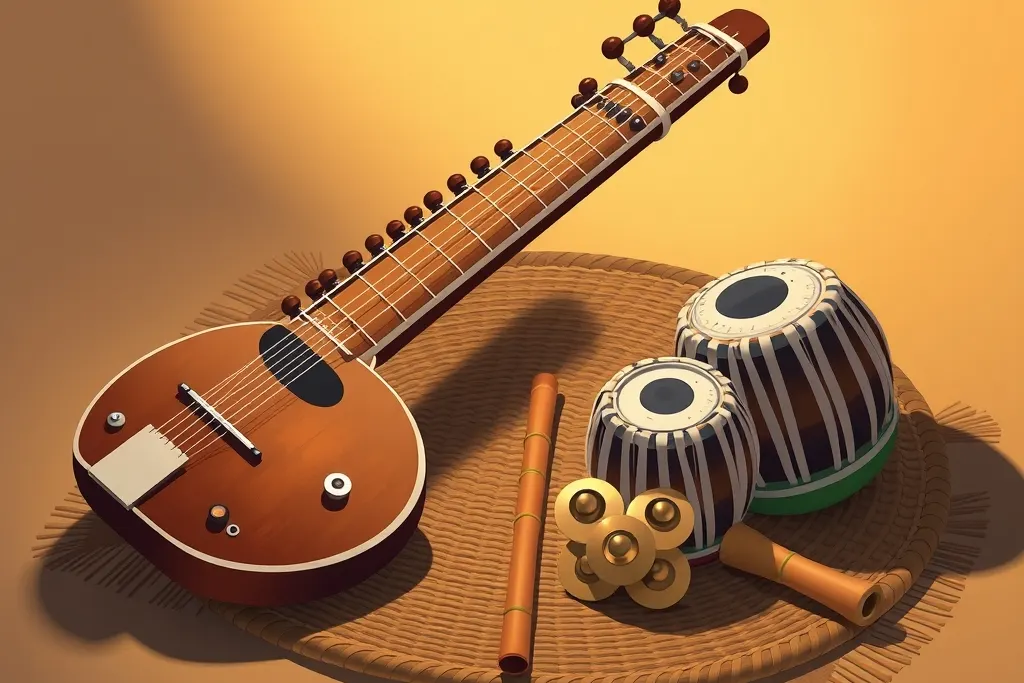
For instruments, ask one question: what produces the sound? If a string vibrates, plucked or bowed, the instrument is tata; if a stretched skin is struck, it is avanaddha; if a column of air is blown, it is sushira; if a solid metal or wooden body is struck or clashed, it is ghana. This works even for instruments you have not met in a list. The harmonium has keys but the sound is made by air passing through reeds, so it is sushira. The tanpura is tata though it gives only the drone, the sarangi and the violin are bowed tata instruments, and the khanjira is avanaddha because it has a skin stretched over a frame.
The timing of ragas follows the idea of prahar, the eight three-hour parts of the day and night. The first part of the day is the time of ragas such as alhaiya bilawal, the morning of bhairav, the first part of the night of yaman and bhupali and the late night of malkauns and bageshri. A good habit is to keep a three-line card for each raga: thaat and jati, vadi and samvadi, time. Then link the Karnatak partner and its melakarta number if the syllabus gives one: Kalyani is the 65th melakarta, Mayamalavagowla the 15th and Shankarabharanam the 29th. Remember that a counterpart shares the notes and is not an identical raga, since the treatment and ornaments differ.
The Karnatak side of the syllabus rests on one idea: the seventy-two melakartas are the parent ragas, each holding all seven notes in ascent and descent, and a janya raga is derived from a melakarta by dropping notes or by taking a zigzag course. So Mohanam, with five notes, is a janya, and Kalyani is itself a melakarta. When a question asks for the Karnatak equivalent of a Hindustani raga, the answer is the raga with the same notes: Yaman is matched with Kalyani, Bhairav with Mayamalavagowla, Alhaiya Bilawal with Shankarabharanam and Bhupali with Mohanam. Say aloud, as a rule, that the pair share notes, and then recall that the Hindustani word is thaat and the Karnatak word is mela.
- Tata: sitar, sarod, sarasvati veena, violin, sarangi, tanpura. Avanaddha: tabla, pakhawaj, mridangam, khanjira, dholak. Sushira: flute, shehnai, nagaswaram, harmonium. Ghana: chimta, cymbals, ghungroo, khartal, chipla, morchang.
- The six ragas by time: alhaiya bilawal (first part of the day), bhairav (morning), yaman and bhupali (first part of the night), malkauns and bageshri (late night).
- The six ragas by jati: yaman, bhairav and alhaiya bilawal are sampurna; bhupali and malkauns are audav-audav; bageshri is audav-sampurna.
For instruments, ask one question: what produces the sound? If a string vibrates, plucked or bowed, the instrument is tata; if a stretched skin is struck, it is avanaddha; if a column of…
Key takeaways
- Tata, avanaddha, sushira, ghana: strings, skins, wind and solid instruments.
- Yaman has the teevra ma; bhupali and malkauns are audav; bageshri is audav-sampurna.
- Yaman and Kalyani, Bhairav and Mayamalavagowla, Bilawal and Shankarabharanam correspond.
- Malkauns is Hindolam and bhupali is Mohanam in the Karnatak system.
Practice questions (45)
Attempt each one before opening the answer. Every explanation names the tempting wrong option as well as the right one, because that is where marks are lost.
Features of raga Yaman:
Show answer
Answer: B — Kalyan thaat, vadi ga, samvadi ni, teevra ma, sampurna, first part of the night
Yaman: Kalyan thaat, vadi ga, samvadi ni, teevra ma, sampurna, first part of the night. The tempting "Bhairav thaat, vadi komal dha, samvadi komal re, sampurna, morning" goes with Bhairav, and "Bilawal thaat, vadi dha, samvadi ga, sampurna, first part of the day" with Alhaiya Bilawal.Which raga has: Kalyan thaat, vadi ga, samvadi ni, teevra ma, sampurna, first part of the night?
Show answer
Answer: A — Yaman
Yaman: Kalyan thaat, vadi ga, samvadi ni, teevra ma, sampurna, first part of the night. The tempting "Bhairav" is linked with Bhairav thaat, vadi komal dha, samvadi komal re, sampurna, morning, and "Malkauns" with Bhairavi thaat, vadi ma, samvadi sa, audav-audav, komal ga, dha, ni, late night.Features of raga Bhairav:
Show answer
Answer: D — Bhairav thaat, vadi komal dha, samvadi komal re, sampurna, morning
Bhairav: Bhairav thaat, vadi komal dha, samvadi komal re, sampurna, morning. The tempting "Kalyan thaat, vadi ga, samvadi ni, teevra ma, sampurna, first part of the night" goes with Yaman, and "Bilawal thaat, vadi dha, samvadi ga, sampurna, first part of the day" with Alhaiya Bilawal.
Show the other 42 questions
Features of raga Alhaiya Bilawal:
Show answer
Answer: A — Bilawal thaat, vadi dha, samvadi ga, sampurna, first part of the day
Alhaiya Bilawal: Bilawal thaat, vadi dha, samvadi ga, sampurna, first part of the day. The tempting "Bhairavi thaat, vadi ma, samvadi sa, audav-audav, komal ga, dha, ni, late night" goes with Malkauns, and "Kalyan thaat, vadi ga, samvadi ni, teevra ma, sampurna, first part of the night" with Yaman.Which raga has: Bilawal thaat, vadi dha, samvadi ga, sampurna, first part of the day?
Show answer
Answer: A — Alhaiya Bilawal
Alhaiya Bilawal: Bilawal thaat, vadi dha, samvadi ga, sampurna, first part of the day. The tempting "Malkauns" is linked with Bhairavi thaat, vadi ma, samvadi sa, audav-audav, komal ga, dha, ni, late night, and "Bageshri" with Kafi thaat, vadi ma, samvadi sa, audav-sampurna, komal ga and ni, late night.Features of raga Malkauns:
Show answer
Answer: C — Bhairavi thaat, vadi ma, samvadi sa, audav-audav, komal ga, dha, ni, late night
Malkauns: Bhairavi thaat, vadi ma, samvadi sa, audav-audav, komal ga, dha, ni, late night. The tempting "Bilawal thaat, vadi dha, samvadi ga, sampurna, first part of the day" goes with Alhaiya Bilawal, and "Kalyan thaat, vadi ga, samvadi dha, audav-audav, notes sa re ga pa dha, first part of the night" with Bhupali.Features of raga Bageshri:
Show answer
Answer: D — Kafi thaat, vadi ma, samvadi sa, audav-sampurna, komal ga and ni, late night
Bageshri: Kafi thaat, vadi ma, samvadi sa, audav-sampurna, komal ga and ni, late night. The tempting "Kalyan thaat, vadi ga, samvadi ni, teevra ma, sampurna, first part of the night" goes with Yaman, and "Bhairav thaat, vadi komal dha, samvadi komal re, sampurna, morning" with Bhairav.Which raga has: Kafi thaat, vadi ma, samvadi sa, audav-sampurna, komal ga and ni, late night?
Show answer
Answer: C — Bageshri
Bageshri: Kafi thaat, vadi ma, samvadi sa, audav-sampurna, komal ga and ni, late night. The tempting "Yaman" is linked with Kalyan thaat, vadi ga, samvadi ni, teevra ma, sampurna, first part of the night, and "Alhaiya Bilawal" with Bilawal thaat, vadi dha, samvadi ga, sampurna, first part of the day.Features of raga Bhupali:
Show answer
Answer: C — Kalyan thaat, vadi ga, samvadi dha, audav-audav, notes sa re ga pa dha, first part of the night
Bhupali: Kalyan thaat, vadi ga, samvadi dha, audav-audav, notes sa re ga pa dha, first part of the night. The tempting "Bhairav thaat, vadi komal dha, samvadi komal re, sampurna, morning" goes with Bhairav, and "Kafi thaat, vadi ma, samvadi sa, audav-sampurna, komal ga and ni, late night" with Bageshri.The Karnatak counterpart of Yaman:
Show answer
Answer: A — Kalyani (65th melakarta, Mechakalyani)
Yaman corresponds to Kalyani (65th melakarta, Mechakalyani). The tempting "Hindolam, a janya of Natabhairavi" goes with Malkauns, and "Sriranjani, a janya of Kharaharapriya" with Bageshri.Kalyani (65th melakarta, Mechakalyani) corresponds to the Hindustani raga
Show answer
Answer: D — Yaman
Yaman corresponds to Kalyani (65th melakarta, Mechakalyani). The tempting "Bhupali" is linked with Mohanam, a janya of Harikambhoji, and "Bhairav" with Mayamalavagowla (15th melakarta).The Karnatak counterpart of Bhairav:
Show answer
Answer: B — Mayamalavagowla (15th melakarta)
Bhairav corresponds to Mayamalavagowla (15th melakarta). The tempting "Shankarabharanam (29th melakarta)" goes with Alhaiya Bilawal, and "Hindolam, a janya of Natabhairavi" with Malkauns.The Karnatak counterpart of Alhaiya Bilawal:
Show answer
Answer: C — Shankarabharanam (29th melakarta)
Alhaiya Bilawal corresponds to Shankarabharanam (29th melakarta). The tempting "Hindolam, a janya of Natabhairavi" goes with Malkauns, and "Sriranjani, a janya of Kharaharapriya" with Bageshri.Shankarabharanam (29th melakarta) corresponds to the Hindustani raga
Show answer
Answer: C — Alhaiya Bilawal
Alhaiya Bilawal corresponds to Shankarabharanam (29th melakarta). The tempting "Malkauns" is linked with Hindolam, a janya of Natabhairavi, and "Bageshri" with Sriranjani, a janya of Kharaharapriya.The Karnatak counterpart of Malkauns:
Show answer
Answer: B — Hindolam, a janya of Natabhairavi
Malkauns corresponds to Hindolam, a janya of Natabhairavi. The tempting "Mayamalavagowla (15th melakarta)" goes with Bhairav, and "Shankarabharanam (29th melakarta)" with Alhaiya Bilawal.The Karnatak counterpart of Bageshri:
Show answer
Answer: A — Sriranjani, a janya of Kharaharapriya
Bageshri corresponds to Sriranjani, a janya of Kharaharapriya. The tempting "Hindolam, a janya of Natabhairavi" goes with Malkauns, and "Mohanam, a janya of Harikambhoji" with Bhupali.Sriranjani, a janya of Kharaharapriya corresponds to the Hindustani raga
Show answer
Answer: D — Bageshri
Bageshri corresponds to Sriranjani, a janya of Kharaharapriya. The tempting "Yaman" is linked with Kalyani (65th melakarta, Mechakalyani), and "Alhaiya Bilawal" with Shankarabharanam (29th melakarta).Mohanam, a janya of Harikambhoji corresponds to the Hindustani raga
Show answer
Answer: A — Bhupali
Bhupali corresponds to Mohanam, a janya of Harikambhoji. The tempting "Bhairav" is linked with Mayamalavagowla (15th melakarta), and "Malkauns" with Hindolam, a janya of Natabhairavi.Class of Sitar: which is it?
Show answer
Answer: A — Tata (string)
Sitar is Tata (string). The tempting "Avanaddha (membrane)" fits Tabla instead. The tempting option "Avanaddha (membrane)" does not fit.Class of Tanpura: which is it?
Show answer
Answer: B — Tata (string)
Tanpura is Tata (string). The tempting "Sushira (wind)" fits Flute instead. The tempting option "Sushira (wind)" does not fit.Class of Sarod: which is it?
Show answer
Answer: C — Tata (string)
Sarod is Tata (string). The tempting "Ghana (solid, metallic)" fits Chimta instead.Class of Sarangi: which is it?
Show answer
Answer: B — Tata (string)
Sarangi is Tata (string). The tempting "Sushira (wind)" fits Flute instead. The tempting option "Sushira (wind)" does not fit.Class of Violin: which is it?
Show answer
Answer: D — Tata (string)
Violin is Tata (string). The tempting "Ghana (solid, metallic)" fits Chimta instead.Class of Pakhawaj: which is it?
Show answer
Answer: C — Avanaddha (membrane)
Pakhawaj is Avanaddha (membrane). The tempting "Ghana (solid, metallic)" fits Chimta instead.Class of Mridangam: which is it?
Show answer
Answer: A — Avanaddha (membrane)
Mridangam is Avanaddha (membrane). The tempting "Tata (string)" fits Sitar instead.Class of Khanjira: which is it?
Show answer
Answer: D — Avanaddha (membrane)
Khanjira is Avanaddha (membrane). The tempting "Ghana (solid, metallic)" fits Chimta instead.Class of Flute: which is it?
Show answer
Answer: B — Sushira (wind)
Flute is Sushira (wind). The tempting "Avanaddha (membrane)" fits Tabla instead.Class of Shehnai: which is it?
Show answer
Answer: A — Sushira (wind)
Shehnai is Sushira (wind). The tempting "Avanaddha (membrane)" fits Tabla instead.Class of Nagaswaram: which is it?
Show answer
Answer: B — Sushira (wind)
Nagaswaram is Sushira (wind). The tempting "Ghana (solid, metallic)" fits Chimta instead.Class of Chimta: which is it?
Show answer
Answer: D — Ghana (solid, metallic)
Chimta is Ghana (solid, metallic). The tempting "Avanaddha (membrane)" fits Tabla instead.Class of Cymbals: which is it?
Show answer
Answer: D — Ghana (solid, metallic)
Cymbals is Ghana (solid, metallic). The tempting "Avanaddha (membrane)" fits Tabla instead.Class of Khartal: which is it?
Show answer
Answer: C — Ghana (solid, metallic)
Khartal is Ghana (solid, metallic). The tempting "Sushira (wind)" fits Flute instead.Class of Chipla: which is it?
Show answer
Answer: C — Ghana (solid, metallic)
Chipla is Ghana (solid, metallic). The tempting "Sushira (wind)" fits Flute instead.Class of Morchang: which is it?
Show answer
Answer: C — Ghana (solid, metallic)
Morchang is Ghana (solid, metallic). The tempting "Sushira (wind)" fits Flute instead.Which of these instruments is NOT Tata (string)?
Show answer
Answer: C — Morchang
Morchang is Ghana (solid, metallic), not Tata (string); the other three are Tata (string).Which of these instruments is Avanaddha (membrane)?
Show answer
Answer: D — Tabla
Tabla is Avanaddha (membrane). The tempting "Chimta" is Ghana (solid, metallic).Which of these instruments is NOT Avanaddha (membrane)?
Show answer
Answer: D — Sarangi
Sarangi is Tata (string), not Avanaddha (membrane); the other three are Avanaddha (membrane).Which of these instruments is NOT Sushira (wind)?
Show answer
Answer: A — Saraswati veena
Saraswati veena is Tata (string), not Sushira (wind); the other three are Sushira (wind).Which of these instruments is Ghana (solid, metallic)?
Show answer
Answer: B — Cymbals
Cymbals is Ghana (solid, metallic). The tempting "Shehnai" is Sushira (wind). The tempting option "Shehnai" does not fit.Which of these instruments is NOT Ghana (solid, metallic)?
Show answer
Answer: C — Mridangam
Mridangam is Avanaddha (membrane), not Ghana (solid, metallic); the other three are Ghana (solid, metallic).How many of these instruments are Tata (string): Shehnai, Saraswati veena, Sarod?
Show answer
Answer: B — Two
Tata (string): Sarod, Saraswati veena. Others: Shehnai is Sushira (wind). The tempting option "None" does not fit.How many of these instruments are Avanaddha (membrane): Khartal, Sitar, Flute?
Show answer
Answer: D — None
Avanaddha (membrane): none of the three. Others: Flute is Sushira (wind); Sitar is Tata (string); Khartal is Ghana (solid, metallic).How many of these instruments are Avanaddha (membrane): Tabla, Mridangam, Dholak?
Show answer
Answer: B — All three
Avanaddha (membrane): Mridangam, Dholak, Tabla. Others: . The tempting option "None" does not fit.How many of these instruments are Sushira (wind): Violin, Saraswati veena, Pakhawaj?
Show answer
Answer: C — None
Sushira (wind): none of the three. Others: Pakhawaj is Avanaddha (membrane); Violin is Tata (string); Saraswati veena is Tata (string).How many of these instruments are Ghana (solid, metallic): Violin, Sarod, Sitar?
Show answer
Answer: D — None
Ghana (solid, metallic): none of the three. Others: Violin is Tata (string); Sarod is Tata (string); Sitar is Tata (string).