Martial Arts Traditions: A Survey (Unit 6)
2. Texts: the Dhanurveda, Mahabharata, Mallapurana and Marmashastra
The Dhanurveda is the older science of warfare. The Mahabharata describes wrestling in the fight of Bhima with Jarasandha and with Kichaka. The Mallapurana records the training and rules of the wrestler; the Marmashastra, with the Sushruta Samhita's 107 marmas, treats the vital points that a Kalaripayattu master both attacks and heals.
| Text | What it gives |
|---|---|
| Dhanurveda | The science of archery and warfare, one of the four Upavedas |
| Mahabharata wrestling | The bouts of Bhima and Jarasandha, and of Bhima and Kichaka |
| Mallapurana | A medieval text on wrestling, its training, diet and rules, written by the Jyesthimalla community of Gujarat |
| Marmashastra | The study of the vital points of the body, used in healing and in martial arts |
| Arthashastra on weapons | Kautilya's lists of weapons, the armoury and the training of the army |
| Sushruta Samhita on marmas | The 107 vital points described in the surgical treatise |
The Dhanurveda is the older science of warfare. The Mahabharata describes wrestling in the fight of Bhima with Jarasandha and with Kichaka. The Mallapurana records the training and rules of…
3. Kalarippayattu: the school and its stages
A kalari is a pit-floor school facing the east, with a shrine in the south-west corner. Training goes through four stages: meithari (body), kolthari (wooden weapons), angathari (metal weapons) and verumkai (unarmed). The flexible sword is the urumi; the master is the gurukkal.
| Term | Meaning |
|---|---|
| Kalari | The school and floor in which the art is taught |
| Meithari | The first stage of body training and exercises |
| Kolthari | The stage of wooden weapons, the staff and the cane |
| Angathari | The stage of metal weapons: sword, shield, spear |
| Verumkai | The stage of unarmed combat |
| Urumi | The flexible sword of Kalarippayattu |
| Marma | A vital point of the body |
| Guru (gurukkal) | The master of the kalari |
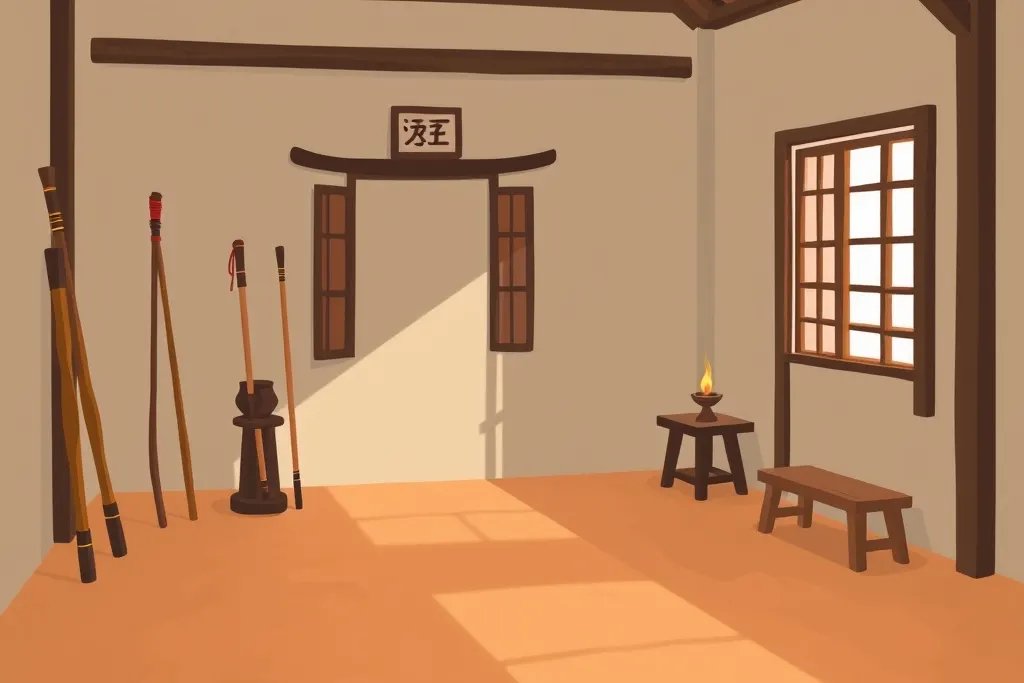
A kalari is a pit-floor school facing the east, with a shrine in the south-west corner. Training goes through four stages: meithari (body), kolthari (wooden weapons), angathari (metal…
4. Learning the survey
Match each art with its region, each text with its content (Mallapurana is wrestling; Marmashastra the vital points; Dhanurveda archery and war), and learn the four stages of the kalari in order.
Match each art with its region, each text with its content (Mallapurana is wrestling; Marmashastra the vital points; Dhanurveda archery and war), and learn the four stages of the kalari in…
5. Sorting the arts by weapon and by purpose
The list of regional arts is long, but it becomes light once you sort it by what is held in the hand. The staff is the weapon of Silambam in Tamil Nadu and the lathi in the village tradition of the north. The sword and spear belong to Thang-ta in Manipur and to the weapons training of the Maratha tradition (Mardani Khel). Gatka of Punjab is the Sikh art of sword and stick. The paika warrior-peasants of Odisha practise a drill, the Paika Akhada. And in wrestling (mallayuddha) there is no weapon at all: the body is the whole means. Kalarippayattu alone covers every stage, from body training through wooden and metal weapons to unarmed combat, and adds the knowledge of vital points.
| Art | Chief means | Region |
|---|---|---|
| Silambam | Long bamboo staff | Tamil Nadu |
| Lathi | Stick | North India, in the village |
| Gatka | Sword and stick | Punjab |
| Thang-ta | Sword (thang) and spear (ta) | Manipur |
| Mardani Khel | Sword and spear | Maharashtra |
| Paika Akhada | Martial drill of warrior-peasants | Odisha |
| Mallayuddha | Bare body, holds, pit of earth | The akhadas |
| Kalarippayattu | Body, wooden and metal weapons, bare hands, marmas | Kerala |
The texts divide in the same way by subject. The Dhanurveda is the science of archery and warfare and counts as one of the four Upavedas; the Mallapurana is the manual of the wrestler, written by the Jyesthimalla community of Gujarat; the Marmashastra studies the vital points that the master of the kalari may strike or heal. The epic gives a living picture rather than a manual: Bhima's wrestling bouts with Jarasandha and Kichaka. A question about a text rarely needs more than the right subject.
The list of regional arts is long, but it becomes light once you sort it by what is held in the hand. The staff is the weapon of Silambam in Tamil Nadu and the lathi in the village…
6. Inside the kalari, with worked examples
Kalarippayattu teaches a sequence in which each stage prepares the next. The student begins with the body (meithari), the preparation of the limbs through exercises and sequences; takes up wooden weapons (kolthari), where the staff and cane train the eye and the hand; moves to metal weapons (angathari), the sword, shield and spear; and ends with the unarmed stage (verumkai). The logic is that a fighter who cannot control his own body cannot control a stick, and one who cannot control a stick should not be given a blade. The master is the gurukkal; the school, the kalari, is a pit-floor hall; the flexible sword, the urumi, belongs to the later stage of metal weapons.
- MeithariBody: preparing the limbs
- KolthariWooden weapons: staff and cane
- AngathariMetal weapons: sword, shield, spear
- VerumkaiUnarmed: bare hands
- The wrestler of the Mahabharata
- Bouts with Jarasandha and Kichaka
- The archer
Kalarippayattu teaches a sequence in which each stage prepares the next. The student begins with the body (meithari), the preparation of the limbs through exercises and sequences; takes up…
Key takeaways
- Kalarippayattu: Kerala; Silambam: Tamil Nadu; Gatka: Punjab; Thang-ta: Manipur; Paika Akhada: Odisha.
- Mallapurana is the wrestling text; Marmashastra treats the vital points.
- Bhima wrestled Jarasandha and Kichaka in the Mahabharata.
- Kalari stages: meithari, kolthari, angathari, verumkai.
Practice questions (36)
Attempt each one before opening the answer. Every explanation names the tempting wrong option as well as the right one, because that is where marks are lost.
Kalarippayattu: which description fits?
Show answer
Answer: C — Kerala; training in a pit-floor school (kalari) with strikes, kicks, weapons and the knowledge of vital points, with Parashurama and Agastya in its legend
Kalarippayattu: Kerala; training in a pit-floor school (kalari) with strikes, kicks, weapons and the knowledge of vital points, with Parashurama and Agastya in its legend. The tempting "The classical Indian wrestling of the akhada, with named holds and a pit of earth" goes with Mallayuddha, and "The stick, a village weapon and the basis of stick combat in north India" with Lathi.Which fits: Kerala; training in a pit-floor school (kalari) with strikes, kicks, weapons and the knowledge of vital points, with Parashurama and Agastya in its legend?
Show answer
Answer: A — Kalarippayattu
Kalarippayattu: Kerala; training in a pit-floor school (kalari) with strikes, kicks, weapons and the knowledge of vital points, with Parashurama and Agastya in its legend. The tempting "Gatka" is linked with Punjab; the Sikh art of sword and stick fighting, and "Paika Akhada" with Odisha; the martial drill of the paika warrior-peasants.Silambam: which description fits?
Show answer
Answer: B — Tamil Nadu; the art of fighting with a long bamboo staff
Silambam: Tamil Nadu; the art of fighting with a long bamboo staff. The tempting "Manipur; the sword (thang) and spear (ta) art of the Meitei" goes with Thang-ta, and "Odisha; the martial drill of the paika warrior-peasants" with Paika Akhada.
Show the other 33 questions
Which fits: Tamil Nadu; the art of fighting with a long bamboo staff?
Show answer
Answer: A — Silambam
Silambam: Tamil Nadu; the art of fighting with a long bamboo staff. The tempting "Mardani Khel" is linked with Maharashtra; weapons training of the Maratha tradition, with sword and spear, and "Kalarippayattu" with Kerala; training in a pit-floor school (kalari) with strikes, kicks, weapons and the knowledge of vital points, with Parashurama and Agastya in its legend.Gatka: which description fits?
Show answer
Answer: D — Punjab; the Sikh art of sword and stick fighting
Gatka: Punjab; the Sikh art of sword and stick fighting. The tempting "Manipur; the sword (thang) and spear (ta) art of the Meitei" goes with Thang-ta, and "Maharashtra; weapons training of the Maratha tradition, with sword and spear" with Mardani Khel.Thang-ta: which description fits?
Show answer
Answer: B — Manipur; the sword (thang) and spear (ta) art of the Meitei
Thang-ta: Manipur; the sword (thang) and spear (ta) art of the Meitei. The tempting "Maharashtra; weapons training of the Maratha tradition, with sword and spear" goes with Mardani Khel, and "The stick, a village weapon and the basis of stick combat in north India" with Lathi.Which fits: Manipur; the sword (thang) and spear (ta) art of the Meitei?
Show answer
Answer: B — Thang-ta
Thang-ta: Manipur; the sword (thang) and spear (ta) art of the Meitei. The tempting "Mardani Khel" is linked with Maharashtra; weapons training of the Maratha tradition, with sword and spear, and "Mallayuddha" with The classical Indian wrestling of the akhada, with named holds and a pit of earth.Paika Akhada: which description fits?
Show answer
Answer: D — Odisha; the martial drill of the paika warrior-peasants
Paika Akhada: Odisha; the martial drill of the paika warrior-peasants. The tempting "The classical Indian wrestling of the akhada, with named holds and a pit of earth" goes with Mallayuddha, and "Kerala; training in a pit-floor school (kalari) with strikes, kicks, weapons and the knowledge of vital points, with Parashurama and Agastya in its legend" with Kalarippayattu.Which fits: Odisha; the martial drill of the paika warrior-peasants?
Show answer
Answer: C — Paika Akhada
Paika Akhada: Odisha; the martial drill of the paika warrior-peasants. The tempting "Kalarippayattu" is linked with Kerala; training in a pit-floor school (kalari) with strikes, kicks, weapons and the knowledge of vital points, with Parashurama and Agastya in its legend, and "Gatka" with Punjab; the Sikh art of sword and stick fighting.Which fits: Maharashtra; weapons training of the Maratha tradition, with sword and spear?
Show answer
Answer: B — Mardani Khel
Mardani Khel: Maharashtra; weapons training of the Maratha tradition, with sword and spear. The tempting "Mallayuddha" is linked with The classical Indian wrestling of the akhada, with named holds and a pit of earth, and "Kalarippayattu" with Kerala; training in a pit-floor school (kalari) with strikes, kicks, weapons and the knowledge of vital points, with Parashurama and Agastya in its legend.Mallayuddha: which description fits?
Show answer
Answer: D — The classical Indian wrestling of the akhada, with named holds and a pit of earth
Mallayuddha: The classical Indian wrestling of the akhada, with named holds and a pit of earth. The tempting "Tamil Nadu; the art of fighting with a long bamboo staff" goes with Silambam, and "Punjab; the Sikh art of sword and stick fighting" with Gatka.Which fits: The classical Indian wrestling of the akhada, with named holds and a pit of earth?
Show answer
Answer: A — Mallayuddha
Mallayuddha: The classical Indian wrestling of the akhada, with named holds and a pit of earth. The tempting "Thang-ta" is linked with Manipur; the sword (thang) and spear (ta) art of the Meitei, and "Paika Akhada" with Odisha; the martial drill of the paika warrior-peasants.Lathi: which description fits?
Show answer
Answer: C — The stick, a village weapon and the basis of stick combat in north India
Lathi: The stick, a village weapon and the basis of stick combat in north India. The tempting "Tamil Nadu; the art of fighting with a long bamboo staff" goes with Silambam, and "Punjab; the Sikh art of sword and stick fighting" with Gatka.Which fits: The stick, a village weapon and the basis of stick combat in north India?
Show answer
Answer: B — Lathi
Lathi: The stick, a village weapon and the basis of stick combat in north India. The tempting "Kalarippayattu" is linked with Kerala; training in a pit-floor school (kalari) with strikes, kicks, weapons and the knowledge of vital points, with Parashurama and Agastya in its legend, and "Silambam" with Tamil Nadu; the art of fighting with a long bamboo staff.Which fits: The science of archery and warfare, one of the four Upavedas?
Show answer
Answer: B — Dhanurveda
Dhanurveda: The science of archery and warfare, one of the four Upavedas. The tempting "Sushruta Samhita on marmas" is linked with The 107 vital points described in the surgical treatise, and "Mahabharata wrestling" with The bouts of Bhima and Jarasandha, and of Bhima and Kichaka.Mahabharata wrestling: which description fits?
Show answer
Answer: D — The bouts of Bhima and Jarasandha, and of Bhima and Kichaka
Mahabharata wrestling: The bouts of Bhima and Jarasandha, and of Bhima and Kichaka. The tempting "A medieval text on wrestling, its training, diet and rules, written by the Jyesthimalla community of Gujarat" goes with Mallapurana, and "The 107 vital points described in the surgical treatise" with Sushruta Samhita on marmas.Which fits: The bouts of Bhima and Jarasandha, and of Bhima and Kichaka?
Show answer
Answer: B — Mahabharata wrestling
Mahabharata wrestling: The bouts of Bhima and Jarasandha, and of Bhima and Kichaka. The tempting "Mallapurana" is linked with A medieval text on wrestling, its training, diet and rules, written by the Jyesthimalla community of Gujarat, and "Arthashastra on weapons" with Kautilya's lists of weapons, the armoury and the training of the army.Mallapurana: which description fits?
Show answer
Answer: A — A medieval text on wrestling, its training, diet and rules, written by the Jyesthimalla community of Gujarat
Mallapurana: A medieval text on wrestling, its training, diet and rules, written by the Jyesthimalla community of Gujarat. The tempting "Kautilya's lists of weapons, the armoury and the training of the army" goes with Arthashastra on weapons, and "The 107 vital points described in the surgical treatise" with Sushruta Samhita on marmas.Marmashastra: which description fits?
Show answer
Answer: A — The study of the vital points of the body, used in healing and in martial arts
Marmashastra: The study of the vital points of the body, used in healing and in martial arts. The tempting "The 107 vital points described in the surgical treatise" goes with Sushruta Samhita on marmas, and "The science of archery and warfare, one of the four Upavedas" with Dhanurveda.Which fits: The study of the vital points of the body, used in healing and in martial arts?
Show answer
Answer: A — Marmashastra
Marmashastra: The study of the vital points of the body, used in healing and in martial arts. The tempting "Mallapurana" is linked with A medieval text on wrestling, its training, diet and rules, written by the Jyesthimalla community of Gujarat, and "Arthashastra on weapons" with Kautilya's lists of weapons, the armoury and the training of the army.Arthashastra on weapons: which description fits?
Show answer
Answer: D — Kautilya's lists of weapons, the armoury and the training of the army
Arthashastra on weapons: Kautilya's lists of weapons, the armoury and the training of the army. The tempting "A medieval text on wrestling, its training, diet and rules, written by the Jyesthimalla community of Gujarat" goes with Mallapurana, and "The 107 vital points described in the surgical treatise" with Sushruta Samhita on marmas.Which fits: Kautilya's lists of weapons, the armoury and the training of the army?
Show answer
Answer: A — Arthashastra on weapons
Arthashastra on weapons: Kautilya's lists of weapons, the armoury and the training of the army. The tempting "Mahabharata wrestling" is linked with The bouts of Bhima and Jarasandha, and of Bhima and Kichaka, and "Mallapurana" with A medieval text on wrestling, its training, diet and rules, written by the Jyesthimalla community of Gujarat.Sushruta Samhita on marmas: which description fits?
Show answer
Answer: B — The 107 vital points described in the surgical treatise
Sushruta Samhita on marmas: The 107 vital points described in the surgical treatise. The tempting "A medieval text on wrestling, its training, diet and rules, written by the Jyesthimalla community of Gujarat" goes with Mallapurana, and "The study of the vital points of the body, used in healing and in martial arts" with Marmashastra.Kalari: which description fits?
Show answer
Answer: D — The school and floor in which the art is taught
Kalari: The school and floor in which the art is taught. The tempting "The stage of wooden weapons, the staff and the cane" goes with Kolthari, and "The flexible sword of Kalarippayattu" with Urumi.Which fits: The school and floor in which the art is taught?
Show answer
Answer: A — Kalari
Kalari: The school and floor in which the art is taught. The tempting "Verumkai" is linked with The stage of unarmed combat, and "Urumi" with The flexible sword of Kalarippayattu.Meithari: which description fits?
Show answer
Answer: C — The first stage of body training and exercises
Meithari: The first stage of body training and exercises. The tempting "The school and floor in which the art is taught" goes with Kalari, and "The stage of wooden weapons, the staff and the cane" with Kolthari.Which fits: The first stage of body training and exercises?
Show answer
Answer: B — Meithari
Meithari: The first stage of body training and exercises. The tempting "Marma" is linked with A vital point of the body, and "Kalari" with The school and floor in which the art is taught.Which fits: The stage of wooden weapons, the staff and the cane?
Show answer
Answer: A — Kolthari
Kolthari: The stage of wooden weapons, the staff and the cane. The tempting "Verumkai" is linked with The stage of unarmed combat, and "Guru (gurukkal)" with The master of the kalari.Angathari: which description fits?
Show answer
Answer: C — The stage of metal weapons: sword, shield, spear
Angathari: The stage of metal weapons: sword, shield, spear. The tempting "The school and floor in which the art is taught" goes with Kalari, and "The stage of wooden weapons, the staff and the cane" with Kolthari.Which fits: The stage of metal weapons: sword, shield, spear?
Show answer
Answer: B — Angathari
Angathari: The stage of metal weapons: sword, shield, spear. The tempting "Urumi" is linked with The flexible sword of Kalarippayattu, and "Guru (gurukkal)" with The master of the kalari.Verumkai: which description fits?
Show answer
Answer: B — The stage of unarmed combat
Verumkai: The stage of unarmed combat. The tempting "The stage of metal weapons: sword, shield, spear" goes with Angathari, and "The flexible sword of Kalarippayattu" with Urumi.Which fits: The stage of unarmed combat?
Show answer
Answer: B — Verumkai
Verumkai: The stage of unarmed combat. The tempting "Kalari" is linked with The school and floor in which the art is taught, and "Angathari" with The stage of metal weapons: sword, shield, spear.Which fits: The flexible sword of Kalarippayattu?
Show answer
Answer: A — Urumi
Urumi: The flexible sword of Kalarippayattu. The tempting "Kolthari" is linked with The stage of wooden weapons, the staff and the cane, and "Angathari" with The stage of metal weapons: sword, shield, spear.Marma: which description fits?
Show answer
Answer: A — A vital point of the body
Marma: A vital point of the body. The tempting "The school and floor in which the art is taught" goes with Kalari, and "The stage of metal weapons: sword, shield, spear" with Angathari.Which fits: A vital point of the body?
Show answer
Answer: A — Marma
Marma: A vital point of the body. The tempting "Guru (gurukkal)" is linked with The master of the kalari, and "Meithari" with The first stage of body training and exercises.Guru (gurukkal): which description fits?
Show answer
Answer: B — The master of the kalari
Guru (gurukkal): The master of the kalari. The tempting "The stage of wooden weapons, the staff and the cane" goes with Kolthari, and "The flexible sword of Kalarippayattu" with Urumi.