Home Science II: Human Development, Textiles and Family Resources
2. Textile Fibres and Their Properties
| Class | Examples | Source and nature |
|---|---|---|
| Natural, plant | Cotton, jute, flax (linen) | Cellulose; absorbent, strong when wet, creases |
| Natural, animal | Wool, silk | Protein; warm, elastic; wool shrinks and is eaten by moths; silk is the only natural filament |
| Regenerated | Rayon (viscose) | Cellulose chemically reformed; silk-like, weak when wet |
| Synthetic | Nylon, polyester, acrylic | Petroleum-based; strong, quick-drying, low absorbency, melt near heat |
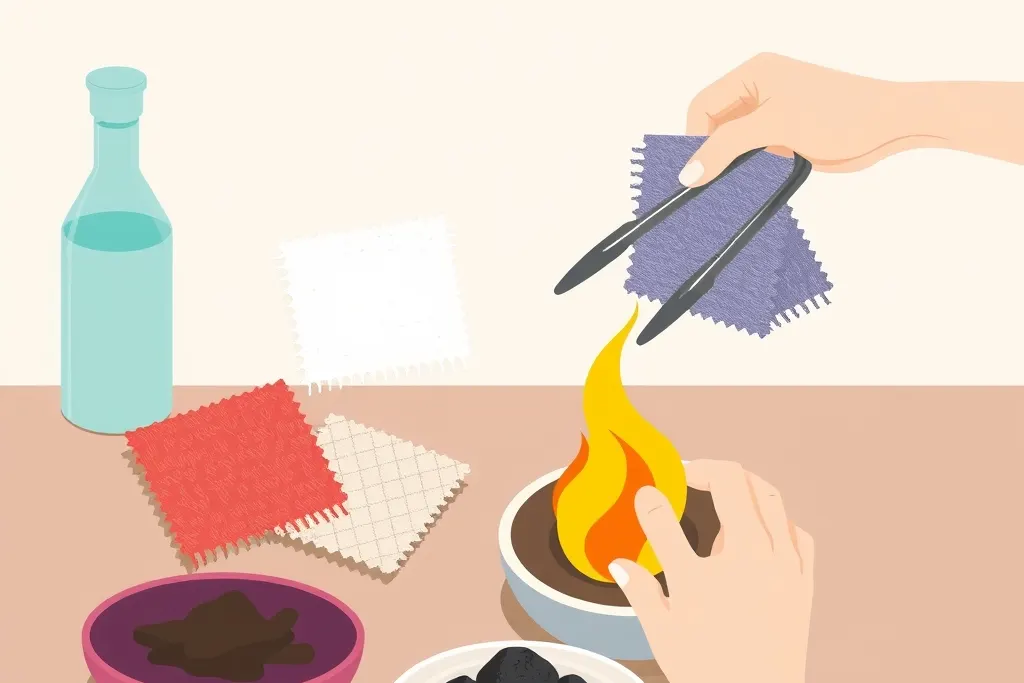
A simple burning test tells fibres apart: cotton and other cellulose fibres burn with a yellow flame and smell of burning paper, leaving a soft grey ash; wool and silk burn slowly, smell of burning hair and leave a brittle black bead that crushes easily; synthetics melt and shrink from the flame and leave a hard bead. A fibre is spun into yarn and the yarn is woven or knitted into fabric. The three basic weaves are the plain weave (over one, under one: strong and common, as in muslin and poplin), the twill (a diagonal rib, as in denim and gabardine) and the satin (long floats giving a lustrous face).
A simple burning test tells fibres apart: cotton and other cellulose fibres burn with a yellow flame and smell of burning paper, leaving a soft grey ash; wool and silk burn slowly, smell of…
3. Care of Fabrics and Reading a Label
Care follows the fibre. Cotton and linen stand hot water and a hot iron. Wool is washed in lukewarm water with a mild detergent, pressed gently and dried flat, since heat and agitation make it felt and shrink. Silk is washed gently in cool water and ironed on the reverse at low heat. Synthetics are washed warm and ironed cool, because a hot iron melts them. Bleach is safe for white cotton but damages wool and silk, and stains are best treated early and by type, a protein stain such as blood in cold water, and grease with a solvent or detergent. A care label uses a small set of symbols: a tub for washing (with a number for the temperature in °C), a triangle for bleaching, an iron with dots for ironing heat, a circle for dry cleaning and a square for drying.
Care follows the fibre. Cotton and linen stand hot water and a hot iron. Wool is washed in lukewarm water with a mild detergent, pressed gently and dried flat, since heat and agitation make…
4. Managing Family Resources
Family resources are human (time, energy, skills, knowledge) and non-human (money, goods, space, community facilities), and management is the process of planning, organising, implementing, controlling and evaluating their use to reach the family’s goals. A budget plans income against expenditure, with the first charge on income for the essentials (food, housing, clothing, health, education), then savings, then wants. Time management uses a schedule that sets priorities and allows for rest, and work simplification reduces effort by cutting unnecessary steps, as by keeping tools where they are used. A consumer is protected by knowing labels, the standards marks (such as the ISI mark on industrial goods, Agmark on farm produce and the BIS Hallmark on gold), the date of expiry and the right to complain.
- Human
- Time, energy
- Skills, knowledge
- Non-human
- Money, goods
- Space, community facilities
- Planning
- Organising
- Implementing
- Controlling
- EvaluatingAgainst the family's goals
Family resources are human (time, energy, skills, knowledge) and non-human (money, goods, space, community facilities), and management is the process of planning, organising, implementing…
5. Worked Example: A Family Budget and a Time Plan
Managing family resources means planning money and time against needs. Take a family with a monthly income of ₹30,000. A simple plan allots 40 per cent to food, which is ₹12,000, 25 per cent to housing and utilities, ₹7,500, 15 per cent to education and health, ₹4,500, 10 per cent to clothing and other needs, ₹3,000, and 10 per cent to savings, ₹3,000. The shares add up to 100 per cent and the amounts to ₹30,000, which is the first check on any budget. A good budget separates fixed expenses, such as rent, from variable ones, such as food, and it sets aside savings before spending, since saving what is left over rarely works.
The same method applies to time. A day has 24 hours, and a plan lists sleep, work, household tasks, study and rest so that they total 24. A weekly plan can show where time is wasted and which tasks can be shared among family members. Resources are also classed as human (energy, skill, knowledge, time) and non-human (money, goods, space), and a family can often substitute one for the other, using its own time and skill to save money, for example by cooking at home.
Managing family resources means planning money and time against needs. Take a family with a monthly income of ₹30,000. A simple plan allots 40 per cent to food, which is ₹12,000, 25 per…
Identifying Fibres by Burning
A simple test to identify a fibre is to burn a small sample and observe how it behaves. Cotton and other plant fibres catch fire quickly, burn with a yellow flame, smell like burning paper and leave a soft grey ash. Wool and silk, which are animal fibres made of protein, burn slowly, curl away from the flame, smell like burning hair and leave a crisp black bead. Synthetic fibres such as polyester and nylon melt and shrink from the flame, burn with a chemical smell and leave a hard bead that cannot be crushed. The properties follow from the chemistry: cotton absorbs moisture and is comfortable in heat, wool traps air and keeps warm, silk has lustre and strength, and polyester is strong, quick to dry and resists creasing.
- Catch fire quickly, yellow flame
- Smell of burning paper
- Soft grey ash
- Burn slowly, curl from flame
- Smell of burning hair
- Crisp black bead
- Melt and shrink from flame
- Chemical smell
- Hard bead, cannot be crushed
A simple test to identify a fibre is to burn a small sample and observe how it behaves. Cotton and other plant fibres catch fire quickly, burn with a yellow flame, smell like burning paper…
Key takeaways
- Development follows cephalocaudal (head to foot) and proximodistal (centre outward) order, goes from general to specific, and the early years are the critical period.
- The stages are prenatal, infancy (to 2), early childhood (2–6), middle childhood (6–12), adolescence (12–18), adulthood and old age.
- Cotton and linen are cellulose, wool and silk are protein, rayon is regenerated and nylon, polyester and acrylic are synthetic; the burning test tells them apart.
- The three basic weaves are plain, twill and satin; wool is washed in lukewarm water and dried flat, synthetics are ironed cool.
- Resources are human or non-human and management plans, organises, implements, controls and evaluates their use; look for ISI, Agmark and the BIS Hallmark.
Practice questions (25)
Attempt each one before opening the answer. Every explanation names the tempting wrong option as well as the right one, because that is where marks are lost.
The principle that development proceeds from head to foot is called:
Show answer
Answer: A — Cephalocaudal
In cephalocaudal development the head region matures before the legs, so a baby holds up its head before it walks. Proximodistal is centre outward.The stage of the life span from 12 to 18 years, marked by puberty and the search for identity, is:
Show answer
Answer: A — Adolescence
Adolescence covers about 12 to 18 years. Middle childhood is 6 to 12 and early childhood 2 to 6.The only natural fibre that is a continuous filament is:
Show answer
Answer: A — Silk
Silk is reeled from the cocoon as a continuous filament several hundred metres long. Cotton, wool and jute are short staple fibres.
Show the other 22 questions
A fibre burns with a smell of burning hair and leaves a brittle black bead that crushes easily. It is probably:
Show answer
Answer: A — Wool or silk
Protein fibres burn slowly with the smell of burning hair and leave a crushable ash bead. Cotton smells like paper and synthetics melt into a hard bead.The diagonal rib weave used in denim is the:
Show answer
Answer: A — Twill weave
The twill weave makes a diagonal pattern, as in denim and gabardine. The plain weave is over-one-under-one and satin has long floats.Woollen garments should be washed in lukewarm water and dried flat because heat and agitation cause them to:
Show answer
Answer: A — Felt and shrink
Wool’s scales interlock under heat and agitation, so the fabric felts and shrinks. Flat drying also stops it stretching under its own weight.The quality-assurance mark for agricultural produce such as ghee and honey is:
Show answer
Answer: A — Agmark
Agmark certifies agricultural and allied produce. The ISI mark is for industrial goods and the Hallmark for gold and silver jewellery.In the management process, “controlling” a plan means:
Show answer
Answer: A — Checking progress and correcting departures
Controlling is monitoring the plan as it runs and adjusting. Setting goals is planning, and judging the final result is evaluating.Proximodistal development means that development proceeds from:
Show answer
Answer: D — The centre of the body outward
Control comes first near the centre, as the shoulder before the fingers. Head to foot is the tempting wrong option because it is the other directional principle, the cephalocaudal one.Cotton and linen are:
Show answer
Answer: A — Plant (cellulose) fibres
Both come from plants and are made of cellulose. Animal fibres is the tempting wrong option for those who confuse linen with wool, but wool and silk are the protein fibres.Which of the following is a synthetic fibre?
Show answer
Answer: B — Nylon
Nylon is made wholly from chemicals. Silk is the tempting wrong option because it feels smooth and artificial to many, but it is a natural animal fibre from the silkworm.The plain weave is made by passing the weft:
Show answer
Answer: C — Over one warp thread and under the next
Over one, under one gives the plain weave of muslin and poplin. Over two, under one is the tempting wrong option because it gives a diagonal rib, which is the twill weave, and long floats give satin.A family budget is a plan that sets:
Show answer
Answer: D — Expected income against planned expenditure
A budget lines up income against expenditure, with essentials first and savings set aside. A time schedule is the tempting wrong option because it is also a plan for a resource, but it plans time and not money.Which of the following is a NON-human resource of a family?
Show answer
Answer: A — Money
Money, goods and space are non-human resources. Time is the tempting wrong option because it is limited like money, but time, energy, skill and knowledge are human resources.Match the fibre with its class. List I: A. Cotton B. Wool C. Rayon D. Polyester List II: 1. Animal protein fibre 2. Plant cellulose fibre 3. Synthetic fibre made from chemicals 4. Regenerated cellulose fibre
Show answer
Answer: A — A-2, B-1, C-4, D-3
Cotton is 2, wool 1, rayon 4 and polyester 3. The pair C-3, D-4 is the tempting swap, because rayon feels artificial like polyester, but rayon is regenerated cellulose from wood pulp.Read the statements on child development.
(1) Development follows the same sequence in all children, though the pace may differ.
(2) Development is determined by heredity alone.Show answer
Answer: A — 1 only
Statement 1 is true. Statement 2 is false: both heredity and environment shape development. "Both" tempts for those who recall that inherited traits are strong, but nurture matters too.A fabric shrinks away from the flame, melts, smells chemical and leaves a hard bead that cannot be crushed. The fibre is:
Show answer
Answer: B — Synthetic
Melting and a hard bead mark a synthetic fibre. Wool and silk are the tempting wrong options as they also leave a bead, but their bead is brittle and crushes easily and they smell of burning hair.A care label shows a wash tub with the number 40 in it. This means the garment can be washed at a maximum of:
Show answer
Answer: C — 40 °C
The number in the tub is the maximum water temperature in degrees Celsius. Forty minutes is the tempting wrong option because a number on a label may suggest time, but time is not a care-label unit.Assertion (A): A sound family budget sets aside savings first. Reason (R): Saving whatever is left after spending rarely works.
Show answer
Answer: A — Both A and R are true, and R is the correct explanation of A
Both are true and R explains A. The second option tempts since R looks like an observation, but it is the reason savings must be the first charge on income.A family with a monthly income of ₹40,000 pays 40% on rent and loan instalments, ₹10,000 on food, and 15% on education and health. The amount left for clothing, other needs and savings is:
Show answer
Answer: D — ₹8,000
Rent and instalments are 16,000, education and health 6,000, food 10,000: total 32,000, leaving 8,000. Check: 40% + 15% = 55% is 22,000, plus food 10,000 = 32,000. The figure 10,000 is the tempting error from forgetting the education and health share.A day plan allots 7 hours to sleep, 8 to work, 3.5 to household tasks, 2 to study and 1.5 to travel. The time left for rest and recreation is:
Show answer
Answer: A — 2 hours
The listed items total 22 hours, leaving 24 - 22 = 2 hours. Check: 7 + 8 = 15, plus 3.5 = 18.5, plus 2 = 20.5, plus 1.5 = 22. The 0.5 hour answer is the tempting slip from dropping the 1.5 hours of travel or the 2 of study.Consider the statements on identifying fibres by burning.
(1) Cotton burns with a yellow flame, smells of burning paper and leaves a soft grey ash.
(2) Wool burns quickly with a paper smell and leaves a soft ash.
(3) Synthetic fibres melt and shrink from the flame and leave a hard bead.Show answer
Answer: C — 1 and 3 only
Statements 1 and 3 are correct. Statement 2 is false: wool burns slowly, smells of burning hair and leaves a brittle black bead. "1, 2 and 3" tempts for those who place wool with cotton as both are natural fibres.Assertion (A): Rayon is a natural fibre because it is made from the cellulose of wood pulp. Reason (R): Cellulose is the material of which cotton is made.
Show answer
Answer: D — A is false, but R is true
A is false: rayon is a regenerated, man-made fibre because the cellulose is dissolved and spun again. R is true. The second option tempts because R is true and links rayon to cotton, but the source material does not decide the class.A baby first sweeps its whole arm to reach a toy and months later picks up a small bead with finger and thumb. Which principles of development are shown?
Show answer
Answer: B — Proximodistal and general to specific
Control moves from the shoulder to the fingers (proximodistal) and from broad movement to fine movement (general to specific). Cephalocaudal is the tempting wrong choice as it is the other directional principle, but the case has no head-to-foot change.Consider the statements on family resources.
(1) Knowledge is a non-human resource.
(2) Money is a non-human resource.
(3) Energy is a human resource.Show answer
Answer: B — 2 and 3 only
Statements 2 and 3 are correct. Statement 1 is false: knowledge belongs to the person and is a human resource. "1, 2 and 3" tempts those who think anything that can be "acquired" is non-human.