Ecosystems, Energy Flow, Biodiversity and Conservation
2. Succession and Population Interactions
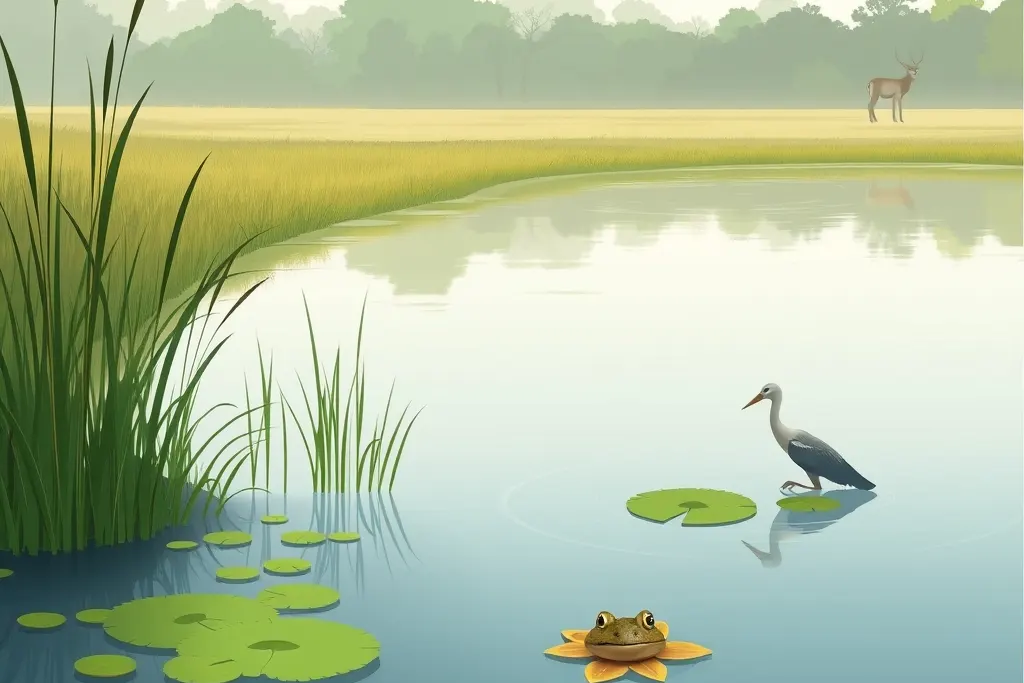
Ecological succession is the orderly replacement of one community by another until a stable climax is reached. Primary succession starts on a place with no soil, such as bare rock, a cooled lava flow or a new sand dune, and its pioneers are lichens, which release acids that break the rock and begin soil formation, followed by mosses, grasses, shrubs and trees. Secondary succession begins where a community was destroyed but soil remains, as after a forest fire or a flood, and it is much faster. In water, the succession from pond to meadow as silt and plant matter accumulate is called hydrarch and on dry rock xerarch.
| Interaction | Effect (A, B) | Example |
|---|---|---|
| Mutualism | + , + | Lichen (alga and fungus), mycorrhiza, flowers and pollinators |
| Commensalism | + , 0 | Orchid on a mango branch, egret with cattle |
| Parasitism | + , − | Cuscuta on a host plant, tick on a dog |
| Predation | + , − | Tiger and deer |
| Competition | − , − | Two grazers sharing one pasture |
- Bare rock, no soil
- Lichens: the pioneersAcids break rock, begin soil
- Mosses
- Grasses
- Shrubs
- TreesUntil a stable climax is reached
Ecological succession is the orderly replacement of one community by another until a stable climax is reached. Primary succession starts on a place with no soil, such as bare rock, a cooled…
3. Biodiversity: Levels, Hotspots and the IUCN Categories
Biodiversity has three levels: genetic diversity within a species (the thousands of rice varieties of India), species diversity (the number and evenness of species in an area) and ecosystem diversity (forests, wetlands, deserts, coral reefs). Diversity rises toward the equator and with the area explored, in the species–area relationship S = CAᶻ, where Z is about 0.1–0.2 for areas within a region. With Z = 0.2, a tenfold larger area holds 1.58 times the species, and a habitat halved in area loses about 13% of its species (0.5⁰·² = 0.87).
A biodiversity hotspot (Norman Myers’s idea) is a region with at least 1,500 endemic vascular plant species that has lost at least 70% of its original habitat; the world has 36 of them. Those that touch India are the Himalaya, Indo-Burma, the Western Ghats and Sri Lanka, and Sundaland (the Nicobar Islands). The IUCN Red List places a species in one of the categories Extinct, Extinct in the Wild, Critically Endangered, Endangered, Vulnerable, Near Threatened, Least Concern, Data Deficient and Not Evaluated, and the three threatened ones are Critically Endangered, Endangered and Vulnerable.
Biodiversity has three levels: genetic diversity within a species (the thousands of rice varieties of India), species diversity (the number and evenness of species in an area) and ecosystem…
4. Threats and Conservation
The main threats are summed up as HIPPO: Habitat loss and fragmentation (the biggest), Invasive alien species, Pollution, human Population growth, and Over-harvesting. In situ conservation protects species in their natural habitat: national parks, wildlife sanctuaries, biosphere reserves and sacred groves. Ex situ conservation is outside it: zoos, botanical gardens, seed and gene banks and cryopreservation in liquid nitrogen at −196 °C. Species-specific schemes include Project Tiger (1973), Project Elephant (1992) and the crocodile project (1975).
The main threats are summed up as HIPPO: Habitat loss and fragmentation (the biggest), Invasive alien species, Pollution, human Population growth, and Over-harvesting. In situ conservation…
5. Worked Examples: Productivity and Population Growth
Two short calculations anchor the ecology in this chapter. Net primary productivity is gross primary productivity minus the energy the producers use in respiration: if an ecosystem's gross productivity is 20 units and respiration takes 8, the net productivity is 20 − 8 = 12, which is the energy actually available to consumers. Energy then falls by about 90 per cent at each step along a food chain, so the 12 units that producers store become about 1.2 for herbivores and 0.12 for the next level. For population growth, an unchecked population grows exponentially as N = N₀eʳᵗ, and its doubling time is ln 2 / r. At a growth rate r = 0.02 a year, the doubling time is 0.693 / 0.02 ≈ 35 years, but in nature growth is checked by the carrying capacity, so real populations follow an S-shaped logistic curve.
Two short calculations anchor the ecology in this chapter. Net primary productivity is gross primary productivity minus the energy the producers use in respiration: if an ecosystem's gross…
Key takeaways
- Energy flows one way and about 10% passes up each trophic level (20,000 J becomes 2,000, 200 and 20); the energy pyramid is always upright.
- NPP = GPP − R; the nitrogen cycle runs through fixation, nitrification and denitrification, each by named bacteria.
- Primary succession begins on bare rock with lichens; secondary succession starts where soil remains and is faster.
- A hotspot has at least 1,500 endemic plants and has lost at least 70% of its habitat; India’s hotspots are the Himalaya, Indo-Burma, Western Ghats and Sri Lanka, and Sundaland.
- In situ conservation (parks, sanctuaries, reserves, sacred groves) protects species where they live; ex situ (zoos, gene banks, cryopreservation) protects them elsewhere.
Practice questions (24)
Attempt each one before opening the answer. Every explanation names the tempting wrong option as well as the right one, because that is where marks are lost.
By the ten per cent law, if producers hold 20,000 J, the energy reaching the secondary consumers (carnivores that eat the herbivores) is:
Show answer
Answer: A — 200 J
Herbivores (primary consumers) get 2,000 J and secondary consumers 10% of that, 200 J. The value 2,000 J belongs to the primary consumers and 20 J to the tertiary.Which ecological pyramid is always upright?
Show answer
Answer: A — Pyramid of energy
Energy is lost at every step as heat, so the energy pyramid cannot be inverted. The numbers pyramid inverts for a tree and the biomass pyramid inverts in the sea.Net primary productivity is equal to:
Show answer
Answer: A — GPP minus the respiration of producers
NPP = GPP − R is the energy left for consumers after the producers have used some for their own respiration; adding R would exceed the energy fixed.
Show the other 21 questions
The pioneer organisms in primary succession on bare rock are:
Show answer
Answer: A — Lichens
Lichens release acids that weather rock and start soil formation, preparing the way for mosses and then higher plants. Grasses, shrubs and trees need soil that does not yet exist.The relationship in which one species benefits and the other is neither harmed nor helped is:
Show answer
Answer: A — Commensalism
Commensalism is + and 0, as an orchid on a mango tree. Mutualism helps both, parasitism harms the host, and competition harms both.With a species–area relationship S = CA^0.2, a habitat is reduced to half its area. The fraction of species retained is nearly:
Show answer
Answer: A — 87%
S′/S = (1/2)^0.2 = 0.87, so only about 13% of the species are lost although half the area is gone. Assuming a linear loss would give 50%.A region qualifies as a biodiversity hotspot if it has at least 1,500 endemic vascular plant species and has lost at least what share of its original habitat?
Show answer
Answer: A — 70%
Myers’s two criteria are endemism (at least 1,500 vascular plants) and threat (at least 70% of the primary vegetation lost); both must hold.Which of the following is an example of ex situ conservation?
Show answer
Answer: A — A botanical garden
A botanical garden holds species outside their natural habitat, which is ex situ. National parks, sacred groves and biosphere reserves protect species where they live.The term "ecosystem" was coined in 1935 by:
Show answer
Answer: C — A.G. Tansley
A.G. Tansley coined the term ecosystem in 1935. Haeckel is the tempting wrong option because he coined the word ecology in 1866, and Lindeman is tied to the trophic-dynamic study and the ten per cent law, not the term itself.The term "ecology" was coined by:
Show answer
Answer: D — Ernst Haeckel
Ernst Haeckel coined ecology in 1866 from Greek roots meaning the study of the household. Tansley is the tempting wrong option because he coined the later term ecosystem; Darwin and Carson are associated with evolution and with the book Silent Spring.In an ecosystem, the flow of energy is:
Show answer
Answer: A — Unidirectional
Energy enters as sunlight, passes from producers to consumers and is lost as heat, so its flow is one-way. Cyclic is the tempting wrong option because nutrients such as carbon and nitrogen do cycle, but energy cannot be reused once it is dissipated as heat.Which type of ecosystem or biome has the highest species diversity on Earth?
Show answer
Answer: B — Tropical rainforest
Tropical rainforests hold the greatest species richness. Temperate grassland is the tempting wrong option for those who think of large open ecosystems, but diversity generally falls from the equator towards the poles and is low in tundra and deserts.In the IUCN Red List, which category describes a species that still exists in the wild but faces an extremely high risk of extinction?
Show answer
Answer: C — Critically Endangered
Critically Endangered is the highest-risk category for species still living in the wild. Vulnerable is the tempting wrong option because it is also a threatened category, but it is the lowest of the three threatened levels, below Endangered and Critically Endangered.Which of the following is an example of in situ conservation?
Show answer
Answer: D — A sacred grove
In situ conservation protects species in their natural habitat, as sacred groves, national parks and sanctuaries do. A zoological park is the tempting wrong option because it is a conservation site, but it keeps animals outside their natural habitat, which is ex situ conservation.Which of the following is a feature of a climax community?
Show answer
Answer: A — It is relatively stable and in equilibrium with the climate of the region
The climax community is the final, relatively stable stage that matches the regional climate. Rapid change is the tempting wrong option, since it describes early seral stages; pioneer species belong to the first stage, not the last.Match the interaction with an example. A. Mutualism B. Parasitism C. Commensalism D. Amensalism — 1. Lichen (alga and fungus) 2. Tapeworm in a human gut 3. Orchid growing on a mango tree 4. A mould that releases an antibiotic harming bacteria
Show answer
Answer: A — A-1, B-2, C-3, D-4
Lichen is mutualism (1), the tapeworm is a parasite (2), the orchid on a tree is commensalism (3) and the antibiotic-producing mould is amensalism (4). The tempting wrong pair swaps parasitism and commensalism, which differ in whether the host is harmed.In a typical pond ecosystem, the pyramid of biomass is often inverted because:
Show answer
Answer: A — Phytoplankton have a small standing biomass but a very high turnover rate
Tiny phytoplankton reproduce so fast that a small standing biomass supports a larger biomass of consumers, inverting the pyramid. The tempting wrong option is that producers always outweigh consumers, which holds on land but fails in water; the pyramid of energy, unlike biomass, is never inverted.Consider the statements about biodiversity.
(1) Alpha diversity is the species diversity within a community or habitat.
(2) Beta diversity is the change in species composition between habitats.
(3) Gamma diversity is the diversity within one small habitat.
(4) Species diversity generally decreases from the equator towards the poles.Show answer
Answer: A — (1), (2) and (4) only
Statements 1, 2 and 4 are correct. Statement 3 is false because gamma diversity is the diversity over the whole region or landscape; it is the tempting confusion with alpha diversity, which is the within-habitat measure.Assertion (A): Tropical regions generally support more species than temperate regions. Reason (R): The tropics have had a long, relatively undisturbed evolutionary time, a stable climate and more solar energy.
Show answer
Answer: A — Both A and R are true, and R is the correct explanation of A
Both are true and R explains A: long stable time allowed speciation and more energy supports more niches. The tempting option that R is not the explanation overlooks that these are the standard reasons given for the latitudinal gradient in diversity.Producers in a food chain fix 50,000 kJ of energy. By the ten per cent law, how much energy is available to the tertiary consumer (the fourth trophic level)?
Show answer
Answer: B — 50 kJ
Producers 50,000 kJ pass to primary consumers 5,000, secondary consumers 500 and tertiary consumers 50 kJ; check: 50,000 × 0.1³ = 50. The tempting wrong option is 500 kJ, which is the energy at the secondary consumer, the third level, not the fourth.In an ecosystem, gross primary productivity is 9,000 kcal per m² per year and plants lose 3,600 kcal per m² per year in respiration. Net primary productivity is:
Show answer
Answer: C — 5,400 kcal per m² per year
NPP = GPP − respiration = 9,000 − 3,600 = 5,400; check: 5,400 + 3,600 = 9,000. The tempting wrong option is 12,600, from adding respiration instead of subtracting it, and 3,600 is the respiratory loss itself.A species–area relationship follows S = C A^Z with Z = 0.25. If a habitat shrinks to one-tenth of its area, the percentage of species lost is about:
Show answer
Answer: D — 44%
Remaining fraction = (0.1)^0.25 = 10^−0.25 ≈ 0.562, so about 56% remain and 44% are lost; check: 0.562⁴ ≈ 0.1. The tempting wrong option is 56%, which is the fraction that survives, not the fraction lost.Two warbler species live in the same spruce trees but feed in different parts of the canopy. This coexistence is best explained by:
Show answer
Answer: A — Resource partitioning
Feeding in different parts of the tree divides the resource and lets competing species coexist, which is resource partitioning. Competitive exclusion is the tempting wrong option because the species do compete, but that principle says that complete competitors cannot coexist; partitioning is how they avoid exclusion.Dividing a large continuous forest into small isolated patches especially threatens species of the forest interior mainly because:
Show answer
Answer: B — Edge habitat increases and the core area shrinks
Fragmentation creates more edge and less core habitat, exposing interior species to heat, wind, predators and invaders. The tempting wrong option is that the area increases, which is false; the total area stays the same or falls, and it is the edge-to-core ratio that changes.