Socio-Cultural Anthropology: Family, Marriage, Kinship, Culture, Religion, Subsistence and Politics
2. Culture, Relativism, Socialisation and Change
Culture (E. B. Tylor, 1871) is the complex whole of knowledge, belief, art, morals, law, custom and other capabilities acquired by a person as a member of society. It is learned, shared, symbolic and cumulative. Cultural relativism, pioneered by Franz Boas, holds that a culture must be understood in its own terms and not judged by the standards of another; its opposite is ethnocentrism (a term of William Graham Sumner, 1906), judging other cultures by one's own as the standard. Socialisation is the lifelong process by which a person learns the culture and becomes a member of society; enculturation is learning one's own culture. Cultural change happens by diffusion (traits spread from one society to another, such as the spread of tea drinking or the mobile phone) and acculturation (change that follows continuous contact between two cultures, each influencing the other, though usually the weaker more), besides invention and innovation.
Culture (E. B. Tylor, 1871) is the complex whole of knowledge, belief, art, morals, law, custom and other capabilities acquired by a person as a member of society. It is learned, shared…
3. Religion and Beliefs: Totemism, Animism, Animatism, Magic and Shamanism
Religion serves society in several functions: it gives meaning and answers to life's crises, provides social cohesion through shared ritual (Durkheim), eases anxiety in uncertain situations (Malinowski), supports moral norms and social control, and marks life-cycle events. Early or "primitive" forms studied by anthropologists include totemism, a belief in a mystical relation between a group (clan) and a plant, animal or object, its totem, which is respected and often not eaten or harmed, and which also regulates marriage because members of one totem clan do not marry one another (exogamy); animism (E. B. Tylor), belief that spirits or souls inhabit natural objects, trees, rivers and the dead; animatism (R. R. Marett), belief in an impersonal supernatural power, mana, that can reside in persons or objects; magic, the attempt to control events by rites and spells, which Frazer divided into homeopathic or imitative magic (like produces like, as in harming an image) and contagious magic (things once in contact remain connected, as in using hair or nails); and shamanism, in which a shaman, a part-time specialist, enters a trance to communicate with spirits, heal and divine, as among Siberian, Native American and many Indian tribal peoples.
| Term | Core idea | Associated name |
|---|---|---|
| Totemism | Clan linked to a sacred plant or animal; exogamy | Durkheim, Frazer |
| Animism | Spirits dwell in nature and the dead | E. B. Tylor |
| Animatism | Impersonal power, mana | R. R. Marett |
| Magic | Control by rite: imitative and contagious | J. G. Frazer |
| Shamanism | Trance specialist heals and divines | Siberian origin of the word |
Religion serves society in several functions: it gives meaning and answers to life's crises, provides social cohesion through shared ritual (Durkheim), eases anxiety in uncertain situations…
4. Subsistence Strategies and Traditional Politics
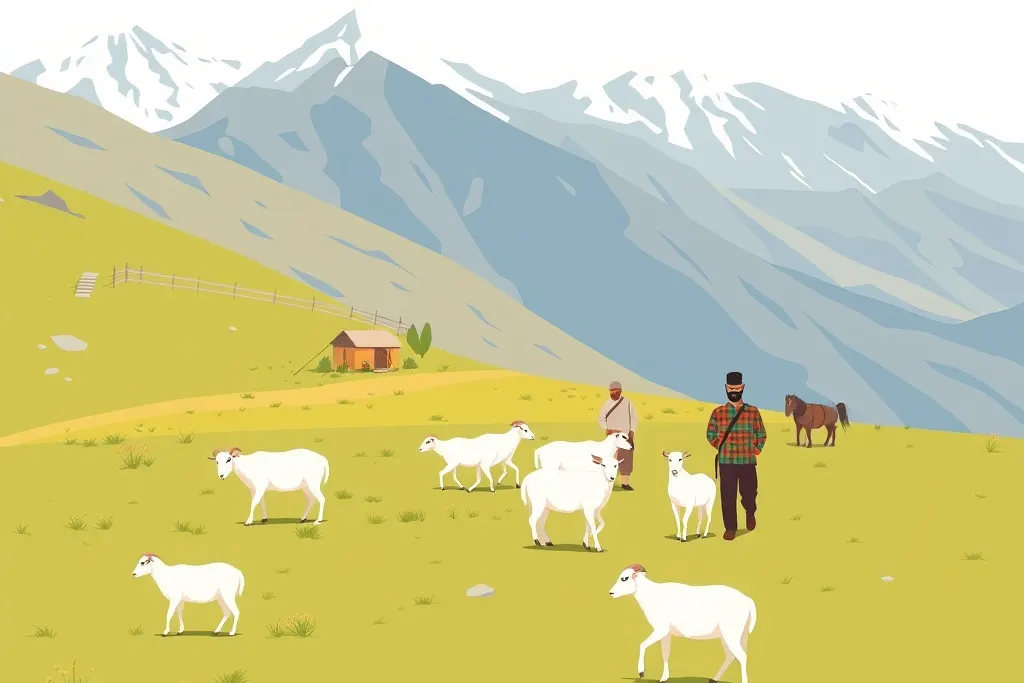
Subsistence strategies are how a society gets its food. Hunting and gathering (foraging) uses wild resources with simple tools, small mobile groups and sharing: gathered plant food is usually the staple and a more reliable calorie source than hunting, as among the !Kung of the Kalahari, the Andamanese and the Birhor. Pastoralism herds domesticated animals and moves with the seasons (Gujjars, Bakarwals, Todas). Horticulture is simple hoe or digging-stick cultivation with shifting cultivation (jhum in north-east India, podu in Odisha and Andhra), and intensive agriculture uses the plough, animals, irrigation and manure, supports dense populations, towns, surplus and social stratification. Each step supports more people per square kilometre but a more unequal society.
Traditional political systems (Elman Service's sequence) run from bands (small, egalitarian, kin-based foragers with a leader by skill or age and no formal office), to tribes (larger, kin-based, linked by clans and councils, with leaders of influence rather than coercive power), to chiefdoms (a hereditary chief at the head of a ranked society, who collects and redistributes goods) and, beyond, to the state. Power is the ability to make others act as one wishes, even against resistance; authority is power regarded as legitimate (Weber's traditional, charismatic and legal-rational types); social control is the means by which a society enforces its norms, informal (gossip, ridicule, ostracism, the fear of the supernatural) and formal (councils, chiefs and later courts and police). In small societies informal sanctions are usually enough.
| Subsistence | Typical political form | Inequality |
|---|---|---|
| Hunting and gathering | Band | Least; egalitarian |
| Pastoralism, horticulture | Tribe | Low to moderate |
| Productive horticulture, early agriculture | Chiefdom | Ranked, hereditary |
| Intensive agriculture | State | High; classes and castes |
- BandSmall, egalitarian; no formal office
- TribeClans and councils; leaders of influence
- ChiefdomHereditary chief redistributes goods
- State
Subsistence strategies are how a society gets its food. Hunting and gathering (foraging) uses wild resources with simple tools, small mobile groups and sharing: gathered plant food is…
Cross Cousins and Parallel Cousins
Kinship questions turn on a distinction that is easy to lose. Parallel cousins are the children of two brothers or of two sisters, and cross cousins are the children of a brother and a sister. Many societies treat the two differently: in parts of south India cross-cousin marriage is preferred, while parallel cousins are regarded as siblings and cannot marry. In a patrilineal society descent is traced through the father, and in a matrilineal one through the mother, as among the Khasi and Garo of Meghalaya.
- Children of two brothers or two sisters
- Treated as siblings; cannot marry
- Children of a brother and a sister
- Marriage preferred in parts of south India
Kinship questions turn on a distinction that is easy to lose. Parallel cousins are the children of two brothers or of two sisters, and cross cousins are the children of a brother and a…
Key takeaways
- The nuclear, joint and extended family differ in size, generations and shared property; marriage may be monogamous or polygamous (polygyny or polyandry); descent may be patrilineal or matrilineal (Khasi, Garo, Nair).
- Cultural relativism (Boas) judges a culture on its own terms; ethnocentrism (Sumner) judges by one's own; cultures change by diffusion and acculturation.
- Religion gives cohesion and meaning; totemism, animism, animatism (mana), magic (imitative and contagious) and shamanism are early belief forms.
- Subsistence runs from foraging through pastoralism and horticulture to intensive agriculture; inequality grows with surplus.
- Political systems run from bands to tribes to chiefdoms to states; power is the ability to compel, authority is legitimate power.
Practice questions (24)
Attempt each one before opening the answer. Every explanation names the tempting wrong option as well as the right one, because that is where marks are lost.
Polyandry, the marriage of one woman to several husbands, is found among the:
Show answer
Answer: B — Toda
The Toda practised fraternal polyandry. The Khasi and Garo are known for matrilineal descent, not polyandry.Judging other cultures by the standards of one's own is called:
Show answer
Answer: A — Ethnocentrism
This is ethnocentrism. Relativism is its opposite, and diffusion and acculturation describe how cultures change.The belief that spirits inhabit natural objects is called:
Show answer
Answer: D — Animism
Tylor's animism is belief in spirits or souls. Animatism is an impersonal power, mana, and totemism links a clan with a species.
Show the other 21 questions
Descent traced through the mother is:
Show answer
Answer: C — Matrilineal
Matrilineal descent follows the mother's line, as among the Khasi. Patrilineal follows the father.Frazer's imitative magic works on the principle that:
Show answer
Answer: B — Like produces like
Imitative or homeopathic magic is "like produces like". The contact principle is contagious magic and the others describe animism and totemism.In Service's sequence, which political form has a hereditary leader at the head of a ranked society?
Show answer
Answer: A — Chiefdom
Chiefdoms have ranked, hereditary leadership and redistribute goods. Bands and tribes are more egalitarian and rely on influence.Power regarded as legitimate by those subject to it is:
Show answer
Answer: D — Authority
Authority is legitimate power in Weber's sense; coercion is power without that acceptance.Acculturation refers to:
Show answer
Answer: C — Change after prolonged contact between two cultures
Acculturation follows continuous first-hand contact and changes both cultures. Learning one's own culture is enculturation and the spread of single traits is diffusion.A society of small mobile groups, equal in status, that survives mainly by gathering wild plant food and some hunting would be classed as:
Show answer
Answer: B — A band of foragers
Small, mobile, egalitarian foragers are bands. Chiefdoms are ranked and states belong to intensive agriculture.Statement 1: Members of the same totemic clan usually may not marry each other. Statement 2: A joint family is the same thing as an extended family. Which is correct?
Show answer
Answer: A — Only statement 1
Statement 1 is right: totemic clans are usually exogamous. Statement 2 is false, since a joint family shares property and a household while an extended family need not.The sororate is the custom by which a widower marries:
Show answer
Answer: C — His deceased wife's sister
Sororate keeps the alliance between two families alive. His deceased brother's widow is the tempting wrong option, which is the levirate.The Kula ring is a system of ceremonial exchange described by Malinowski among the people of the:
Show answer
Answer: D — Trobriand Islands
Kula links island communities through the circulation of shell valuables. Andaman Islands is the tempting wrong option, which Radcliffe-Brown studied instead.Exogamy is the rule that a person must marry:
Show answer
Answer: A — Outside his or her own group
Exogamy forbids marriage inside a defined group such as a clan. Within the group is the tempting wrong option, which is endogamy.Arnold van Gennep's three phases of a rite of passage are:
Show answer
Answer: B — Separation, transition (liminal) and incorporation
Rites of passage detach a person from an old status, hold them in between, and then admit them to a new status. Birth, marriage and death is the tempting wrong option, which names life-cycle events and not the phases of the rite.Lewis Henry Morgan's evolutionary stages of society run in the order:
Show answer
Answer: C — Savagery, barbarism, civilisation
Morgan's Ancient Society (1877) proposed this ladder. The reverse order is the tempting wrong option, which runs the stages backwards.A man's mother's brother's daughter is his:
Show answer
Answer: D — Cross-cousin
Children of a brother and a sister are cross-cousins. Parallel cousin is the tempting wrong option, which refers to children of two brothers or two sisters.Under avunculocal residence a married couple lives with or near the:
Show answer
Answer: A — Husband's mother's brother
Avunculocal means the maternal uncle's home. Husband's father is the tempting wrong option, which is patrilocal residence.Consider these statements about marriage payments and customs:
(1) Dowry is property given with the bride to the groom's side.
(2) Bride price is paid by the groom's family to the bride's family.
(3) The levirate is marriage with the deceased wife's sister.Show answer
Answer: B — 1 and 2 only
Statements 1 and 2 are correct; the levirate is marriage with the deceased husband's brother, so 3 is wrong. Option 4 is the tempting wrong option.Assertion (A): The incest taboo is found in virtually every society. Reason (R): Lévi-Strauss argued that it forces families to marry outside and so creates alliances.
Show answer
Answer: A — Both A and R are true, and R is the correct explanation of A
Both are true and R explains A: forbidding marriage within the family obliges exchange between groups. Option 2 is the tempting wrong option, though R gives the alliance theory.Match the scholar with the concept.
A. Van Gennep – 1. Rites of passage;
B. Marcel Mauss – 2. Gift exchange and reciprocity;
C. L. H. Morgan – 3. Classificatory kinship terms;
D. Marshall Sahlins – 4. Generalised, balanced and negative reciprocity.Show answer
Answer: C — A-1, B-2, C-3, D-4
The third option is correct for all four. Option 1 is the tempting wrong option, which swaps van Gennep and Mauss.In the Kula exchange, the red shell necklaces (soulava) and white shell armbands (mwali) travel in:
Show answer
Answer: D — Opposite directions around the ring of islands
Necklaces move clockwise and armbands anticlockwise, so each partner must give one kind and receive the other. The same direction is the tempting wrong option, which would stop the exchange from being a circuit of reciprocity.Sharing food freely within a family without counting returns is an example of Sahlins's:
Show answer
Answer: A — Generalised reciprocity
Generalised reciprocity involves giving without an expectation of immediate return, typical among close kin. Balanced reciprocity is the tempting wrong option, which expects an equivalent return within a set time.A lineage differs from a clan in that lineage members:
Show answer
Answer: B — Can trace their descent from a known common ancestor
A lineage can demonstrate its genealogy, while a clan only assumes a common ancestor. Always marry within the group is the tempting wrong option, which is the opposite of the usual exogamy of both.Victor Turner's concept of 'communitas' refers to:
Show answer
Answer: C — Intense solidarity and equality among people in the liminal phase of a ritual
Turner saw initiates in the in-between stage sharing a bond that suspends ordinary rank. The caste hierarchy of a village is the tempting wrong option, which is the very ranking that communitas sets aside.