Agriculture VI: Horticulture — Fruits, Vegetables, Flowers and Preservation
2. Propagation, Training and Pruning
| Method | What is done | Examples |
|---|---|---|
| Seed | Sexual propagation; seedlings vary | Papaya, many vegetables, rootstocks |
| Cutting | A piece of stem, root or leaf is rooted | Rose, grape, sugarcane, bougainvillea |
| Layering | A branch is rooted while attached to the parent; air layering (gootee) in a moss-wrapped ring | Litchi, guava, jasmine |
| Budding | A single bud with a bit of bark is inserted into the rootstock (T-budding, patch budding) | Citrus, rose, mango, ber |
| Grafting | A scion (shoot) is joined to a rootstock (cleft, whip, inarching, veneer) | Mango (veneer, inarching), apple, guava |
Training shapes a young tree: the central leader system (apple, pear), the open centre or vase system (peach, plum) and the modified leader. Pruning is the removal of parts to control size, remove dead, diseased or crossing branches, and encourage fruiting (grapes need heavy annual pruning; the fruit forms on new shoots). Intercropping in young orchards, with vegetables or legumes, gives income before the trees bear. Frost is guarded against by light irrigation, smoke, windbreaks and covering young plants; sunburn of trunks and fruit is prevented by whitewashing or shade.
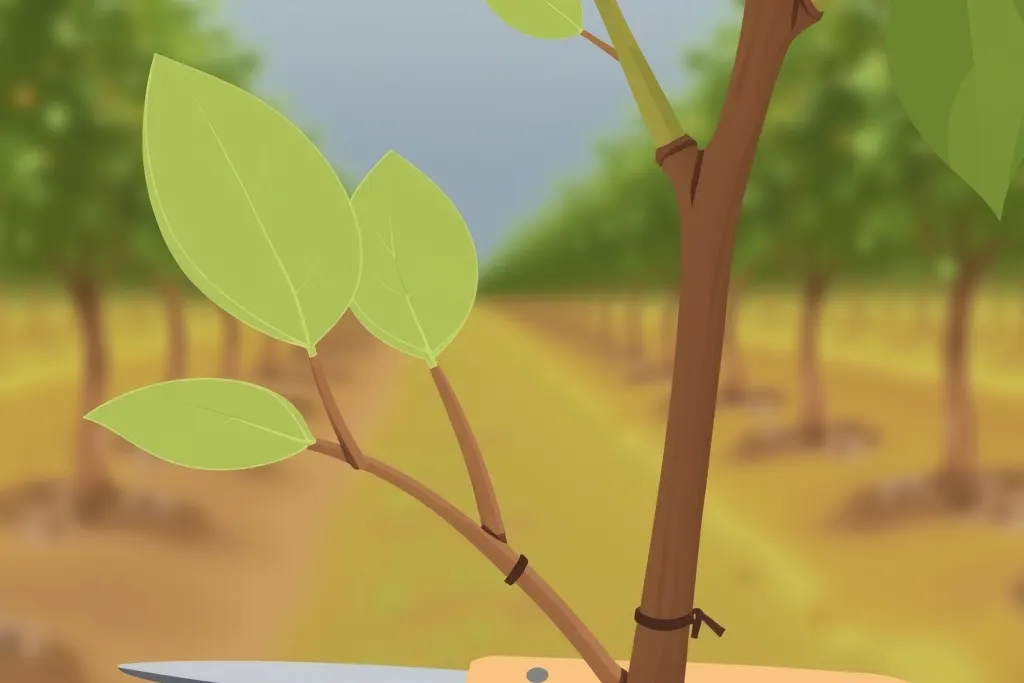
Training shapes a young tree: the central leader system (apple, pear), the open centre or vase system (peach, plum) and the modified leader. Pruning is the removal of parts to control size…
3. Fruits, Vegetables and Flowers
| Group | Crops and key points |
|---|---|
| Fruits | Mango: king of fruits, propagated by veneer grafting, flowers in winter, fruit in summer; Papaya: raised from seed, papain from latex, dioecious so male plants are thinned; Banana: planted by suckers or tissue culture, harvested about 12 months, fruit ripens in bunches; Guava: rich in vitamin C, layering or budding; Citrus: orange, lemon, mandarin; budded on rootstocks, canker and greening; Grape: trained on trellis, pruned heavily, harvest in hot dry weather |
| Vegetables | Root crops: radish, carrot (cool season); Potato: tuber crop of rabi, planted by seed tubers, late blight is the key disease; Onion: bulb crop, curing before storage; Cole crops: cauliflower, cabbage (cool season, transplanted); Solanaceous: brinjal, tomato (warm season, transplanted; tomato wilt and fruit borer); Leafy: spinach (cool season, direct sown, rich in iron) |
| Flowers | Rose: budded or cut, the queen of flowers, heavy pruning; Gladiolus: corm, cut flower; Canna: rhizome, ornamental; Chrysanthemum: suckers or cuttings, short-day plant; Marigold: annual, sown from seed, loose flowers for garlands and carotenoid extraction |
Crops named in the syllabus
4. Preservation of Fruits and Vegetables
Preservation stops spoilage by micro-organisms and enzymes. Its principles are to remove or keep out microbes (canning, bottling), destroy them by heat (pasteurisation, boiling), inhibit them with high sugar (jam, jelly, squash: at least 68 per cent total soluble solids in jam), salt or acid (pickles, vinegar) or chemical preservatives (sodium benzoate, potassium metabisulphite), remove water (drying, dehydration) and low temperature (refrigeration, freezing). Fruit products such as jam and jelly are regulated by the Fruit Products Order (FPO).
| Product | Made from | Key requirement |
|---|---|---|
| Jelly | Clear fruit juice (apple, guava) | Pectin, acid and sugar in balance; at least 45 parts fruit to 55 sugar; clear and firm |
| Jam | Fruit pulp (mango, mixed fruit, papaya) | At least 45 per cent fruit and 68.5 per cent total soluble solids |
| Tomato ketchup | Tomato pulp with sugar, salt, vinegar and spices | At least 12 per cent total soluble solids and 1 per cent acidity as acetic acid; preservative permitted |
| Chips | Sliced potato or banana, fried or dried | Uniform slices, correct frying temperature, moisture-proof packing in nitrogen-flushed pouches |
Preservation stops spoilage by micro-organisms and enzymes. Its principles are to remove or keep out microbes (canning, bottling), destroy them by heat (pasteurisation, boiling), inhibit…
5. Worked Calculations: Plant Spacing and Plants per Hectare
Orchard planning starts with spacing. The number of plants per hectare is 10,000 m² divided by the area occupied by one plant, which is row spacing times plant spacing. Mango planted at 10 m × 10 m has 10,000 / 100 = 100 plants per hectare; citrus at 6 m × 6 m has 10,000 / 36 ≈ 278; guava at 5 m × 5 m has 400; and banana at 1.8 m × 1.8 m has about 3,086. Close spacing gives more plants and more early yield per hectare but crowds the trees later, while wide spacing suits large trees such as mango. The layout, such as square, rectangular, triangular or hexagonal, decides how many plants fit.
| Crop and spacing | Working | Plants |
|---|---|---|
| Mango, 10 m × 10 m | 10,000 / 100 | 100 |
| Citrus, 6 m × 6 m | 10,000 / 36 | 278 |
| Guava, 5 m × 5 m | 10,000 / 25 | 400 |
| Banana, 1.8 m × 1.8 m | 10,000 / 3.24 | 3,086 |
Orchard planning starts with spacing. The number of plants per hectare is 10,000 m² divided by the area occupied by one plant, which is row spacing times plant spacing. Mango planted at 10…
Key takeaways
- Fruits and vegetables are protective foods rich in vitamins, minerals and fibre; horticulture diversifies cropping and the processing industry cuts post-harvest loss.
- Orchard layouts are square, rectangular, triangular, quincunx and contour; plant types are trees, shrubs, climbers, annuals and perennials.
- Propagation is by seed, cutting, layering, budding and grafting; budding suits citrus and rose, grafting mango and apple, layering litchi and guava.
- Training shapes the tree and pruning controls size and fruiting; frost is met with irrigation, smoke and windbreaks, and sunburn with whitewash.
- Preservation uses heat, sugar, salt, acid, preservatives, drying and cold; jam needs 68.5 per cent soluble solids, jelly needs pectin, acid and sugar, and ketchup needs 12 per cent solids.
Practice questions (24)
Attempt each one before opening the answer. Every explanation names the tempting wrong option as well as the right one, because that is where marks are lost.
Which orchard layout puts an extra filler tree at the centre of each square?
Show answer
Answer: B — quincunx
In the quincunx system the fifth tree sits at the centre of a square of four, giving more trees per hectare until the permanent ones need the space. A contour layout follows the slope.Which of these is an annual ornamental plant?
Show answer
Answer: A — marigold
An annual completes its life in one season. Rose and bougainvillea are perennials (a shrub and a climber), and neem is a tree.Air layering (gootee) is the usual method of propagating
Show answer
Answer: D — litchi and guava
A ring of bark is removed from a branch, wrapped in moist moss and rooted while still on the tree, which then is cut off as a new plant.
Show the other 21 questions
In budding, a single bud with a small piece of bark is inserted into the
Show answer
Answer: C — rootstock
The bud is the scion and it is joined to a rootstock that supplies the roots. T-budding is used for citrus and roses.Grapes are pruned heavily every year because
Show answer
Answer: B — fruit is borne on new shoots arising from the pruned canes
Retaining too much old wood gives poor fruit; pruning balances vegetative growth with fruiting.Papaya is a dioecious plant, so in a plantation
Show answer
Answer: A — most male plants are thinned out, keeping a few for pollination
Only female plants (and hermaphrodites) bear fruit; about one male plant for ten females is kept. The latex of unripe papaya yields papain.Late blight is the major disease of
Show answer
Answer: D — potato
Phytophthora infestans caused the Irish famine of the 1840s; in India it spreads in cool, humid weather and is controlled with fungicides and resistant varieties.For a jam, the total soluble solids should be at least about
Show answer
Answer: C — 68.5 per cent
Twelve per cent is the ketchup standard. High sugar at 68 per cent or more prevents microbial growth by drawing water out of microbes and the product.A fruit jelly sets properly only when the juice has the right balance of
Show answer
Answer: B — pectin, acid and sugar
Guava and apple are rich in pectin; the sugar (about 55 parts to 45 of fruit) draws off water and the acid helps the gel form.The national fruit of India is the:
Show answer
Answer: C — Mango
The mango (Mangifera indica) is the national fruit and is called the king of fruits. Banana is the tempting wrong option, which is the most widely grown fruit by area but not the national fruit.In grafting, the part that provides the root system is the:
Show answer
Answer: D — Rootstock
The rootstock supplies the roots and the scion forms the shoots and fruit. Scion is the tempting wrong option, which is the upper part chosen for its fruit quality.The plant hormone mainly responsible for fruit ripening is:
Show answer
Answer: A — Ethylene
Ethylene triggers ripening, particularly in climacteric fruits. Auxin is the tempting wrong option, which promotes root formation and cell elongation instead.Which of the following is a climacteric fruit?
Show answer
Answer: B — Banana
Banana shows a respiration and ethylene surge during ripening and ripens after harvest. Grape is the tempting wrong option, which is non-climacteric and must ripen on the vine.Gladiolus is propagated commonly by:
Show answer
Answer: C — Corms
Gladiolus grows from a corm and its cormels. Tubers is the tempting wrong option, which describes potato and dahlia.IBA and NAA are used in horticulture mainly to:
Show answer
Answer: D — Promote rooting of cuttings
These are auxins that stimulate root initiation. Ripen fruits is the tempting wrong option, which is the role of ethylene or ethephon.Which pair of vegetables belongs to the same species, Brassica oleracea?
Show answer
Answer: A — Cabbage and cauliflower
Cabbage, cauliflower, broccoli and kohlrabi are cole crops of B. oleracea. Cabbage and mustard is the tempting wrong option, since both are Brassicas, but mustard belongs to other species.About propagation of fruit crops, consider:
(1) Banana is commonly propagated by suckers.
(2) Papaya is commonly propagated by seed.
(3) Grape is commonly propagated by seed.Show answer
Answer: B — 1 and 2 only
Statements 1 and 2 are right; grape is propagated by hardwood cuttings, so 3 is wrong. Option 4 is the tempting wrong option.Assertion (A): Grapes are harvested only when fully ripe. Reason (R): Grapes are non-climacteric and do not ripen further after harvest.
Show answer
Answer: A — Both A and R are true, and R is the correct explanation of A
Both are true and R explains A: since they cannot ripen off the vine, they must be picked ripe. Option 2 is the tempting wrong option, though R is the cause.Match the fruit crop with its usual method of propagation.
A. Banana – 1. Suckers or tissue culture;
B. Litchi – 2. Air layering;
C. Grape – 3. Hardwood cuttings;
D. Citrus – 4. Budding.Show answer
Answer: C — A-1, B-2, C-3, D-4
The third option is correct for all four. Option 4 is the tempting wrong option, which swaps litchi and grape, both being long-trailing woody plants.Compared with the square system, the hexagonal planting system of orchards accommodates:
Show answer
Answer: D — About 15% more plants per hectare
Each tree occupies 0.866 d² instead of d², so about 15% more fit. Fewer plants is the tempting wrong option, as hexagons look more spread out.Trees are planted 10 m apart in a hexagonal system. The number of plants in one hectare is about (area per plant = 0.866 d²):
Show answer
Answer: A — 115
Area per tree = 0.866 × 100 = 86.6 m², so 10,000 ÷ 86.6 ≈ 115. 100 is the tempting wrong option, which is the square-system count.As per the usual standard, a ready-to-serve (RTS) fruit beverage contains at least:
Show answer
Answer: B — 10% fruit juice and 10% TSS
RTS needs a minimum of 10% juice and 10% TSS. 25% and 40% is the tempting wrong option, which is the squash standard.Nucellar seedlings of mango and citrus are important to growers because they are:
Show answer
Answer: C — Genetically identical to the mother plant
They arise from nucellus cells by apomixis, so they are clones of the mother and uniform as rootstocks. Produced by fertilisation is the tempting wrong option, which would give genetically varied offspring.In the preservative solution for cut flowers, sucrose is added mainly to:
Show answer
Answer: D — Supply energy for the flowers' metabolism
Sugar acts as food and helps buds open and keep colour. Kill bacteria is the tempting wrong option, which is the work of the germicide such as 8-hydroxyquinoline in the same solution.